
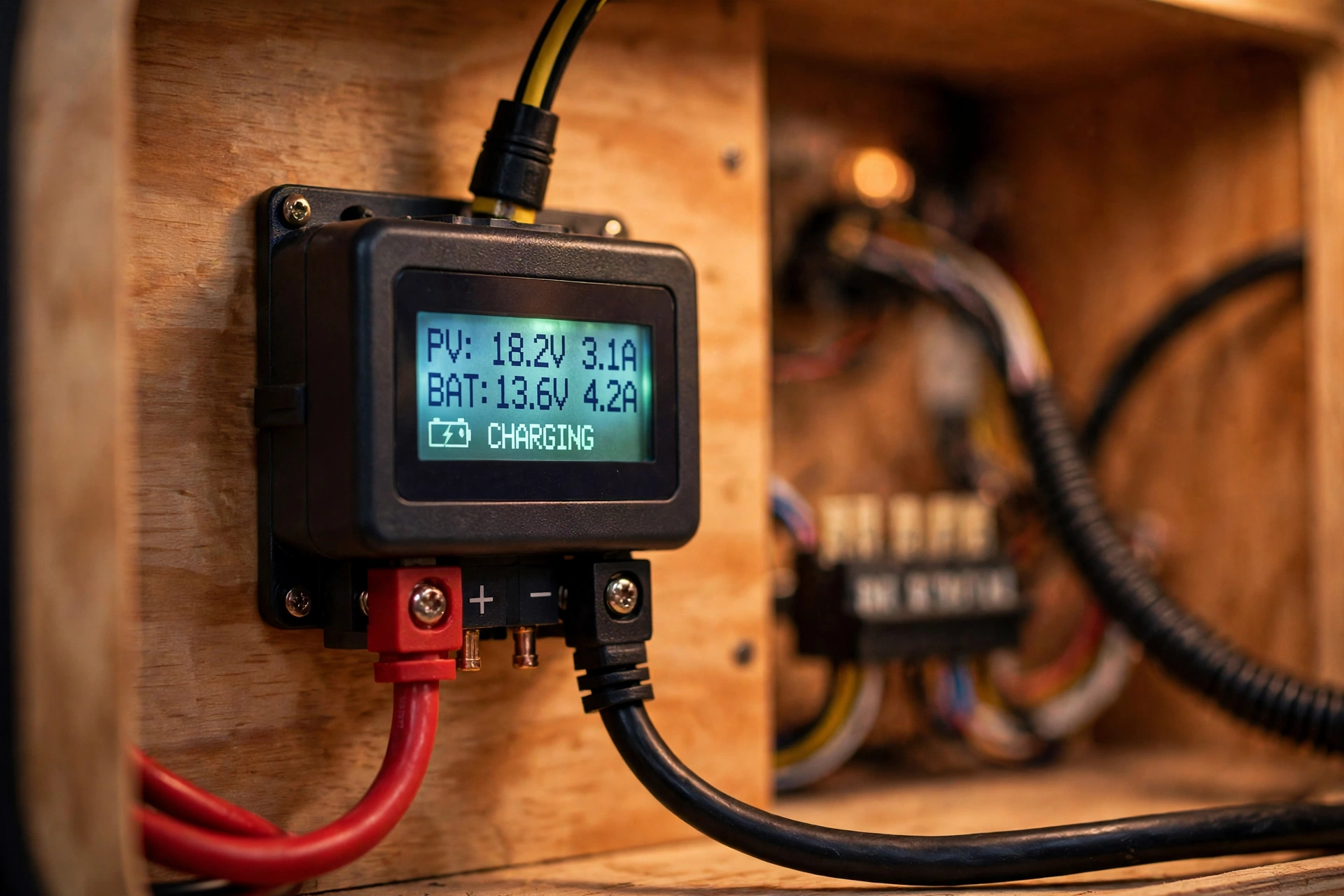
The short answer: a charge controller is the box between your solar panels and your battery that turns raw panel output into safe, controlled charging — and the wrong one quietly wastes power or kills batteries. Panels are dumb power sources. They push out whatever voltage and current the sun gives them, with no regard for what the battery can take. The controller is the part that translates between the two: it holds the panel at its most productive voltage, steps the power down to what the battery needs, and stops charging when the battery is full. Skip it, undersize it, or set it wrong, and you pay for it in lost harvest or a dead battery bank.
Disclosure: this guide is research, not hands-on testing — every figure below comes from published manufacturer specs and independent guides as of October 2026. There are no affiliate links on this page. See our disclosure for how the site is funded.
What a charge controller actually does
A solar panel and a battery speak different electrical languages. A nominal 12V panel actually produces about 18 to 22V at its maximum power point, and its open-circuit voltage can reach 22 to 24V. A 12V battery, meanwhile, wants to be charged at roughly 13.8 to 14.6V depending on chemistry, and it must never be pushed past its full-charge voltage.
Left connected directly, the panel forces the battery toward the panel’s voltage. The battery overcharges, heats up, and in a lead-acid battery the electrolyte boils off. In a lithium battery, overvoltage can trip the battery management system or damage cells outright. The controller prevents all of that by doing three jobs at once:
- Voltage regulation. It steps panel voltage down to the battery’s charging voltage and holds it there, tapering current as the battery fills.
- Overcharge protection. It stops or drastically reduces charging once the battery reaches full, so a sunny afternoon cannot cook a full battery.
- Load protection (on many models). It disconnects loads before the battery drains too deeply, which is the other way batteries die — deep discharge.
Some controllers also block reverse current at night, when a panel would otherwise slowly drain the battery it charged all day. Think of the controller as the battery’s guardian: the panel is the income, the battery is the savings account, and the controller is the part that decides how much goes in and when to stop.
If you are still choosing the rest of the system, our charge controllers hub compares the actual controllers, and our solar battery guide explains what the battery on the other side of the controller needs.
PWM vs MPPT: a switch versus a converter
There are two kinds of controller, and the difference is what happens to the voltage gap between panel and battery.
PWM: the simple switch
PWM (pulse width modulation) connects the panel to the battery almost directly and switches the connection on and off hundreds of times a second to control the average current. The panel is pulled down to the battery’s voltage — so a panel that could make 18V at its best point is forced to operate at about 13V. The extra voltage is simply lost. That is why a PWM controller on a 100W panel typically delivers only about 70 to 75W into a 12V battery.
PWM works fine when the panel voltage is close to the battery voltage, which is the case for a single 12V-nominal panel on a 12V battery. It is cheap, simple, and has almost nothing to go wrong. It is the right choice for a small setup: a single panel keeping a camper battery topped up, or a 100W panel on a shed.
MPPT: the smart converter
MPPT (maximum power point tracking) is a DC-to-DC converter with a brain. It continuously finds the voltage and current combination where the panel produces the most watts — its maximum power point — holds the panel there, and converts the power down to battery voltage. Excess voltage becomes extra charging current instead of waste heat. The same 100W panel that delivered about 70W through PWM delivers close to its full rating through MPPT.
That conversion buys three practical advantages:
- More harvest, especially in cold weather. Cold panels produce higher voltage, and MPPT turns that bonus into current. PWM throws it away.
- Series wiring. Panels wired in series produce higher voltage, which means thinner, cheaper wire and less loss over long cable runs. PWM cannot use series strings effectively; MPPT can.
- Flexible panel choice. MPPT lets you charge a 12V battery from higher-voltage panels — including the inexpensive residential-style panels — which PWM cannot do.
| PWM | MPPT | |
|---|---|---|
| How it works | Fast on/off switch, panel pulled to battery voltage | DC-DC converter, panel held at its best power point |
| Energy harvest | About 70–80% of panel rating | About 93–99% of panel rating |
| Typical gain over PWM | — | Roughly 10–30% more energy, most in cold weather and with larger arrays |
| Panel voltage | Must closely match battery voltage | Can be much higher than battery voltage |
| Wiring | Panels usually in parallel | Panels can be in series, thinner wire works |
| Best for | Small systems under about 200W, single 12V panel | Arrays above about 200W, series strings, cold climates |
| Cost | Low | Higher, but the extra harvest usually pays for it within one to two years on larger systems |
The practical rule: under about 200W with a voltage-matched panel, PWM is cheap and fine. Above that, or whenever panels are wired in series, MPPT is the better buy — it is also the only sensible choice for a cabin or RV system you plan to grow.
Sizing a controller to your panels and battery
Sizing a controller means answering two questions: how many amps must it handle, and how much panel voltage must it tolerate.
The amps: panel watts divided by battery voltage, times 1.25
The standard formula is:
Required controller amps = (total panel watts ÷ battery voltage) × 1.25
The 1.25 safety factor covers bright-sky and edge-of-cloud moments when panels briefly exceed their rated output. Then round up to the next standard controller size (10A, 20A, 30A, 40A, 50A, 60A, 80A, 100A).
| Array | Battery | Calculation | Controller to buy |
|---|---|---|---|
| 100W | 12V | 100 ÷ 12 × 1.25 ≈ 10.4A | 15A or 20A |
| 200W | 12V | 200 ÷ 12 × 1.25 ≈ 20.8A | 30A |
| 400W | 12V | 400 ÷ 12 × 1.25 ≈ 41.7A | 50A |
| 400W | 24V | 400 ÷ 24 × 1.25 ≈ 20.8A | 30A |
| 600W | 24V | 600 ÷ 24 × 1.25 ≈ 31.3A | 40A |
| 800W | 48V | 800 ÷ 48 × 1.25 ≈ 20.8A | 30A |
Notice how the same 400W array needs a 50A controller on 12V but only a 30A controller on 24V. Higher battery voltage means lower current for the same power, which is one reason larger off-grid systems move to 24V or 48V. If you are still deciding system voltage, size the controller last — the battery voltage you choose decides the number.
The volts: cold mornings raise panel voltage
For an MPPT controller you must also respect its maximum PV input voltage. Panels wired in series add their voltages together, and cold weather pushes panel voltage higher still — open-circuit voltage can rise roughly 15% above its rated value on a freezing morning. A string that reads 90V on a warm afternoon can exceed 100V at dawn in winter and destroy a controller rated for 100V.
The check: add up the open-circuit voltage (Voc) of every panel in a series string, multiply by about 1.15 for cold conditions, and make sure the result sits comfortably below the controller’s maximum PV input voltage. If it is close, drop a panel from the string or buy a controller with a higher voltage limit.
Match the battery type setting
Almost every modern controller has a battery-type setting — lithium, AGM, gel, flooded lead-acid — and it changes the charging voltages. A lithium battery charged at lead-acid voltages, or a lead-acid battery held at lithium float voltage, loses capacity fast. Set the chemistry before you connect the battery, and check it again after any factory reset or firmware update. This single setting is the most common cause of premature battery death in DIY systems.
The mistakes that kill batteries
Most battery deaths in small solar systems trace back to the controller, not the battery. These are the ones to avoid:
- No controller at all. Direct panel-to-battery connections overcharge on sunny days. The battery that dies in year two was often being quietly cooked since month one.
- Undersized controller. A 20A controller on a 400W array does not just waste the extra power — it can overheat and fail, sometimes taking the battery’s charging protection with it. Size with the 1.25 factor and round up.
- Wrong battery-type setting. See above. Lithium and lead-acid want different voltages, and the default setting on a new controller is often lead-acid.
- Ignoring the cold-voltage limit. A series string that is fine in summer can exceed the controller’s input voltage on the first frosty morning. Check Voc with the 1.15 cold multiplier before you wire.
- No low-voltage disconnect. If your controller has a load output, use it for small DC loads. It cuts power before the battery drains into the damage zone. A battery drained flat repeatedly loses a large share of its cycle life.
- Mounting it where it cooks. Controllers shed heat. Mount in a ventilated spot out of direct sun, with airflow around the heatsink, or the controller will derate itself on hot days exactly when you need it most.
A simple buying checklist
- System size: under about 200W with a matched 12V panel, PWM is acceptable. Anything bigger, or any series wiring, buy MPPT.
- Amps: panel watts ÷ battery voltage × 1.25, rounded up to the next standard size — and leave headroom if you plan to add panels later.
- Volts: cold-corrected string Voc comfortably below the controller’s maximum PV input voltage.
- Battery compatibility: the controller must have a setting for your chemistry — especially lithium, which needs a lithium profile and a low-temperature charging cutoff.
- Display and monitoring: a screen or Bluetooth app that shows charging amps and battery voltage is worth having. It is how you spot a problem before the battery pays for it.
Get those five right and the controller disappears into the background, which is exactly what it should do: a quiet box that keeps the battery alive for years while the panels do their work. For the other half of the system, read our solar battery guide — it covers how much usable capacity a battery really holds and how to size a bank for an off-grid cabin or RV.