
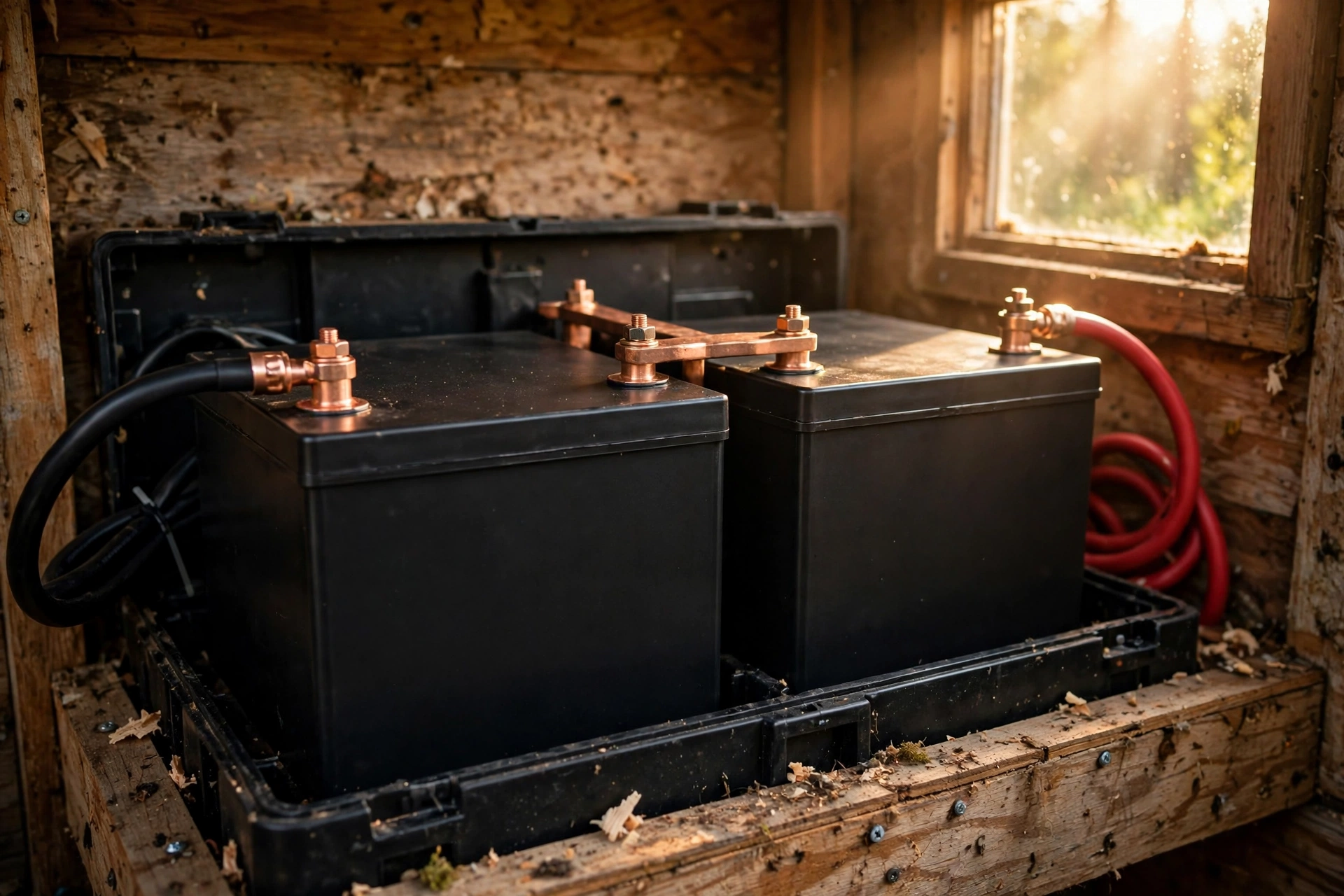
The short answer: the best 100Ah LiFePO4 battery for most RV, camping, and off-grid solar setups is the LiTime 12V 100Ah, at about $336. It stores 1,280Wh, is rated for 4,000+ cycles at 100% depth of discharge, weighs 24.25 lbs, and costs roughly a third of the premium brands for the same capacity. If your budget is tighter, the Epoch Eco 100Ah at about $299 is the cheapest honest 100Ah battery we found. If you charge through freezing winters, buy a heated battery instead: the Renogy 12V 100Ah Pro at about $630, with Bluetooth and self-heating. If you want the longest warranty and US-based support, the Battle Born 100Ah Smart at about $949 carries a 10-year warranty.
Disclosure: we may earn a commission if you buy through links on this page, at no extra cost to you. See our disclosure for how that works. Prices below are manufacturer or retailer list prices checked in October 2026 and will move; check the listing before you buy.
How this guide was put together: this is research-desk work, not hands-on testing. Picks are based on published specs, manuals, and owner reports as of October 2026. No battery here was bench-tested by us. Cycle-life figures are quoted with their depth-of-discharge conditions, because a cycle number without conditions is not a specification.
Why 100Ah became the standard building block
100Ah at 12.8V is 1,280Wh, and that number sits in a sweet spot. It is big enough to run a real RV or cabin load for a day, small enough to lift with one hand (21 to 31 lbs, against 60 to 70 lbs for a lead-acid battery of the same label), and cheap enough to buy one at a time. That last point is the real reason 100Ah dominates: you can start with one battery, learn your actual consumption, and add identical batteries in parallel later instead of guessing a bank size up front and getting it wrong.
The capacity also matches the most common solar arrays. A 100Ah battery accepts up to 100A of charge current, so a 200 to 400W array charges it at a comfortable 15 to 30A. A 200Ah battery on the same small array charges slowly and spends more time at partial charge; a 50Ah battery on a 400W array wastes panel output. For a single-battery RV or cabin system, 100Ah and 200 to 400W of panels are the matched pair.
There is one number that matters more than the label: continuous discharge current. Almost every 100Ah battery here delivers 100A continuous, which is 1,280W. That runs lights, fans, a fridge, a laptop, and a small inverter. It does not run a 2,000W inverter at full load, a microwave, or an air conditioner on its own. If your biggest load exceeds 1,280W, you need either two batteries in parallel or a larger single battery, not a different 100Ah battery. The Renogy Core is the exception in this roundup at 150A continuous, which is why it earns a pick for trolling motors and higher-surge loads.
The shortlist: 100Ah only
Every battery below is a 12V (12.8V nominal) 100Ah LiFePO4 deep-cycle battery. No other capacities, no lead-acid, no lithium-ion. Prices are October 2026 manufacturer or retailer prices, cross-checked against at least two sources each.
| Battery | Price (Oct 2026) | Continuous discharge | Cold charging | Bluetooth | Weight | Warranty |
|---|---|---|---|---|---|---|
| LiTime 12V 100Ah | About $336 | 100A | Cutoff varies by variant — verify | No (Bluetooth variants sold separately) | 24.25 lbs | 5 years |
| Epoch Eco 100Ah | About $299 | 100A | Cutoff, no heater | No | 21 lbs | 6 years |
| Renogy Core 100Ah (Bluetooth) | About $319 | 150A | Cutoff | Yes (Bluetooth 5.3) | 21.83 lbs | See listing |
| Renogy Pro 100Ah (self-heating) | About $630 | 100A | Self-heating | Yes | About 27 lbs | See listing |
| Dakota Lithium 100Ah (heated) | About $795 from dealers (list ≈ $950) | 100A | Self-heating to -20°C | No | About 21 to 28 lbs by version | 11 years |
| Battle Born 100Ah Smart | About $949 | 100A | Cutoff; heated version $1,049 | Yes, via app | 31 lbs | 10 years |
A note on the LiTime row: LiTime sells several 100Ah variants under similar names — the base battery, a Bluetooth version, a self-heating version, and a Smart ComFlex version with Victron communication at about $370. The $336 price and the specs above are for the base battery. If low-temperature protection or Bluetooth matters to you, buy the named variant, not the cheapest listing with a similar name.
The picks, one by one
Best overall: LiTime 12V 100Ah
The LiTime is the default recommendation because it gets the fundamentals right at the lowest honest price: 1,280Wh, 4,000+ cycles at 100% depth of discharge, a 100A BMS with overcharge, over-discharge, overcurrent, short-circuit, and temperature protection, and 24.25 lbs in a Group 31 case. It is rated IP65 against dust and water jets, and it expands to 4 in series and 4 in parallel for up to 20.48kWh. The trade-offs are the 5-year warranty, the shortest in this roundup alongside the Renogy Core, and the base model’s lack of Bluetooth and built-in heating. If you want phone monitoring, the LiTime Bluetooth and ComFlex variants cost about $34 to $40 more. Buy this if you want the most watt-hours per dollar and you charge above freezing or already have a warm battery location.
Best budget: Epoch Eco 100Ah
The Epoch Eco is the cheapest 100Ah battery in this roundup at about $299, and it is not a stripped-down compromise. It carries 4,500+ cycles at 100% depth of discharge, a 100A BMS with low-temperature charge cutoff, a 6-year warranty, and the lightest case here at 21 lbs in a Group 24 footprint, which fits battery boxes the Group 31 LiTime does not. It expands further than anything else here: up to 4 in series and 16 in parallel. What you give up is Bluetooth, so state of charge comes from your shunt or charge controller display, not your phone, and there is no heater, so it will not charge below freezing. Buy this if your budget is fixed, your battery box is Group 24, or you plan a large parallel bank where the per-battery savings multiply.
Best for high-surge loads: Renogy Core 100Ah with Bluetooth
The Renogy Core is the only 100Ah battery here with a 150A continuous discharge rating, with 300A for 30 seconds, which is why it is sold as a trolling-motor battery and why it earns this pick. A single battery can run 30 to 55 lb thrust trolling motors, and two or three in series cover larger motors. It is also the most compact case here after the Epoch: Group 24, about a third smaller than a Group 31, at 21.83 lbs, with IP67 waterproofing and Bluetooth 5.3 for real-time monitoring in the Renogy app. The 150A BMS has a low-temperature cutoff but no heater. Buy this if your biggest load is a trolling motor, a high-surge inverter, or anything that regularly pulls more than 100A from a single battery.
Best heated battery: Renogy Pro 100Ah with self-heating
The Renogy Pro is the heated battery to buy if you also want monitoring. It pairs self-heating with Bluetooth, an automotive-grade BMS with 60+ protection mechanisms, a backup protection circuit that cuts off 40 times faster than a conventional passive circuit if a MOSFET fails, and an IP67 flame-retardant case with mounting brackets. At about $630 it costs about twice the LiTime, and it is parallel-only: it must never be wired in series, so a 24V or 48V bank needs a different battery. That is a real limitation for cabin builds, but for a 12V RV or van system that charges through winter, it is the right trade. Buy this if your battery charges outdoors in freezing weather and you want to see its state of charge on your phone.
Best warranty: Dakota Lithium 100Ah heated
Dakota Lithium’s heated 100Ah battery carries the longest warranty in this roundup at 11 years, and its Even-Heat technology lets it charge down to -20°C, the coldest charging floor here. It is a Group 24 battery, so it fits smaller boxes, and it delivers the standard 100A continuous with 200A peak. The price is the least tidy figure in this roundup: dealers list it around $795 while the list price sits near $950, so shop around rather than paying the first price you see. There is no Bluetooth, and published weights vary by version, so measure your box rather than trusting a single spec sheet. Buy this if the warranty matters most to you, or if you camp through winters cold enough that other heated batteries stop charging.
Best premium support: Battle Born 100Ah Smart
The Battle Born is the most expensive battery here at about $949 for the Smart version, and the price buys two things the budget batteries do not: a 10-year warranty with lifetime technical support, and US assembly in Reno, Nevada, with the support network that comes with it. The Smart version adds Dragonfly Intelligence monitoring through the Battle Born app, with a wireless mesh network between batteries; the Smart Heated version at about $1,049 adds integrated heating. It is rated 3,000 to 5,000 cycles at 80% depth of discharge, which is a shorter headline number than the LiTime or Epoch, but at a shallower depth, so the figures are not directly comparable. It is also the heaviest here at 31 lbs in a Group 27/31 case. Buy this if you want the longest support horizon and a phone call answered by someone who knows your system, and the premium is worth it to you.
How many 100Ah batteries do you need?
Size from daily energy, not from the battery label. Add up what you use in a day, in watt-hours, then divide by 1,280 and round up.
| Daily use | Example loads | 100Ah batteries |
|---|---|---|
| About 500Wh | LED lights, phones, laptop, water pump | 1 |
| About 1,000Wh | Above plus a 12V compressor fridge | 1, with little margin |
| About 2,000Wh | Fridge plus a small inverter, TV, fan | 2 |
| About 3,000Wh or more | Fridge, inverter, microwave in short bursts | 3 or more, or a larger bank |
Then check the solar side: each 100Ah battery wants roughly 200 to 400W of panels to refill in a day of good sun. A single battery on a 100W panel will take two to three days to recover from empty, which is fine for weekend use and frustrating for full-time living. Our solar battery guide covers sizing the bank against the array in more depth, and the best LiFePO4 battery roundup compares other capacities when 100Ah is not the right unit size.
What to check before you buy
- Group size. Measure your battery box, not just the label. Group 24 (Epoch Eco, Renogy Core, Dakota) fits boxes a Group 31 (LiTime) does not. A battery that does not fit is a return, not a rounding error.
- Cold charging, not cold discharging. Every battery here discharges in the cold. The question is what happens when you charge below 32°F: cutoff, heater, or damage. Buy the answer that matches your winters.
- Variant, not just brand. LiTime and Renogy both sell several 100Ah variants at very different prices. Confirm Bluetooth, heating, and series/parallel limits on the exact listing, not the brand page.
- Charge profile. Your solar charge controller and any shore charger need a LiFePO4 profile at 14.2 to 14.6V absorption. A lead-acid profile undercharges lithium and shortens its life. Our best MPPT charge controller roundup covers controllers with lithium presets.
- Series or parallel plans. If you will ever build a 24V or 48V bank, do not buy a parallel-only battery like the Renogy Pro. If you will only ever parallel, the limitation costs nothing.
- Inverter size. A single 100Ah battery at 100A continuous supports about a 1,200W inverter in practice. Size the inverter to the bank, not the other way round.
The bottom line
For most RV, camping, and off-grid solar setups, the LiTime 12V 100Ah is the best 100Ah LiFePO4 battery: 1,280Wh, 4,000+ full cycles, and 24.25 lbs for about $336. Buy the Epoch Eco at about $299 if the budget is fixed or your box is Group 24. Buy the Renogy Core if a single battery must deliver more than 100A. Buy the Renogy Pro or the Dakota Lithium heated battery if your battery charges through freezing winters. Buy the Battle Born Smart if a 10-year warranty and US-based support are worth about $949 to you. Whichever you pick, size the bank from your daily watt-hours, match the panels to the bank, and confirm the cold-charging behavior before the first frost.
For the rest of the system, see the batteries hub for the full category, including our broader best LiFePO4 battery roundup, and the charge controllers hub when you pick the controller to charge it.