
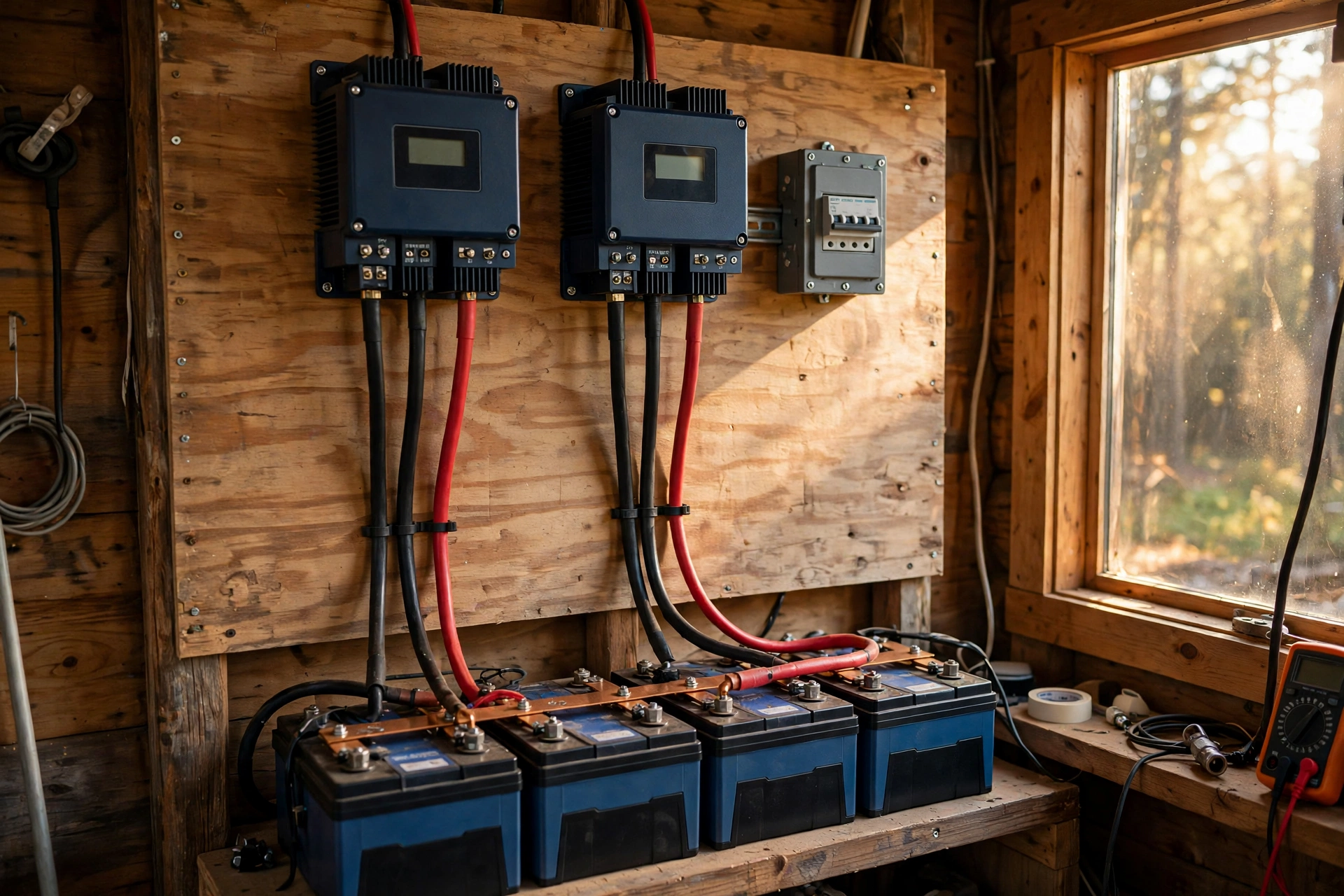
The short answer: the best MPPT charge controller for most DIY off-grid and RV builds is the Victron SmartSolar MPPT 100/30, at about $135. It delivers 30A of charge current, accepts up to 100V from your panels, handles 440W on a 12V battery or 880W on a 24V battery, and gives you full setup and monitoring over Bluetooth with no dongle to buy. For a bigger array, the Victron SmartSolar MPPT 150/35 costs the same as the 50A Victron, about $194, and buys 150V of PV headroom plus 48V battery support. For a large cabin or a 48V bank, the Renogy Rover 60A is the value step-up at about $400, with an LCD on the unit and 60A of charging.
Disclosure: we may earn a commission if you buy through links on this page, at no extra cost to you. See our disclosure for how that works. Prices below are as listed by the vendor or retailer in October 2026 and will move; check the listing before you buy.
How this guide was put together: this is research-desk work, not hands-on testing. Picks are based on published specs, manuals, owner reports, and measurements as of October 2026. No controller here was bench-tested by us.
What MPPT actually does, and why it beats PWM
Every solar panel has a sweet spot called the maximum power point: one specific combination of voltage and current where it produces the most watts. That point moves constantly, with sunlight, temperature, and shade. A nominal “12V” panel actually produces about 18 to 22V at its maximum power point, and up to about 22 to 24V open-circuit.
A PWM controller is essentially a fast switch. It connects the panel to the battery and pulses the connection to hold the battery at the right voltage, which forces the panel to operate at battery voltage, about 13 to 14V, even though its maximum power point sits near 18V. The current stays the same, the voltage is pulled down, and the missing watts are lost as heat. On a small 12V panel matched to a 12V battery the gap is small and the loss is modest. On a 24V or residential panel, or two panels in series, the gap is large and PWM wastes a third or more of the array.
An MPPT controller is a DC-to-DC converter with a brain. It continuously measures the panel’s voltage and current, finds the maximum power point, and converts the excess voltage into extra current. A 100W panel producing 18V at 5.5A becomes about 14V at roughly 7A at the battery, minus conversion losses of about 2 percent. That is why MPPT typically harvests 15 to 30 percent more energy than PWM from the same panels, with the biggest gains in cold weather, when panel voltage is highest, and in low or variable light, when the power point moves fastest.
The practical rule: MPPT is the right call for anything 200W or larger, any panel whose voltage is well above battery voltage, any RV or off-grid cabin system you actually depend on, and any lithium battery, where charge precision matters more. PWM survives only for a single small 12V panel on a 12V battery. Our charge controller guide covers the full MPPT vs PWM trade-off and the wiring basics.
The shortlist: MPPT only
Every controller below is MPPT. No PWM units made this list, because this roundup answers one question: which MPPT controller, at which size.
| Controller | Max amps | Max PV volts | Battery voltage | Max array (12V / 24V) | Display / app | Price (Oct 2026) |
|---|---|---|---|---|---|---|
| Victron SmartSolar MPPT 100/30 | 30A | 100V | 12/24V | 440W / 880W | App only (Bluetooth built in) | About $135 |
| Victron SmartSolar MPPT 100/50 | 50A | 100V | 12/24V | 700W / 1,400W | App only (Bluetooth built in) | About $194 |
| Victron SmartSolar MPPT 150/35 | 35A | 150V | 12/24/36/48V | 500W / 1,000W | App only (Bluetooth built in) | About $194 |
| Renogy Rover 60A | 60A | 140V | 12/24/36/48V | 800W / 1,600W | LCD + app via optional BT module | About $400 |
| Renogy Rover Lite 60A | 60A | 150V | 12/24/36/48V | 900W / 1,800W | LCD + app via optional BT module | About $250 |
| EPEVER Tracer 4210AN | 40A | 100V | 12/24V | 520W / 1,040W | LCD on unit; app needs adapter | About $180 with MT50 meter |
Prices are the vendor or retailer list prices found in October 2026. The Victron 100/50 and 150/35 prices are confirmed across three retailers each at $193.80. The EPEVER figure is for the bundle with the MT50 remote meter; the bare controller sells for less. The Renogy Rover 60A price is controller-only; the bundle with the Bluetooth module and Renogy ONE Core lists at about $600.
The picks, one by one
Best overall: Victron SmartSolar MPPT 100/30
The 100/30 is the default recommendation for a reason, and the reason is not brand loyalty. Its numbers cover the most common DIY builds with room to spare: 30A of charge current, 100V of PV headroom, 440W of panels on a 12V battery and 880W on a 24V battery. Two 200W panels in series, the classic RV roof setup, fits comfortably. Bluetooth is built in, so setup, battery profiles, and live yield all run through the free VictronConnect app with no dongle. Peak conversion efficiency is rated at 98 percent, and the unit carries a 5-year warranty, the longest in this roundup. There is no screen on the box itself, which is the one real compromise: if you want at-a-glance numbers without opening your phone, add a separate display or pick a controller with one built in. It also has no load output, so it cannot switch a DC load directly. For most RV and cabin builds, neither matters. Buy this if your array is 200 to 440W on a 12V battery and you want the controller you will not outgrow next year.
Best 50A step-up: Victron SmartSolar MPPT 100/50
The 100/50 is the same controller with a bigger output stage: 50A instead of 30A, the same 100V PV ceiling, 700W of panels on 12V and 1,400W on 24V. Everything else carries over, built-in Bluetooth, 98 percent peak efficiency, the BatteryLife algorithm that protects a lead-acid battery from slow death by partial charge, and the 5-year warranty. At about $194 it costs about $60 more than the 100/30, which is a fair price for 67 percent more charge current. The interesting comparison is with the 150/35 below, which costs the same $194: choose the 100/50 when your array is large but your strings stay short, two panels in series at most, and your battery is 12V or 24V. Buy the 100/50 if your array is headed past 440W on 12V and you have no plans for 48V or three-panel strings.
Best for high-voltage strings and 48V: Victron SmartSolar MPPT 150/35
The 150/35 trades current for voltage: 35A, but a 150V maximum PV input and support for 12, 24, 36, and 48V battery banks, with 500W on 12V, 1,000W on 24V, 1,500W on 36V, and 2,000W on 48V. Three 200W panels in series, or a pair of high-voltage residential panels, fit where a 100V controller would be destroyed on the first cold morning. It keeps the same built-in Bluetooth, 98 percent peak efficiency, and 5-year warranty as the rest of the SmartSolar line, and adds a VE.Direct port for wired monitoring and GX integration. At about $194 it is the same price as the 100/50, so the choice between them is purely about your system: more amps for a 12/24V array, or more voltage headroom and 48V support. Buy the 150/35 if you run long series strings, high-voltage panels, or a 48V bank, or if you want the headroom to move to 48V later without replacing the controller.
Best large-array controller: Renogy Rover 60A
The Rover 60A is the step up when 50A is not enough: 60A of charging, 140V of PV headroom, and 12/24/36/48V auto-detection, with 800W of panels on 12V, 1,600W on 24V, 2,400W on 36V, and 3,200W on 48V. It has an LCD screen on the unit, which no Victron in this roundup offers, a 20A load output for switching DC loads, and Renogy’s lithium reactivation feature for reviving a deeply discharged lithium battery. Tracking efficiency is rated above 99 percent with conversion efficiency up to 98 percent, and it carries a 3-year warranty. Bluetooth costs extra: the BT-1 or BT-2 module is sold separately or bundled with the Renogy ONE Core, which pushes the bundle price to about $600. At about $400 controller-only it undercuts the Victron 150/45 and 150/60 by a wide margin while covering the same panel wattage on a 24V system. Buy this if you are building a cabin-scale system, 600W and up, or a 48V bank, and you want a screen on the wall and the most amps per dollar in the premium tier.
Best budget 60A: Renogy Rover Lite 60A
The Rover Lite 60A is the Rover 60A’s stripped-down sibling: 60A of charge current, 150V of PV headroom, 12 to 48V support, and tracking efficiency above 99 percent, at about $250 direct from Renogy, $150 less than the Rover 60A. It takes more panel power per volt than its sibling, 900W on 12V and 1,800W on 24V, and it keeps the LCD screen, the 20A load output, and the lithium reactivation feature. The savings come from a simpler plastic housing instead of the Rover’s die-cast case, a shorter 2-year warranty against the Rover’s 3-year coverage, and slightly lower conversion efficiency, rated above 97 percent. Monitoring runs through the DC Home app with an optional Bluetooth module. Buy this if you need 60A and 150V on a budget, and the system lives somewhere sheltered where the lighter housing and shorter warranty do not matter.
Best budget 40A: EPEVER Tracer 4210AN
The Tracer 4210AN matches the Rover 40A’s headline numbers, 40A, 100V max PV, 520W on 12V and 1,040W on 24V, at a lower bare-controller price, and it is the most configurable unit here, with a user-defined battery profile that lets you set exact voltages for unusual lithium chemistries. The LCD is on the unit, the build is a die-cast aluminium case that sheds heat well, and MPPT tracking efficiency is rated above 99.5 percent. The cost of the savings is convenience: there is no built-in Bluetooth, so phone monitoring needs a separate eBox adapter, and lithium setup requires that adapter or the MT50 remote meter to set parameters properly. Buy this if you are comfortable configuring a controller through its menus, you want the most amps per dollar in the 40A class, and you do not need an app on day one.
How to size an MPPT controller: two limits
Sizing has two limits, and both must hold. Get either wrong and the controller either clips your output or, worse, fails.
Limit 1: charge current. Divide total panel watts by battery voltage. That is the current the controller must carry at full sun. Then add about 25 percent headroom, because panels briefly exceed their rated output in cold, bright conditions, and because a controller run at its limit all day runs hot and shortens its own life.
| Array | Battery | Current (watts ÷ volts) | Controller to buy |
|---|---|---|---|
| 200W | 12V | About 17A | 20A or 30A |
| 400W | 12V | About 33A | 40A |
| 400W | 24V | About 17A | 20A |
| 600W | 24V | About 25A | 30A |
| 800W | 24V | About 33A | 40A |
| 1,200W | 48V | About 25A | 30A (150V class) |
Notice what doubling the battery voltage does: the same 400W array needs a 40A controller on 12V and only a 20A controller on 24V. That is one of the real reasons larger off-grid builds move to 24V or 48V, and it is why a controller’s amp rating alone tells you nothing without the battery voltage beside it.
Limit 2: maximum PV voltage. Add up the open-circuit voltage (Voc) of the panels in each series string, then check it against the controller’s maximum PV input voltage, with a cold-weather margin. A panel rated at 22V Voc at 25°C can reach about 24 to 25V on a freezing morning, because voltage rises as temperature falls. Two such panels in series reach about 48 to 50V cold, which fits a 100V controller easily. Three in series reach about 72 to 75V, which fits a 100V controller but leaves little margin, and four in series reach about 96 to 100V, which needs the 150V class. Never exceed the maximum PV voltage, even briefly: over-current is clipped, over-voltage is damage.
A note on wiring order. Connect the battery to the controller first, then the panels. The controller needs the battery connected to detect the system voltage and set itself up; connecting panels first can leave it unconfigured or, on some units, damaged. Disconnect in the reverse order: panels off first, then the battery.
What to check before you buy
- Battery chemistry setting. Confirm the controller has a preset for your exact battery: LiFePO4, AGM, gel, or flooded. A “user” profile is not the same as a lithium preset.
- Max PV voltage vs your cold-morning Voc. Size on the coldest morning, not the warm afternoon. This is the most common sizing mistake in DIY builds, and it is the mistake that destroys controllers.
- 100V or 150V? Count your series string voltage first. Two panels in series is a 100V job; three or more, or residential panels, is a 150V job.
- Display vs app. Decide whether you want numbers on the wall or on your phone. A controller with neither leaves you guessing about system health.
- Load output. If you want the controller to switch lights or a fan directly and cut them off before the battery is flat, you need a load output. The Victron 100/30 and 100/50 do not have one; the 75/15 and both Renogy units do.
- Room to grow. A 40A or 60A controller on a 200W array looks oversized today and looks like foresight the day you add two more panels. Controller cost scales slowly with amps; replacing a controller scales badly.
The bottom line
For most DIY off-grid and RV builds, the Victron SmartSolar MPPT 100/30 is the best MPPT charge controller: the right amperage, the right voltage headroom, and the best app, for about $135. At the same $194, choose the Victron SmartSolar MPPT 100/50 for more charge current on a 12/24V array, or the Victron SmartSolar MPPT 150/35 for 150V strings and 48V support. Go to the Renogy Rover 60A for a cabin-scale array, to the Renogy Rover Lite 60A for the same 60A with more PV headroom at a lower price and a shorter warranty, and to the EPEVER Tracer 4210AN for the cheapest honest 40A. Whichever you pick, size it on both limits, current and cold-morning voltage, and wire the battery first.
For the rest of the system, see the charge controllers hub for the full category, including our broader best solar charge controller roundup, and the solar panels and batteries hubs when you size the array and the bank to match. Our charge controller guide covers the MPPT vs PWM decision and wiring basics in more depth.