
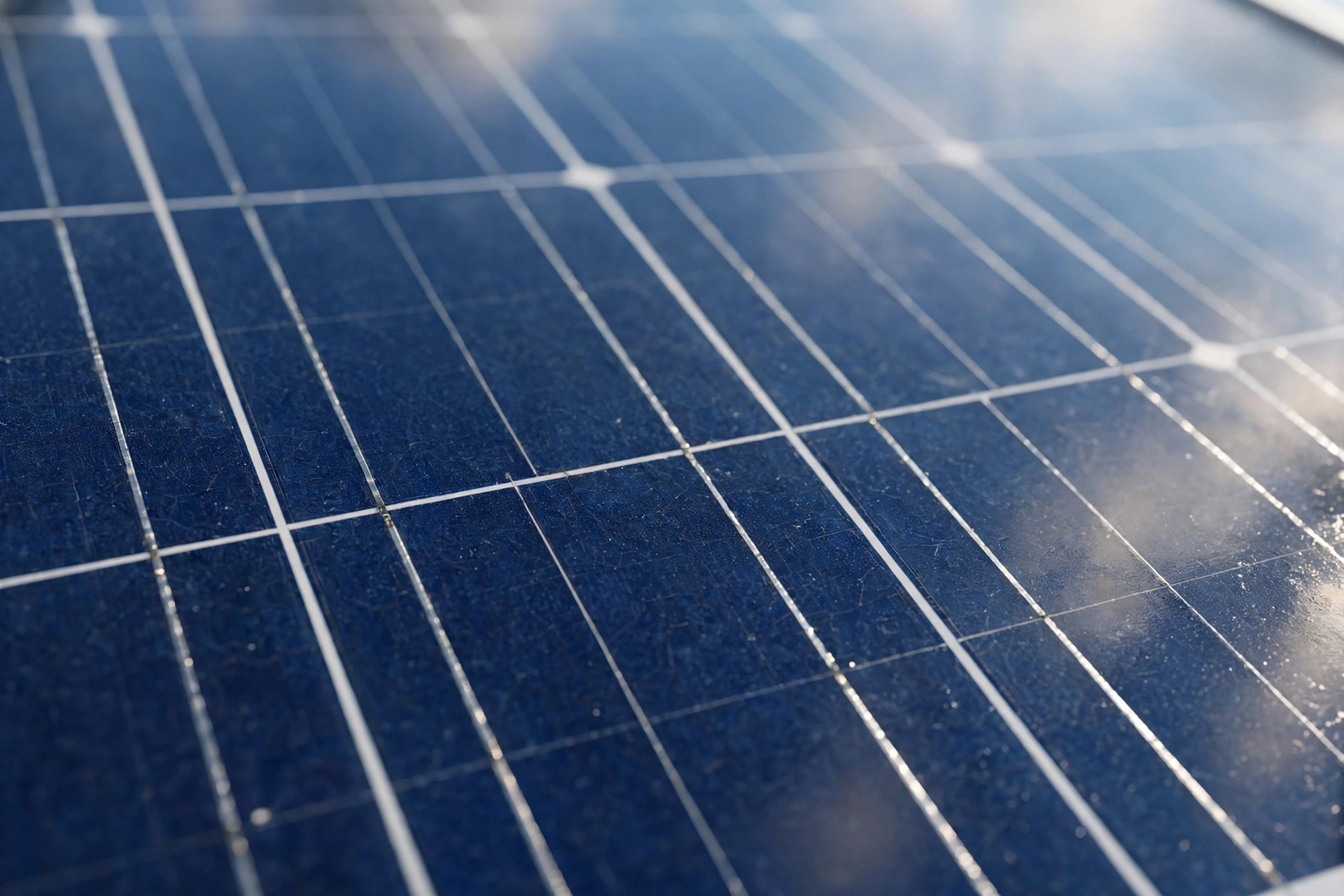
The short answer: photons of sunlight knock electrons loose inside silicon cells, the cell’s built-in electric field pushes those electrons in one direction to form a DC current, and an inverter converts that DC into the AC your appliances use. No moving parts, no combustion — just light hitting a carefully engineered sandwich of silicon.
Disclosure: Powered by Solar Panels is reader-supported. Some links on this site may earn us a commission if you buy through them, at no extra cost to you — see our disclosure for the full picture. This guide contains no affiliate links; it is purely explanatory, based on published research as of October 2026.
The photovoltaic effect, from first principles
Everything starts with a photon — a packet of light energy — striking a solar cell. A cell is mostly silicon, the same semiconductor used in computer chips, formed into two thin layers with opposite electrical characters: one layer with extra electrons (n-type), one with missing electrons, or “holes” (p-type). Where the two layers meet, an electric field forms. That field is the whole trick.
Here is the sequence, step by step:
- A photon hits the silicon and its energy is absorbed by an electron, knocking that electron loose from its atom. The freed electron leaves behind a hole.
- The electric field at the junction pushes the electron one way and the hole the other. Without the field, the electron would just fall back into a hole and the energy would become heat. The field separates them before that happens.
- Metal contacts on the cell collect the electrons and route them out through wiring. Electrons flowing in one direction through a wire is an electric current — direct current, or DC.
- Cells are wired together into a panel so their small individual currents and voltages add up to something useful. A single cell produces roughly half a volt; a panel strings dozens of them together to reach 18–24 volts or more.
- An inverter converts the DC into AC at the voltage and frequency your appliances expect. In an RV or portable setup, that inverter may sit inside a power station or stand alone between the battery and your loads.
That is the entire mechanism. Light in, separated charges, current out. The panel is a solid-state device: nothing moves, nothing wears out by friction, and the only reason output varies is that the incoming light varies.
What a panel is actually made of
A panel is a stack of layers, each with a job:
| Layer | What it does |
|---|---|
| Tempered glass (front) | Lets light through while protecting the cells from hail, dust, and knocks |
| Encapsulant (usually EVA) | Clear plastic that seals the cells in and holds the stack together |
| Silicon cells | Where the photovoltaic effect happens — the working heart of the panel |
| Backsheet or second glass layer | Seals the rear, keeps moisture out |
| Aluminium frame | Gives the panel rigidity and mounting points |
| Junction box + cables | Collects the current from the cells and carries it out to your system |
Most portable and RV panels use monocrystalline silicon cells — cut from a single silicon crystal, dark blue or black, and the most efficient common type at around 20% conversion or better. Polycrystalline cells, made from multiple crystals, are cheaper and slightly less efficient. Thin-film panels are lighter and flexible but notably less efficient per square metre, which matters when panel area is limited on an RV roof or a campsite table.
DC to AC: why the inverter matters
Panels produce DC, and DC is awkward. It is what batteries store and what USB devices and 12V appliances run on, but standard household appliances — a laptop charger, a fridge, a fan — expect AC. The inverter is the translator: it switches the DC on and off rapidly to synthesize an alternating waveform at the right voltage and frequency.
In off-grid setups the inverter usually sits after the battery, not directly after the panel, because the battery smooths out the panel’s variable output. The flow is: panel → charge controller → battery → inverter → AC appliance. Some portable power stations combine the charge controller, battery, and inverter in one box, so you plug the panel straight in and get AC sockets out. Either way, the panel itself never produces AC — the inverter always does that job.
What happens on cloudy days
Panels do not need a visible sun. They respond to daylight across the visible and near-infrared spectrum, and cloud scatters sunlight rather than blocking it entirely. On an overcast day, diffuse light still reaches the cells, and output typically lands around 10–25% of clear-sky levels, depending on how thick the cloud is. Thin high cloud may cost you only a little; a dark storm sky costs you most of it.
Two practical consequences follow for off-grid use. First, a system sized only for sunny days will fall short on a grey week — experienced off-grid users size panels and batteries for the worst realistic stretch, not the best day. Second, clouds can occasionally increase output briefly: a cloud edge can reflect extra light onto the panel, a phenomenon known as the cloud-edge effect, producing a short spike above clear-sky output. It is real, but it lasts minutes, not hours — do not plan around it.
What happens at night
Nothing. Panels produce zero electricity in the dark, because there are no photons to knock electrons loose. This is not a flaw to engineer around at the panel level; it is the physics of the device. The solution lives elsewhere in the system: the battery.
During the day, surplus panel output charges the battery. After dark, the battery discharges through the inverter to run your loads. That is why battery capacity, not panel wattage alone, decides whether you have lights and a charged phone at 10pm in a cabin or RV. A big panel with a tiny battery gives you plenty of power at noon and nothing at night; the two have to be sized together. For more on the big picture — how sunlight becomes electricity and heat — see How Does Solar Energy Work?.
Why panels produce less than their label sometimes
A “100W panel” is rated under laboratory test conditions: 1,000 watts of light per square metre, a cell temperature of 25°C, and a standard spectrum. Real conditions rarely match the lab, and each deviation costs output:
- Angle: sunlight striking at a slant spreads over more area, so less energy lands per cell. Tilting a portable panel toward the sun can recover a large fraction of lost output.
- Shade: even partial shade on one part of a panel can disproportionately cut its output, because cells are wired in series and the weakest cell limits the string. Keep panels clear of branches, roof racks, and tent poles.
- Heat: silicon cells lose a little efficiency as they get hotter — typically around 0.3–0.5% per degree Celsius above 25°C. A panel in cool mountain sun can outperform the same panel in desert heat.
- Dirt: dust, pollen, and bird droppings block light. A quick wipe restores output; in most climates, rain does much of the job.
None of this means the panel is failing. It means output follows the light, the temperature, and the cleanliness of the glass, moment by moment.
How long do panels last?
A long time, by the standards of anything you take camping. Most reputable manufacturers warrant their panels to still produce 80–90% of their rated output after 25 years, and panels commonly keep working well beyond the warranty period at slowly declining output. The degradation rate is typically around 0.5% per year. There is no engine to service and no fuel to buy; the main maintenance is keeping the glass clean and the connections tight. For a portable panel that gets folded, carried, and set up repeatedly, the frame and hinges will usually wear out before the cells do.
Putting it together in an off-grid setup
For an RV, cabin, or campsite, the panel is one component in a short chain:
- Panel converts sunlight to DC.
- Charge controller (MPPT is the efficient choice) regulates that DC to charge the battery safely.
- Battery stores the energy for night and cloudy stretches.
- Inverter turns stored DC into AC for standard appliances.
Size the panel for how much energy you use in a day, size the battery for how many sunless hours you need to ride through, and remember the panel only works while light falls on it. Understand that chain and you understand how solar panels work — not as a mysterious black box, but as a straightforward piece of physics with a battery doing the night shift. When you are ready to choose hardware, compare options in the solar panels hub.