
The short answer: photovoltaic paint is a genuine research field with impressive laboratory results, but as of October 2026 you cannot buy it. No company sells a tin of paint that generates electricity. The gap between the lab and the shop is not efficiency — it is durability, sealing, and wiring, and it is still wide.
Disclosure: Powered by Solar Panels is reader-supported. Some links on this site may earn us a commission if you buy through them, at no extra cost to you — see our disclosure for the full picture. This guide contains no affiliate links; it is purely explanatory, based on published research as of October 2026.
What photovoltaic paint actually is
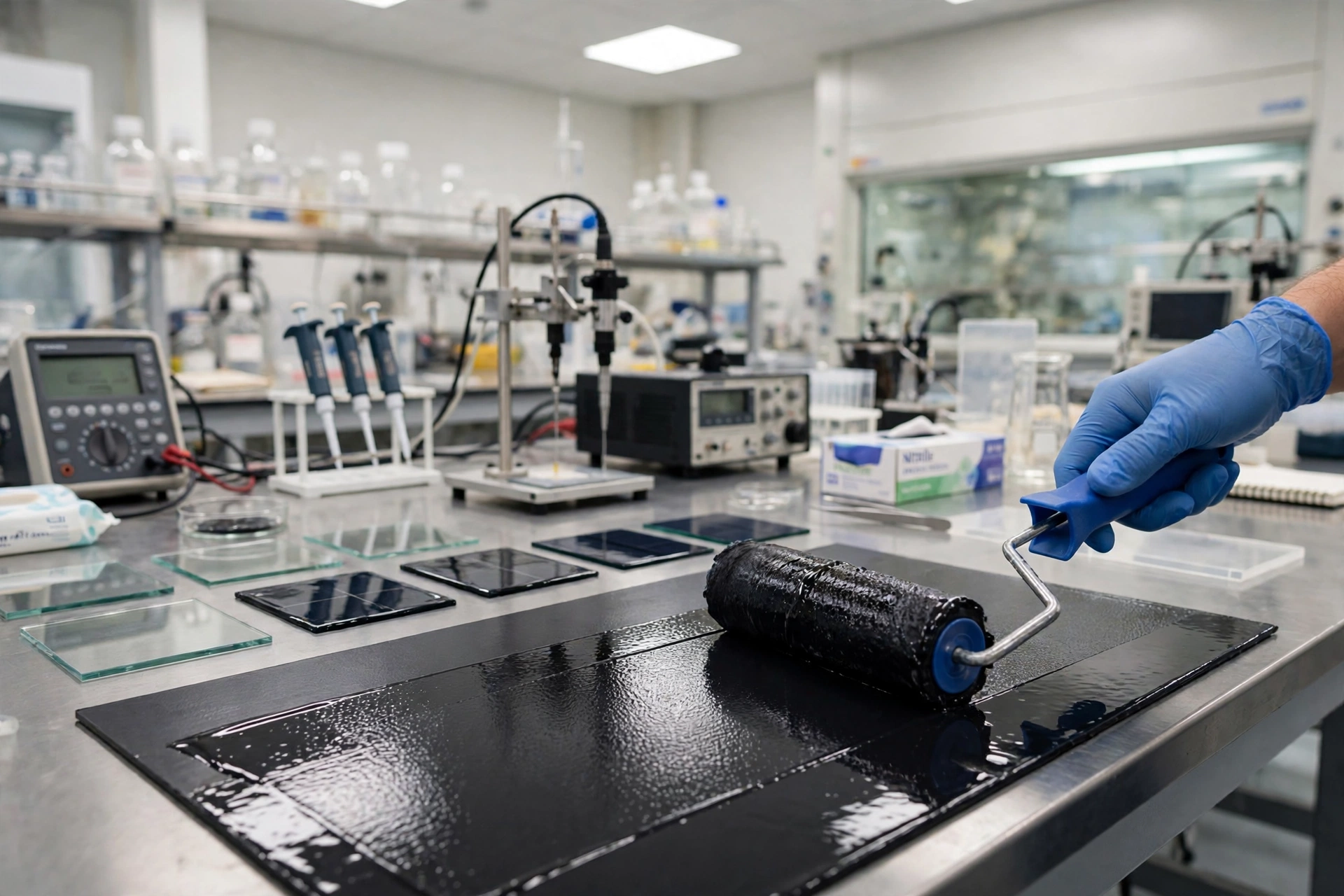
The idea is simple enough to state in one sentence: instead of bolting a rigid panel onto a surface, dissolve the light-absorbing material into a liquid and apply it like paint — sprayed, rolled, or printed directly onto whatever you want to turn into a generator.
That is the whole appeal. A silicon panel is a factory-made object with a fixed shape, a glass front, an aluminium frame, and mounting hardware. A coating has none of those constraints. In principle it could cover a curved van roof, a tent, a backpack, or a building facade — any surface, in any shape, with no mounting at all.
Three different materials are being developed under the “solar paint” umbrella, and they are not the same thing:
| Approach | What it is | Status in 2026 |
|---|---|---|
| Perovskite inks | A crystal-structured semiconductor dissolved into a liquid ink and coated onto a surface | The leader — lab cells near 27% efficiency |
| Quantum dots | Nanoscale semiconductor crystals suspended in a liquid, tuned by particle size to absorb different parts of sunlight | Lab record 18.1%, further behind |
| Hydrogen-producing paint | A coating that uses sunlight to split moisture from the air into hydrogen and oxygen | Produces fuel, not electricity — a different idea entirely |
The hydrogen version deserves a quick clarification, because it often gets mixed into solar paint articles. It does not generate electric current. It makes hydrogen gas, which would then need collecting, storing, and running through a fuel cell. It is a chemistry experiment, not a power source for your campsite, and it is further from any product than the other two.
How it is supposed to work
The physics is the same photovoltaic effect that runs a normal panel — photons knock electrons loose, and an internal electric field pushes the freed electrons in one direction to form a current. If you want the mechanism step by step, see how solar panels work. What changes with paint is not the physics but the construction.
A conventional silicon cell is a slice of crystal, built in a factory and sealed under glass. A paint-on cell is built up as a stack of ultra-thin layers deposited from liquid:
- A conductive base layer on the surface, which collects current.
- The absorber layer — the perovskite ink or quantum dot suspension — which is where sunlight is converted into separated charges.
- Charge-transport layers on either side, which pull electrons one way and holes the other before they can recombine.
- A top electrode and a sealant, which collect the current and protect the stack from air and moisture.
In a lab this stack is laid down with spin coating or slot-die coating on a small, perfectly flat piece of glass, in controlled conditions. The “paint” vision is to do the same thing with a spray gun or roller on a real surface in the real world — and that jump, from a 1 cm² glass slide in a glovebox to a wall in the rain, is where almost every problem lives.
What the research actually shows
The efficiency numbers are impressive, and they are why this field keeps getting funded:
- Perovskite single-junction cells reached a certified record of 26.7% efficiency (King Abdullah University, 2024, on the NREL efficiency chart). That is within reach of commercial silicon panels, which sit around 20–22%.
- Perovskite-silicon tandems — a perovskite layer stacked on a silicon cell — have passed 33% in the lab.
- Quantum dot cells reached an 18.1% record in 2024 (UNIST, South Korea, recognised by NREL), up from under 4% when the field started around 2010.
- Durability is improving too. In a paper published in early 2026, NREL researchers reported perovskite cells at 26.1% efficiency that lost only ≈2% of their output after 2,100 hours of operation at 65°C. A small 6 cm² mini-module held 23% efficiency with under 9% degradation after 2,200 hours.
That last point matters, because for a decade the standard criticism of perovskites was that they worked brilliantly for a week and then fell apart. But note the conditions: these are small, hermetically sealed test devices in a laboratory, measured in hundreds or a few thousand hours. A solar panel in the field needs to survive 25 years of sun, rain, frost, and heat — ≈219,000 hours — and nobody has demonstrated that for a paint-on cell.
The research is also moving toward real manufacturing. In September 2026, the University of Sheffield announced a project to spray-coat perovskite cells directly onto carbon-fibre surfaces for high-altitude aircraft, funded with £967,714 by the UK’s Advanced Research and Invention Agency. The attraction there is weight: the sprayed cells offer a power-to-weight ratio ≈30 times that of silicon. And in October 2026, University of Surrey researchers published a way to make perovskite inks without the toxic solvents the process has relied on — a practical step toward factory production.
The problems that keep it in the lab
Efficiency was the headline problem a decade ago. It is not the headline problem now. Four problems are, and they are all harder than efficiency:
Durability. Perovskites are sensitive to moisture, oxygen, heat, and UV light — precisely the things a painted outdoor surface is exposed to. A silicon panel solves this with a glass front and a sealed frame; a coating has no such protection, and adding a protective layer on top of a paint largely defeats the point of it being paint. Lead is also part of the problem: the highest-efficiency perovskites contain lead, which raises toxicity and disposal questions if the coating is spread over large surfaces. Lead-free tin perovskites exist but trail at ≈15% efficiency in the lab.
Sealing. This is the same problem from the other side. A solar cell is a sealed device, and its lifetime is set by how well the seal keeps water out. A painted layer is, by design, thin, exposed, and in direct contact with the weather. Every crack, scratch, or blister is a path for moisture into the active layer. Nobody has shown a paint-on cell surviving years outdoors.
Collecting the current. A panel has busbars, a junction box, and cables. A painted wall has none of these. Getting current out of a large coated area means adding a grid of conductors across the surface and keeping those connections weatherproof — which starts to look a lot like building a panel on the wall, with extra steps.
Cost versus silicon. This is the quiet killer. Silicon panels are a mature commodity: mass-produced, ≈20% efficient, warranted for 25 years, and cheap enough that the panel is often the smallest cost in a system. A paint would have to be cheaper per watt over its lifetime, with a comparable warranty, to displace that. At present it is neither cheaper nor longer-lived, and there is no manufacturing line producing it at scale to bring the cost down.
Can you buy it today?
No — and be wary of anything that suggests otherwise. As of October 2026:
- No consumer photovoltaic paint is on sale. There is no product you can order, no price, no warranty, and no retailer listing. Search results for “solar paint” mostly return reflective cool-roof coatings (which generate no electricity), cosmetic products, or market-research reports about a future industry.
- The closest real products are perovskite modules, not paint. A small number of companies, such as Australia’s Halocell Energy, are selling factory-made perovskite modules in limited quantities. Those are rigid panels made in a factory — the perovskite is inside a sealed module, not something you apply yourself.
- The most famous solar paint project is a car concept. Mercedes-Benz announced its solar paint research in December 2024: a 5-micrometre photovoltaic layer applied like a paste under a car’s colour coat, claimed at ≈20% efficiency, with an 11 m² application supposedly generating enough electricity for up to 12,000 km of driving a year in Stuttgart. It is a research programme and a concept car, not a production feature, and Mercedes has given no date for it reaching a showroom.
The honest timeline is that photovoltaic paint is years away from being a product you can buy, if it ever becomes one. The research is real and well funded, and perovskite modules — the factory-made kind — may reach the mainstream first. A tin of paint you apply yourself is a further step beyond that, and it has to solve the sealing and wiring problems, not just the efficiency one.
What to do instead for an unusual surface
If the reason solar paint appeals to you is that your surface is curved, temporary, or otherwise unsuitable for a rigid glass panel, the practical answers already exist:
- Flexible thin-film panels — CIGS (copper indium gallium selenide) panels are lightweight, can curve gently, and can be glued or strapped onto van roofs, boat decks, and other curved surfaces where a framed panel will not sit flat.
- Foldable portable panels — for temporary or mobile use, a folding panel packs flat and sets up in a minute. See our guide to the best portable solar panels for the options that actually exist today.
- Lightweight rigid panels — some portable panels use a thin, frameless design that is far lighter than a household panel and can be mounted with adhesive or straps rather than bolts.
None of these is as elegant as paint. All of them are real products with prices and warranties that work today.
The bottom line
Photovoltaic paint is a good idea with real science behind it. Perovskite inks have matched silicon’s lab efficiency, quantum dots are improving, and research funding is flowing. But a solar cell is not just a light-absorbing material — it is a sealed, wired, weatherproof device that has to survive decades outdoors, and nobody has shown how to do that with a coating applied like paint. Until that changes, the answer is: in the lab, impressively; on your wall, not yet.