
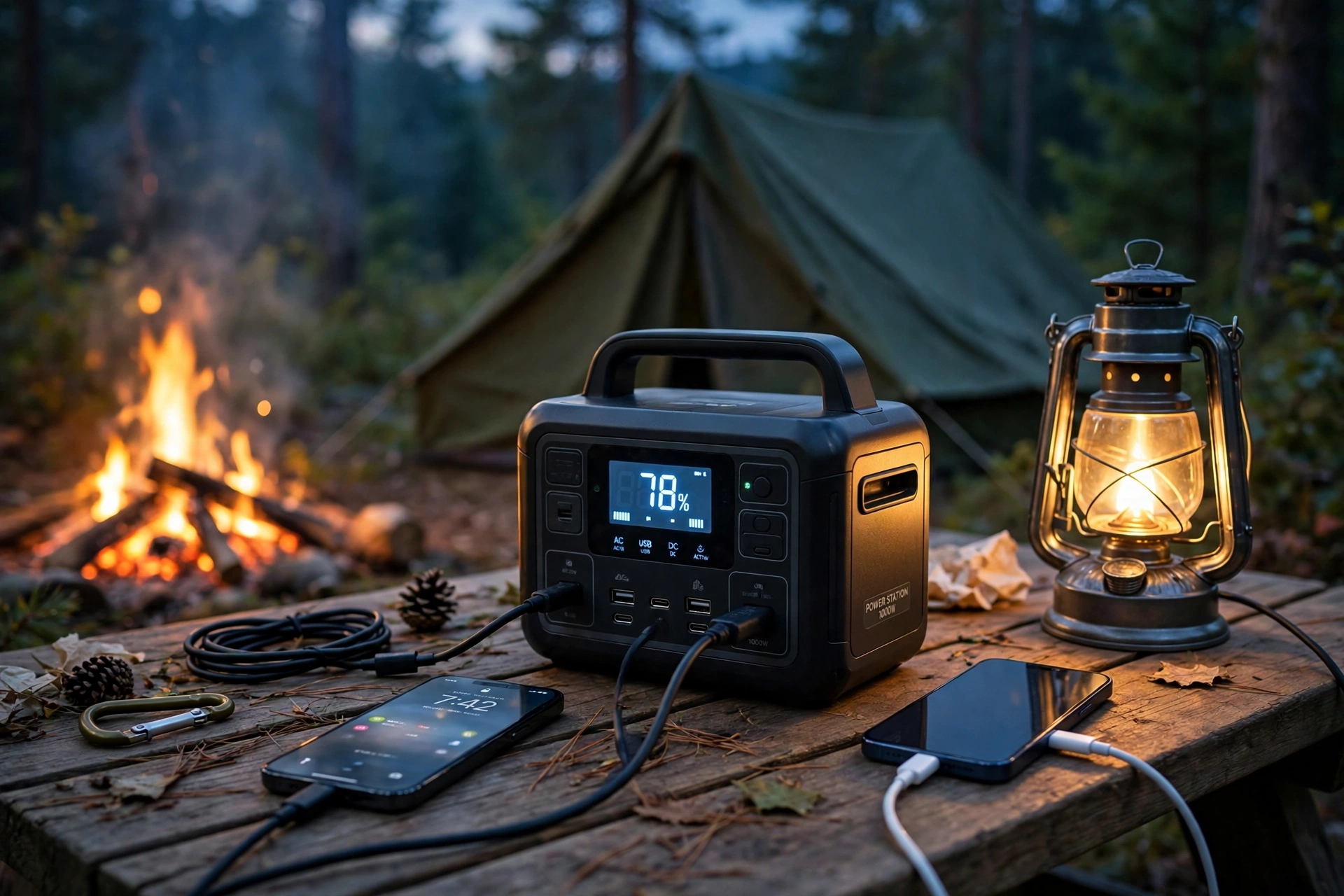
The short answer: the best portable power station for camping for most car campers is the Jackery Explorer 1000 v2. It packs 1,070Wh and 1,500W of AC output into 23.8 lb, the lightest 1kWh-class station here, and its 400W solar input pairs with a single 200W folding panel for a long weekend. If you only need phones, lights, and a laptop, save the weight and buy the Anker SOLIX C300 at 9.1 lb. If you run a 12V cooler for a family basecamp, the Anker SOLIX C1000 Gen 2 gives you the same 1kWh in a more powerful 2,000W box.
Disclosure: we may earn a commission if you buy through links on this page, at no extra cost to you. See our disclosure for how that works. This guide is research, not hands-on testing: every figure below comes from published manufacturer specs, retailer listings, and owner reports as of October 2026, and prices are the list or street prices we could verify at that date.
Quick picks
- Best for most car campers: Jackery Explorer 1000 v2 — 1,070Wh, 1,500W, 23.8 lb, about $499.
- Best lightweight pick: Anker SOLIX C300 — 288Wh, 300W, 9.1 lb, about $250.
- Best ultralight small pick: Jackery Explorer 300 Plus — 288Wh, 300W, 8.3 lb, about $299.
- Best for a powered basecamp: Anker SOLIX C1000 Gen 2 — 1,024Wh, 2,000W, 24.9 lb, about $799 list, often about $499 on sale.
- Best for solar-heavy trips: EcoFlow DELTA 3 Plus — 1,024Wh, 1,800W, 27.6 lb, about $699, with the highest solar input here at 1,000W.
- Best for running big appliances: BLUETTI AC180 — 1,152Wh, 1,800W, 35.3 lb, about $499.
The six stations compared
| Model | Capacity | AC output | Weight | Max solar input | Price, Oct 2026 |
|---|---|---|---|---|---|
| Anker SOLIX C300 | 288Wh | 300W | 9.1 lb | 100W | About $250 |
| Jackery Explorer 300 Plus | 288Wh | 300W | 8.3 lb | 100W | About $299 |
| Jackery Explorer 1000 v2 | 1,070Wh | 1,500W | 23.8 lb | 400W | About $499 |
| Anker SOLIX C1000 Gen 2 | 1,024Wh | 2,000W | 24.9 lb | 600W | About $799 list, often about $499 |
| EcoFlow DELTA 3 Plus | 1,024Wh | 1,800W | 27.6 lb | 1,000W | About $699 |
| BLUETTI AC180 | 1,152Wh | 1,800W | 35.3 lb | 500W | About $499 |
Prices are US list or street prices checked in October 2026; they move with sales. The Anker C300 price is the least firmly verified figure here: the DC version is listed at $250 and has been seen at $200 on sale, while the AC version’s US list price was not confirmed at the time of writing.
Capacity vs. weight is the whole decision
A portable power station is a battery, an inverter, and a solar charge controller in one box. Two numbers describe it, and confusing them is the most common buying mistake.
Watts (W) say what you can plug in. A 300W station runs phones, laptops, lights, and a small fan, but not a 1,000W kettle. A 1,500W or 1,800W station runs the kettle, a coffee maker, and most 12V coolers.
Watt-hours (Wh) say how long it runs.
Watt-hours (Wh) say how long it runs. A 1,000Wh station holds roughly three and a half times the energy of a 288Wh station. That is the number that decides whether your cooler survives night two.
The catch is that the headline Wh is not what reaches your devices. The inverter that turns battery DC into wall-socket AC loses energy as heat, and the station itself draws standby power while it is on. Across published measurements and owner reports, a realistic planning figure is about 80 to 85% of headline capacity as usable energy. Size your trip on that number, not the box.
| What you run | Draw | About 288Wh (about 230Wh usable) | About 1,024Wh (about 820Wh usable) |
|---|---|---|---|
| Phone charge | About 12Wh per full charge | About 19 charges | About 65 charges |
| Laptop | About 50W continuous | About 5 hours | About 16 hours |
| LED lantern | About 5W | About 45 hours | About 160 hours |
| Small fan | About 30W | About 8 hours | About 27 hours |
| CPAP, no humidifier | About 60W | About 4 hours | About 14 hours |
| 12V compressor cooler | About 20W averaged over cycling | About 12 hours | About 40 hours |
Read the cooler row carefully, because it is where trips go wrong. A compressor cooler draws about 35 to 45W while its compressor runs, then idles near zero, so its average is about 20W and a 1kWh station covers a long weekend. A thermoelectric cooler, the cheap kind, draws its rated power continuously with no cycling, and the same station dies in well under a day. If you camp with a cooler, buy compressor.
Weight is the other half of the trade, and it is linear in a way capacity is not. Every extra 100Wh costs roughly 2 to 3 lb in this class. A 288Wh station at 8 to 9 lb goes in a daypack or rides on a picnic table. A 1kWh station at 24 to 28 lb is a two-handed carry from the car to the tent, and a 35 lb station like the AC180 is basecamp gear that you place once and do not move. Tent campers who walk from a car park should treat 10 lb as a soft ceiling; car campers can happily take 25 lb; only basecampers with a trolley should look past 30 lb.
Why LiFePO4 wins for repeated camping use
Battery chemistry decides how many weekends a station survives, not how it performs on the first one. The chemistry to know is LiFePO4, lithium iron phosphate.
An older lithium-ion cell (the kind in the original Jackery Explorer 300 and in most laptop batteries) is typically rated for about 500 full charge cycles before its capacity falls to 80% of new. Heat in a parked car and storage at full charge count against it further.
LiFePO4 cells are rated very differently: the stations in this roundup carry ratings of 3,000 cycles (Jackery Explorer 300 Plus), 3,500 cycles (BLUETTI AC180), or 4,000 cycles (Jackery Explorer 1000 v2, Anker SOLIX C1000 Gen 2, EcoFlow DELTA 3 Plus) to 80% capacity. That is six to eight times the cycle life, because the iron-phosphate cathode is far more stable under repeated charging than cobalt-based cathodes.
For a camper, the practical consequence is simple. A LiFePO4 station is still a good battery after hundreds of weekends. A lithium-ion station bought the same year is a degraded one. Every model in this roundup uses LiFePO4, which is now the standard for camping stations — if you are comparing against an older or cheaper model that does not, that missing chemistry is usually the reason it is cheaper.
Solar recharge while you hike
The point of a camping power station is that the sun refills it while you are away from it. A solar panel’s rated wattage is measured at 1,000W per square metre of sunlight, at 25°C, with the panel perfectly angled. A campsite gives you less: morning and evening sun at an angle, passing cloud, dust, and a panel laid flat instead of tilted. A realistic planning rule is that a portable panel delivers about 60 to 80% of its rating during the middle of the day, and far less at the edges.
That gives simple arithmetic. A 100W panel delivers about 60 to 80W, so it refills a 288Wh station in about 4 to 5 hours of good sun, and barely dents a 1,000Wh station. A 200W panel delivers about 120 to 160W, so it refills a 1,000Wh station in about 7 to 9 hours of good sun — a full day, with the panel re-angled at midday. Manufacturer claims of 3 to 4 hours for the same job assume two panels at once and perfect sun; treat them as best-case, not a plan.
Solar input ceilings matter here, and they differ more than the headline capacities do. The two 288Wh stations cap out at 100W of solar, so a bigger panel buys you nothing on them. The Jackery 1000 v2 accepts 400W, the Anker C1000 Gen 2 accepts 600W, the BLUETTI AC180 accepts 500W, and the EcoFlow DELTA 3 Plus accepts up to 1,000W across two inputs. If your trips are multi-day and solar is your only recharge, the DELTA 3 Plus’s ceiling is a genuine advantage. Note that some retailer listings for the DELTA 3 Plus quote 500W rather than 1,000W; EcoFlow’s spec sheet describes two solar inputs at 500W each, which is the figure used here.
The six models, one verdict each
Anker SOLIX C300 — the lightweight pick. 288Wh and 300W in a 9.1 lb box with two 140W USB-C ports, the fastest laptop charging in the small class. Its 100W solar cap and 300W AC ceiling mean it is a phones, lights, and laptop station, not a cooler station. Buy it for tent camping and trips where every pound is carried. Skip it if anything you own has a heating element or a compressor.
Jackery Explorer 300 Plus — the ultralight small pick. The same 288Wh and 300W as the C300, slightly lighter at 8.3 lb, with a folding handle and a 3,000-cycle LiFePO4 battery. Its edge over the C300 is weight and simplicity; its weakness is the same 100W solar cap and a single AC outlet. Choose between the two on weight and USB-C speed: the Jackery is lighter, the Anker charges laptops faster.
Jackery Explorer 1000 v2 — the best portable power station for camping for most people. 1,070Wh, 1,500W, 23.8 lb, and about $499. It is the lightest way to carry a kilowatt-hour, it runs a 12V cooler for about 40 hours, a kettle, and a coffee maker, and its 400W solar input pairs cleanly with a single 200W folding panel. Its limits are honest ones: no battery expansion, so 1,070Wh is all you ever get, and 1,500W rules out the largest appliances. For a weekend car-camping trip, neither limit bites.
Anker SOLIX C1000 Gen 2 — the powerful 1kWh pick. 1,024Wh, but 2,000W of output, 600W of solar input, and a 49-minute wall recharge. That output headroom is what you pay for: it runs anything the Jackery runs, plus hungrier gear like a small induction plate. It is a pound heavier than the Jackery and its $799 list price is higher, though street prices around $499 erase the gap when they appear. Buy it if your load list includes something over 1,500W; otherwise the Jackery is the lighter buy.
EcoFlow DELTA 3 Plus — the solar-heavy pick. 1,024Wh, 1,800W, 27.6 lb, about $699, with the 1,000W solar ceiling and expansion batteries that take it to 5kWh. It is the station for multi-day basecamps where solar is the only recharge and the panel stays out all day. It is also the loudest under load in owner reports, and the heaviest of the 1kWh trio, so it suits a fixed basecamp better than a move-every-day trip. Note the naming trap: the DELTA 3 (non-Plus) is a different, smaller model.
BLUETTI AC180 — the big-appliance pick. 1,152Wh, 1,800W, and about $499, the most capacity per dollar here. Its 35.3 lb weight is the price: this is a station you carry once, from car to basecamp, and leave there. It suits family basecamps where one heavy box powers the cooler, the lights, and everyone’s devices. Solo tent campers should not buy it.
Pairing a portable panel
A station without a panel is a battery you must pre-charge at home. For camping, the panel is half the purchase, and the pairing rules are simple.
Match the panel to the station’s solar input, not to your ambition. A 100W folding panel suits both 288Wh stations and is all they can use. A 200W folding panel is the right partner for the 1,000Wh class and refills either the Jackery or the Anker in a day of good sun. A 400W panel only makes sense with the DELTA 3 Plus, the only station here that can accept it.
Buy folding, not rigid, for camping: a folding panel packs flat, weighs about 10 to 15 lb for 200W, and sets up in a minute. Check the connector before you buy — Jackery, EcoFlow, Anker, and BLUETTI all use different solar input plugs, and same-brand panels are the safe pairing. Third-party panels work if the voltage range matches the station’s input range (typically 11 to 60V). Angle the panel toward the sun and re-angle it around midday; a panel laid flat loses a large share of its output outside midday. Keep the station in the shade while the panel sits in the sun: batteries charge slower and age faster when hot.
What to leave behind, and what to check before you go
Noise. A power station is quieter than any generator, but it is not silent. Under a heavy load the cooling fan spins up, and EcoFlow rates the DELTA 3 Plus below 30 dB at 600W and below 40 dB at 1,200W — quiet conversation level, but audible in a silent forest at night. If you run a cooler overnight, place the station outside the tent vestibule, and prefer the 12V DC output for the cooler: DC avoids the inverter entirely, which cuts both losses and fan noise.
Weight, honestly assessed. Weigh the station plus the panel plus the cables before the trip, not the station alone. A 1kWh station with a 200W panel and cables is about 35 to 40 lb of gear. That is fine in a car, not fine carried a mile to a walk-in site. If your site is walk-in, the 288Wh class is the answer, and the cooler stays home.
What not to bring. Electric kettles, hair dryers, and space heaters each draw 1,000W or more and drain a 1kWh station in under an hour. Boil water on a stove. Leave the heater at home. A station is for electronics, lights, fans, coolers, and medical devices like CPAP machines — not for making heat.
Cold mornings. Do not charge a LiFePO4 station below freezing; most manufacturers rate charging from 32°F (0°C) upward, while discharging is fine down to about -4°F (-20°C). If the forecast is below 32°F, sleep with the station in the tent and charge it after the sun has warmed it.
Whichever you choose, buy the station first and size the panel to it, not the other way around. And compare the full range in our Portable Power Stations hub, where this roundup sits alongside the price-band and use-case guides for the same stations.