
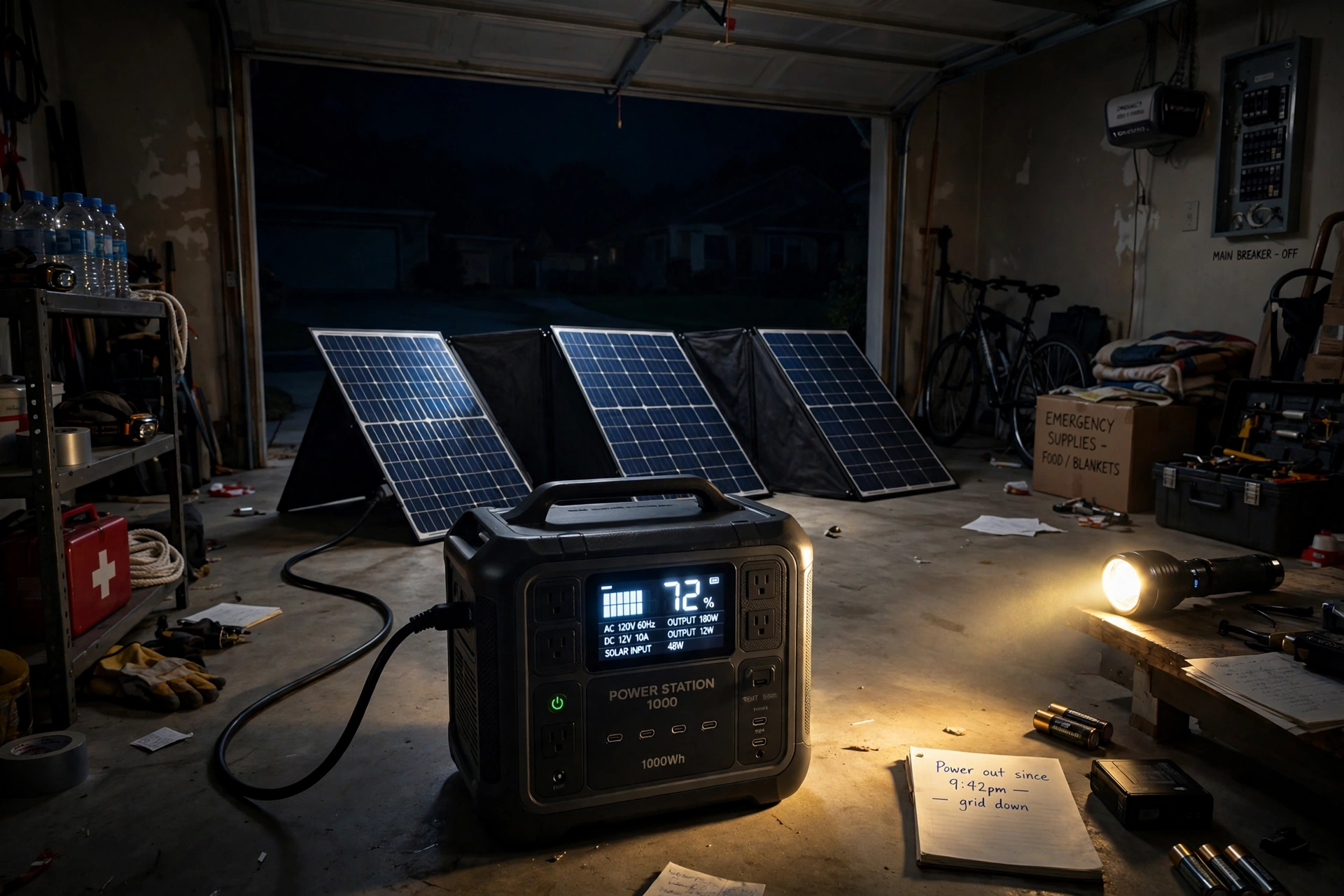
The short answer: the best solar generator for home backup for most homes is the EcoFlow Delta 2 Max — 2,048Wh of storage, a 2,400W inverter, and up to 1,000W of solar input, for about $1,049 at EcoFlow’s US store as of October 2026. It is the cheapest way to get a full day of fridge-plus-essentials backup with room to grow. If you want the strongest inverter in this class, the Bluetti Elite 200 V2 gives you 2,600W for about $899 on sale. And if your budget is tight, the Anker Solix C1000 Gen 2 covers the true essentials for about $700.
Disclosure: we may earn a commission if you buy through links on this page, at no extra cost to you. See our disclosure for details. Prices below are from the manufacturers’ own US stores, checked in October 2026; sale prices move often, so confirm at checkout.
How this guide was put together: this is a research roundup, not a hands-on test. Picks are based on published manufacturer specifications, manuals, and owner reports as of October 2026. No unit was tested by us, and no figure below comes from our own measurements.
What a “solar generator” is, and what it is not
Start with the mechanism, because the name misleads people into buying the wrong thing.
A solar generator is three components in one box:
- A battery that stores energy, measured in watt-hours (Wh). This is your fuel tank. A 2,048Wh battery holds about 2 kWh.
- An inverter that turns the battery’s DC power into household AC power, measured in watts (W). This is your engine. A 2,400W inverter can run appliances totalling 2,400W at once.
- A solar charge controller that takes power from solar panels and feeds it into the battery, measured by its maximum solar input in watts. This is your refuelling rate.
The box itself generates nothing. The panels generate; the box stores and converts. That distinction matters because it tells you which number to care about for which job: capacity decides how long things run, inverter watts decide what can run at all, and solar input decides how fast the box refills during a long outage.
It is also not a whole-house system. A portable station powers whatever you plug into it. It cannot run central air conditioning, an electric water heater, or an electric range, and it cannot backfeed your home’s wiring without a transfer switch and a model built for it. The largest unit below, the Delta Pro 3, can feed selected circuits through a transfer switch — but that is an edge case, not the job most buyers are hiring for. The job here is narrower: keep the fridge cold, the lights on, the phones charged, and the router running until the grid comes back.
How to size home backup: watts × hours = watt-hours
Sizing is arithmetic, not guesswork. For each appliance you want to keep running, multiply its running watts by the hours you need it, and add the results up.
| Load | Typical draw | Daily energy |
|---|---|---|
| Modern fridge (cycling) | 100–150W while running | About 1–1.5kWh/day |
| LED lights (a few rooms) | 20–40W total | About 0.2kWh over an evening |
| Wi-Fi router + modem | 10–20W | About 0.3kWh/day |
| Phone charging (2 phones) | 10–20W | About 0.1kWh/day |
| Laptop | 45–65W | About 0.3kWh for a work session |
| CPAP machine | 30–60W | About 0.3kWh overnight |
| Microwave (short bursts) | 1,000–1,200W | About 0.3kWh for a few uses |
| Coffee maker | 800–1,000W | About 0.2kWh for a pot |
A fridge plus lights, router, phones, and a laptop comes to roughly 1.5–2kWh per day. That is why about 2,000Wh is the sweet spot: one full day of essentials from a single charge, with a little margin. A 1,000Wh station covers the same loads for about half a day. A 4,000Wh station covers about two days — or one day with a microwave and coffee maker in the mix.
Two details catch people out. First, startup surge: a fridge compressor briefly draws two to three times its running watts when it kicks on. A fridge that runs at 150W may surge to 400–600W for a second. Every station below handles that easily, but it is why inverter size matters even for “small” loads. Second, inverter losses: converting DC to AC loses roughly 10–15% of the stored energy, so a 2,048Wh battery delivers about 1,740Wh of usable AC power. The runtimes in this guide already account for that.
Solar recharging is the same arithmetic in reverse. A 400W array in 4–5 hours of good sun produces roughly 1.6–2kWh gross, about 1.2–1.6kWh after charging losses — roughly what a fridge uses in a day. That is the point of panels in a long outage: they turn a one-day battery into a multi-day one, as long as the sun cooperates.
The comparison: five home-backup solar generators
| Model | Capacity | Inverter (continuous / surge) | Max solar input | Weight | Price (station only, Oct 2026) |
|---|---|---|---|---|---|
| EcoFlow Delta 2 Max | 2,048Wh | 2,400W / 4,800W | 1,000W | 50 lb | About $1,049 |
| Bluetti Elite 200 V2 | 2,074Wh | 2,600W / not published | 1,000W | 53.4 lb | About $899 on sale (list $1,399) |
| Jackery Explorer 2000 v2 | 2,042Wh | 2,200W / 4,400W | 400W | 39.5 lb | About $899 |
| Anker Solix C1000 Gen 2 | 1,024Wh | 2,000W / 3,000W | 600W | 24.9 lb | About $700 |
| EcoFlow Delta Pro 3 | 4,096Wh | 4,000W / 8,000W | 2,600W | 113.5 lb | About $2,799 on sale (list $3,299) |
All five use LiFePO4 batteries — the chemistry that now defines this class, rated by the manufacturers for at least 3,000 cycles (most to 80% of original capacity; Jackery rates the 2000 v2 to 70% after 4,000 cycles), which works out to roughly a decade of regular use. Prices are the manufacturers’ US store prices at the time of writing; all five brands run frequent sales, so treat the list price as the ceiling and the sale price as the number you will probably pay. (Bluetti does not publish a surge rating for the Elite 200 V2, so the table shows only its 2,600W continuous rating.)
The picks, one by one
Best overall: EcoFlow Delta 2 Max
The Delta 2 Max wins on balance, not on any single number. Its 2,048Wh battery and 2,400W inverter cover a full day of fridge-plus-essentials, and it is the only station in this class with two solar inputs totalling 1,000W — so it refills faster from panels than anything else near its price. It also expands: two extra batteries take it to 6,144Wh if an outage stretches past a day or two, and its 2,300W wall charging refills it from the grid in about an hour and a half when power returns. At 50 lb it is heavy but still carryable, and at about $1,049 it is the cheapest per watt-hour of the expandable options. The Bluetti below gives you 200W more inverter power, but 2,400W already covers a fridge, microwave, and coffee maker running together.
Buy it if: you want one station that handles a typical outage and can grow with extra batteries later. Skip it if: you need the absolute strongest inverter, or you want the lightest 2kWh box — the Jackery below is 10 lb lighter.
Strongest inverter: Bluetti Elite 200 V2
The Elite 200 V2’s headline is its 2,600W inverter — the most powerful in the 2kWh class — which means it runs high-draw appliances like a toaster or a small air conditioner that would trip a weaker station. It matches the Delta 2 Max on capacity (2,074Wh) and solar input (1,000W), and Bluetti backs it with a 5-year warranty. At about $899 in Bluetti’s current sale it is also the cheapest 2kWh station here. The trade-off is that it is a single self-contained unit: unlike the Delta 2 Max, no extra-battery expansion is offered, so what you buy is what you get. At 53.4 lb it is also the heaviest of the 2kWh options.
Buy it if: you want maximum inverter power per dollar and do not plan to expand. Skip it if: you think you will want more capacity later — the Delta 2 Max is the expandable one.
Lightest 2kWh option: Jackery Explorer 2000 v2
Jackery’s 2000 v2 is the smallest and lightest 2kWh LiFePO4 station in this roundup at 39.5 lb — about 10 lb lighter than the EcoFlow and Bluetti — and it runs nearly silent at under 30 dB, which matters if the station sits in a living room overnight. Its 2,200W inverter handles a fridge’s startup surge without trouble, and it switches over in under 20ms, fast enough to keep a router and computer online through a blip. The real weakness is solar input: 400W maximum, the lowest here, so it takes about 7.5 hours of good sun with two 200W panels to refill. That is fine for a one-day outage, but it recovers slowly in a multi-day one. It also does not expand.
Buy it if: weight and quiet operation matter most, and your outages are usually a day or less. Skip it if: you expect multi-day outages where solar recharge speed is the bottleneck — the EcoFlow and Bluetti refill two and a half times faster from panels.
Best budget pick: Anker Solix C1000 Gen 2
The C1000 Gen 2 is half the capacity of the others — 1,024Wh — and that is exactly the point. For about $700 you get a 2,000W inverter that runs a fridge, lights, router, phones, and a CPAP for roughly half a day, in a 24.9 lb box you can carry one-handed. Its 600W solar input is generous for its size, refilling the battery in about 1.8 hours of strong sun, and its 49-minute wall recharge is the fastest here. The trade-offs are honest ones: no expansion, and a fridge-only runtime of about 12 hours instead of 24. It is the right pick for apartments, short outages, and anyone who wants backup for the essentials rather than the whole kitchen.
Buy it if: your budget is under $750, your outages are usually under 12 hours, or you live in an apartment where a 50 lb box is a non-starter. Skip it if: you need a full day of fridge coverage from one charge — step up to a 2kWh model.
Best for long outages: EcoFlow Delta Pro 3
The Delta Pro 3 is a different animal: 4,096Wh, a 4,000W inverter, 2,600W of solar input, and expansion to 12kWh. It is the only station here with dual 120V/240V output, so it can feed a transfer switch and selected home circuits — the closest a portable unit gets to whole-home backup. It runs a fridge for about two days on its own, and with 800W or more of panels it can keep going indefinitely in good weather. The cost is weight and price: 113.5 lb means it lives on wheels in the garage, and about $2,799 on sale is more than double the 2kWh picks. For most homes it is more station than the job needs. For homes in storm country where outages run for days, it is the only portable option that answers the problem properly.
Buy it if: you face multi-day outages and want transfer-switch capability. Skip it if: a single day of backup is enough — the Delta 2 Max does that job for about a third of the price.
Pairing panels: how much solar do you actually need?
The station is only half the system. Panels decide how long you can keep going after the first day, and the right amount follows from the station’s solar input limit and your daily load.
- For a 2kWh station running a fridge: 400W of panels replaces roughly what the fridge uses on a sunny day — the minimum useful amount for a multi-day outage.
- For the same station with a microwave and coffee maker in the mix: 600–800W, if the station accepts it. The Delta 2 Max and Elite 200 V2 both take 1,000W.
- For the 1kWh Anker: 200–400W is plenty; a single 400W panel nearly maxes its 600W input.
- For the Delta Pro 3: 800W minimum, and it can take 2,600W, so there is headroom to add panels later.
Two practical notes. First, panel wattage is a lab rating: expect 70–80% of it in real sun, less in cloud or winter, so size up rather than down. Second, folding portable panels are the right match for this job — they store in a closet, deploy in the yard during an outage, and need no installation. See our solar panels hub for panel picks when that roundup is live.
What this setup cannot do
Honesty about limits is the point of a research guide, so here are the hard edges:
- No central air conditioning. A central AC unit draws 3,000–5,000W running and far more at startup. No portable station here comes close, and even the Delta Pro 3 cannot start one.
- No electric water heater, range, or dryer. These are 3,000–5,000W loads that would drain a 2kWh battery in under half an hour.
- No powering the whole house through the wall. Only the Delta Pro 3, wired through a transfer switch by an electrician, can feed home circuits. The other four power what you plug into them, nothing else.
- No indefinite runtime without sun. In a cloudy multi-day outage, even 400W of panels may only replace half of what the fridge uses, and the battery will slowly run down. Keep the fridge closed, run the microwave sparingly, and charge phones from a small power bank so the big battery stays for the fridge.
- No substitute for a fuel generator in a week-long outage. A portable solar setup keeps the essentials alive for a few days; a fuel generator with a jerry can runs indefinitely. Solar wins on silence, indoor safety, and zero fuel logistics. Fuel wins on raw endurance.
The bottom line
For most homes, the answer is a 2kWh-class station and 400W of folding panels. The EcoFlow Delta 2 Max is our pick: that capacity with the fastest solar recharge and room to add batteries, for about $1,049. For the strongest inverter for the least money, take the Bluetti Elite 200 V2 at about $899 on sale. On a tight budget or facing short outages, the Anker Solix C1000 Gen 2 covers the essentials for about $700. And where the power stays out for days, the EcoFlow Delta Pro 3 is the only portable answer that scales to the problem.
Whichever you choose, buy it before the storm, not during it: charge it fully, test it on your fridge for an hour on a quiet weekend, and store it at about 80% charge, topped up every few months. A backup system you have never run is a hope, not a plan. Compare the full range in our portable power stations hub.