
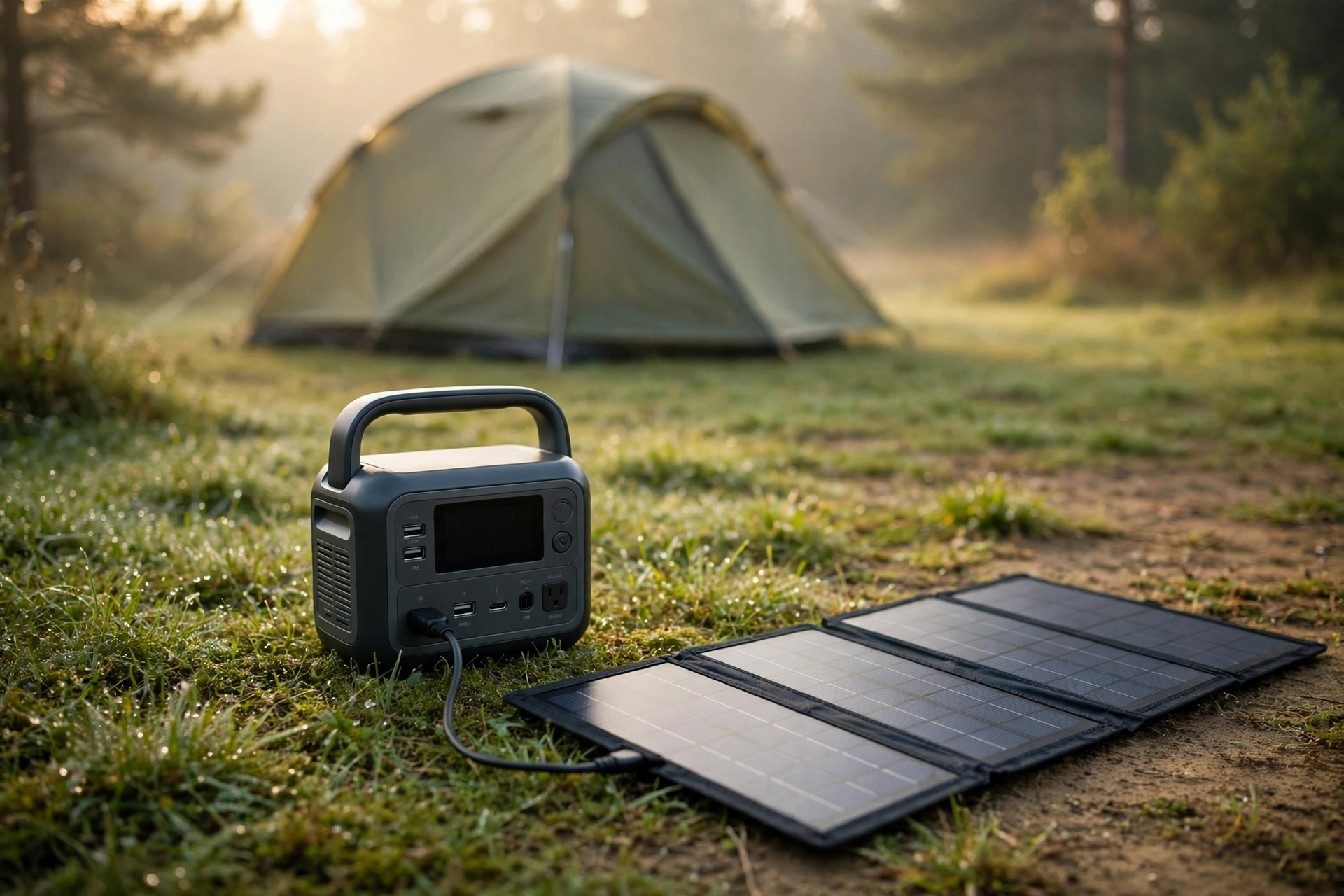
The short answer: the Explorer 300 you can buy today is a much better battery than the Explorer 300 of two years ago — but only if you get the right one. The current version pairs a 292Wh LiFePO4 battery with a 100W USB-C port, two AC outlets, and a 7.5 lb body for ≈$259–$289. The older lithium-ion version, still sold under the same name in some channels, has roughly one-fifth the cycle life and a weaker USB-C port for the same money. Everything below is about the current LiFePO4 version unless stated otherwise, and the first section tells you how to tell them apart.
Disclosure: this is a research review, not hands-on testing. Every figure below comes from Jackery’s published specs, its Amazon listing, and independent guides checked on October 31, 2026. We have not run this unit ourselves. There are no affiliate links on this page — prices link to the plain vendor store. See our disclosure for how the site is funded.
The naming mess, first — because it decides what you receive
Jackery has sold three different 300-class stations under nearly the same name, and its own pages mix their specs together. The store page for the “Explorer 300” headlines the new LiFePO4 version but still carries old-model body copy (293Wh, 60W USB-C) further down the same page. Before ordering, check three things:
- The listing title and bullets should say 292Wh and LiFePO4, with a USB-C port labelled 100W. If a listing says 293Wh, 60W USB-C, or Quick Charge 3.0, it is the older lithium-ion model.
- When it arrives, check the front panel. The LiFePO4 unit’s USB-C port is labelled “IN/OUT USB-C 100W” with two “USB-A 15W” ports below it; the older model reads “IN/OUT: PD 60W” with a Quick Charge 3.0 logo.
- Check the rating label on the unit for the watt-hour figure (292Wh or 293Wh) and the battery chemistry.
The other two names to know: the Explorer 300 Plus (288Wh LiFePO4, one AC outlet, app control) is the earlier LiFePO4 successor and is no longer sold new by Jackery US; the Explorer 300 v2 (288Wh LiFePO4, squarer body) is a separate model that was sold out on Jackery’s store at last check. Neither is the unit reviewed here.
| Version | Capacity | Battery | USB-C | AC outlets | Weight |
|---|---|---|---|---|---|
| Explorer 300, current (this review) | 292Wh | LiFePO4, 4,000+ cycles to 70% | 100W | 2 | 7.5 lb |
| Explorer 300, original | 293Wh | Lithium-ion, 800 cycles to 80% | 60W PD | 2 | 7.1 lb |
| Explorer 300 Plus | 288Wh | LiFePO4, 3,000 cycles to 80% | 100W class | 1 | ≈8.3 lb |
| Explorer 300 v2 | 288Wh | LiFePO4, 4,000+ cycles | 100W | 2 | 8.1 lb |
Specs: what the current Explorer 300 actually is
A portable power station is three things in one box: a battery, an inverter that turns battery DC into household AC, and a charge controller that manages solar input. At 300Wh, the Explorer 300 is the smallest size where all three are genuinely useful — big enough for a weekend of small devices, far too small for a house.
| Spec | Explorer 300 (current LiFePO4 version) |
|---|---|
| Capacity | 292Wh |
| Battery | LiFePO4, 4,000+ cycles to 70% capacity |
| AC output | 300W continuous, 600W surge, 2 pure sine wave outlets |
| USB-C | 1 x 100W PD, works as input and output |
| USB-A | 2 x 15W |
| 12V car port | 120W (12V, 10A) |
| Solar charging | 80% in ≈2.8 hours with a 100W panel; ≈7.5 hours with a 40W panel |
| Wall charging | Not published for this version (the older model quoted 2.5 hours using its AC adapter plus a 60W USB-C charger together) |
| Maximum solar input | Not published |
| Weight | 7.5 lb, built-in carry handle |
| Noise | 36.4 dB (Jackery figure) |
| Operating temperature | −10 to 40 °C |
| Warranty | 5 years on Jackery’s store for the new version; 2 years on the Amazon listing |
| Price, October 31, 2026 | $289 on Jackery’s store; ≈$259 on Amazon, with bag and 40W-panel bundles higher |
Two gaps in that table are Jackery’s, not ours: the wall-charging time and maximum solar input for the LiFePO4 version are not published anywhere we found. The 100W USB-C input also accepts a laptop-style USB-C charger, which is a practical workaround for the missing wall-charging figure.
How long it runs things: the runtime math
Runtime estimates use usable energy, not rated energy: inverter and conversion losses leave roughly 85% of the rated watt-hours, so the Explorer 300 gives about 248 usable Wh. Runtime in hours is usable Wh divided by average load in watts. That is why a 300W-rated station does not run a 300W device for an hour — it runs it for about 50 minutes, and anything over 300W shuts the AC outlets off.
| Device | Average load | Runtime |
|---|---|---|
| Wi-Fi router | 10W | ≈24.8 hours |
| CPAP (humidifier off) | 8–20W | A full night or more |
| CPAP (conservative planning draw) | 40W | ≈6.2 hours |
| 12V cooler | 45W | ≈5.5 hours |
| Laptop | 60W | ≈4.1 hours |
| Mini fridge | 60W | ≈4.1 hours |
| 55-inch LED TV | 100W | ≈2.5 hours |
| Full-size fridge (cycling, conservative) | 150W | ≈1.7 hours, if its start-up surge stays under 600W |
The fridge row is the honest limit of this size class: 1.7 hours is less than the 4 hours a closed refrigerator keeps food safe with no power at all, and a full-size compressor can pull more than 600W for a moment when it starts. For a CPAP, the 12V car port is the better connection — running from DC skips most of the inverter loss the 0.85 factor accounts for. A window AC (≈450W), a sump pump, a space heater, a microwave, and a hair dryer all exceed the 300W limit outright.
Solar charging: good speed, thin documentation
On paper the solar story is strong: 80% in about 2.8 hours from a 100W panel means one good solar day refills the station, since a 100W panel at roughly 75% of rating across 5 peak sun hours delivers about 375Wh — more than one full charge. The 40W panel option, at 7.5 hours to 80%, is a slow trickle by comparison and only makes sense as a bundled travel panel.
The catch is compatibility checking. Jackery’s own Amazon listing for the SolarSaga 100W Air says that panel is not compatible with the Explorer 300 / 300 v2 series and can trigger an input voltage error (code F7). The safe route is a panel whose listing names the Explorer 300 as compatible, or Jackery’s matched bundle with its 40W panel. Do not assume any panel with the right wattage will work — voltage windows, not wattage, decide compatibility, and this station’s unpublished maximum solar input makes that check harder than it should be.
What owners report
Owner ratings aggregate both versions of this station, so treat them as a brand-and-design signal rather than a verdict on the LiFePO4 unit alone. Amazon buyers rate the Explorer 300 listing 4.6 out of 5 across more than 11,000 ratings, and Jackery’s own store shows 4.88 out of 5 across 76 reviews. The recurring owner themes in published roundups are consistent with the spec sheet: genuinely one-hand portable, quiet enough for a tent, and simple to operate — with the 300W ceiling the most common reason owners outgrow it. Our EcoFlow vs Jackery guide covers how Jackery’s simplicity-first approach compares with EcoFlow’s faster-charging, expandable line.
Explorer 300 vs its 300Wh rivals
Every rival below is also LiFePO4, so the chemistry advantage that defined the original Explorer 300’s weakness is gone — the comparison now turns on output, charging speed, warranty, and weight. Prices checked October 2026; all move with promotions.
| Spec | Jackery Explorer 300 | Bluetti Elite 30 V2 | Anker Solix C300 | EcoFlow River 3 Plus |
|---|---|---|---|---|
| Price | ≈$259–$289 | $250–$280 | ≈$330 | ≈$299 |
| Capacity | 292Wh | 288Wh | 288Wh | 286Wh |
| Cycle rating | 4,000 to 70% | 3,000+ to 80% | 3,000 | 3,000 to 80% |
| AC output | 300W (600W surge), 2 outlets | 600W, 1,500W power lifting for resistive loads | 300W (600W surge), 3 outlets | 600W (1,200W surge), 3 outlets |
| USB-C | 1 x 100W | 1 x 100W | 2 x 140W, 1 x 15W | 1 x 100W |
| Wall charging | Not published | 80% in 45 minutes | 80% in 50 minutes | Full in 60 minutes |
| Solar input | Not published (100W panel quoted) | 200W | 100W panel recommended | 220W |
| UPS switchover | Not stated | 10 ms or less | 10 ms | Under 10 ms |
| Expandable | No | No | No | Yes, to 858Wh |
| Weight | 7.5 lb | ≈9.5 lb | ≈9.1 lb | 10.4 lb |
| Warranty | 2 years (Amazon) / 5 years (Jackery store) | 5 years | 5 years | 5 years |
On paper the Explorer 300 wins two rows: it is the lightest by about 1.6 lb and carries the highest cycle rating, though Jackery counts cycles to 70% capacity while the others count to 80%, so the ratings are not directly comparable. It loses most of the others. The Bluetti Elite 30 V2 costs the same or less, doubles the continuous AC output to 600W, adds a 10 ms UPS and a 45-minute charge to 80%, and comes with a 5-year warranty, at 2 lb more. The Anker Solix C300 is the one for laptop users: two 140W USB-C ports and a third AC outlet, for roughly $40–$70 more. The EcoFlow River 3 Plus is the only one of the four that takes an extra battery, and it also runs 600W. If weight is what you notice most — a hike to a campsite, a small vehicle — the Explorer 300 is still the pick. If the station will mostly sit at home as a router and phone backup, the Elite 30 V2’s UPS and 600W inverter make it the better tool for the money. For a first station on a tight budget, our portable power station under $300 guide puts this size class in context.
Who should buy it, and who should skip it
Buy it if: you want a light power station for phones, laptops, cameras, a 12V cooler, or a CPAP on a camping night; you need a router and lights through a short outage; you value a brand with wide US support; or you are buying a first station and want the cheapest credible LiFePO4 entry point.
Skip it if: you need to run a refrigerator or anything over 300W (look at 1 kWh stations such as the Explorer 1000 v2, covered in our upcoming review); you need two or more CPAP nights without recharging; you want UPS switchover for a home office; or you want an expansion path — this capacity is permanent.
The bottom line
The current Explorer 300 earns its place as a camping and short-outage station: lightest in its class, a battery rated for a decade of regular use, and a price that undercuts most LiFePO4 rivals. Its weaknesses are documentation, not hardware — unpublished wall-charging time and solar input, a listing that mixes two generations, and a warranty that reads 2 years in one channel and 5 in another. Verify the LiFePO4 version before you buy, confirm panel compatibility before you pair it with solar, and accept the 300W ceiling for what it is. Bought on those terms, it is a good first power station; bought blind, the same name can still deliver the older battery.