
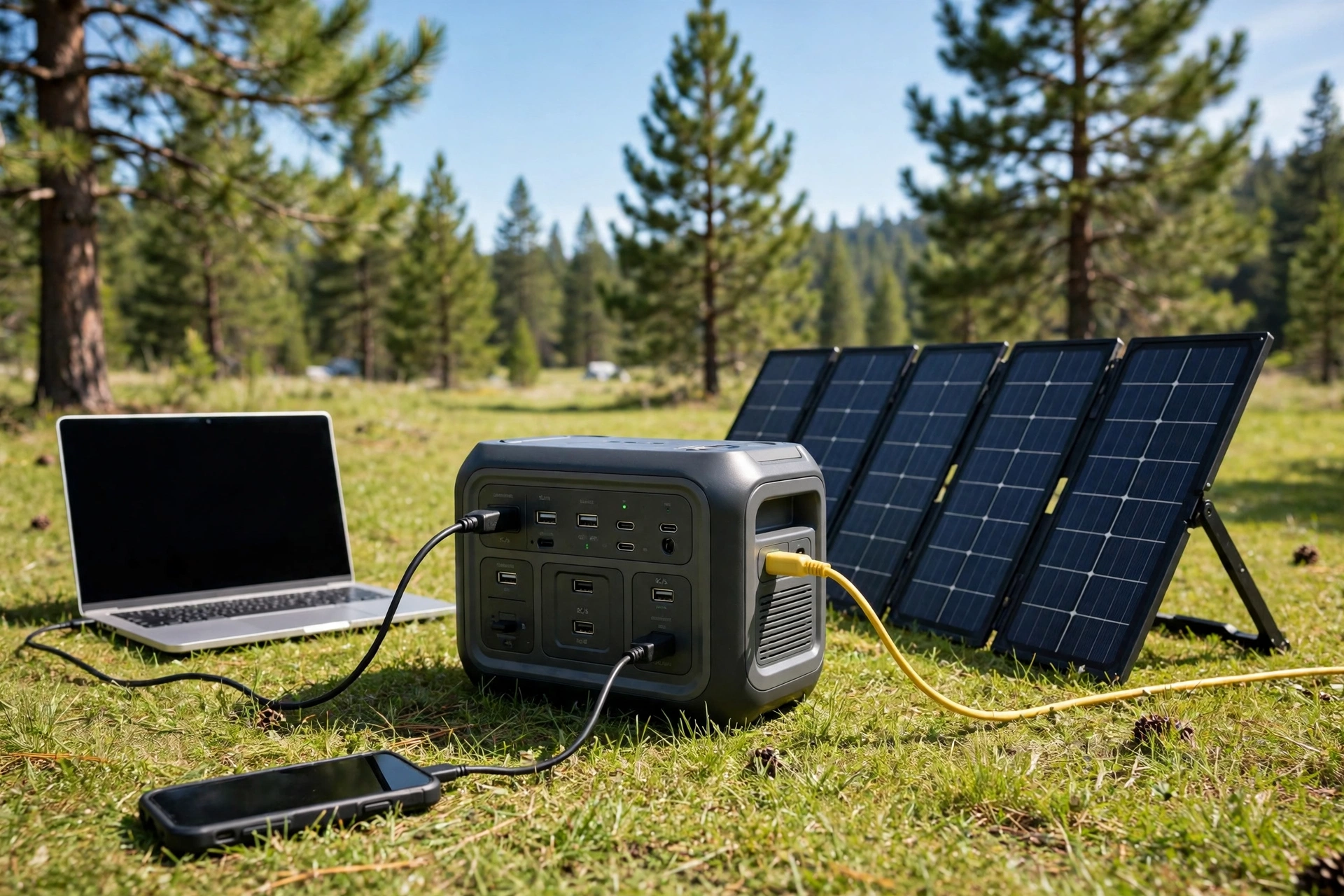
The short answer: the best portable power station under $300 is the Jackery Explorer 300 Plus — 288Wh and a 300W inverter for about $279, with LiFePO4 cells rated for 3,000 cycles and a 100W USB-C port that charges a laptop directly. If you need more AC muscle, the Bluetti EB3A gives you a 600W inverter for about $199 to $240. If price is everything, the EcoFlow River 2 at about $189 covers the same small-electronics job for the least money.
Disclosure: we may earn a commission if you buy through links on this page — see our disclosure. The links here are plain manufacturer and retailer links with no affiliate tracking attached. Prices were checked against manufacturer and retailer sites in October 2026 and move often with sales, so treat every price below as a snapshot, not a quote.
This is a research roundup, not a hands-on test: picks rest on published specs, owner reports, and published measurements as of October 2026.
What watt-hours actually buy you at this size
A portable power station is three things in one box: a battery, an inverter that turns the battery’s DC into household AC, and a charge controller that manages solar input. Two numbers describe almost everything it can do, and confusing them is the most common buying mistake.
Watt-hours (Wh) are the size of the tank. A 288Wh station holds about four times the energy of a 70Wh power bank, so it runs the same load about four times as long. Watts (W) are the width of the tap. A 600W inverter can feed a 500W blender; a 300W inverter cannot, no matter how big the battery behind it is. Capacity decides how long, output decides what.
One correction: you never get the full rated watt-hours out — the inverter loses energy as heat and the battery keeps a reserve. Plan on about 85 percent being usable: a 288Wh station delivers about 245Wh, a 245Wh station about 208Wh. Every runtime below uses that 85 percent rule unless it is a manufacturer-published figure.
| Load | Draw | Runtime on a 288Wh station |
|---|---|---|
| 12V compressor fridge | 60W | About 4 hours |
| Laptop | 70W | About 3.5 hours |
| Phone charge | 11Wh per charge | About 22 charges |
| LED camp light | 9W | About 27 hours |
| CPAP, no humidifier | 40W | About 6 hours |
| Small fan | 30W | About 8 hours |
Inverter watts: the ceiling on what runs
The inverter sets the hard limit. Add up the watts of everything you want to run at once; pass the inverter’s continuous rating and the station shuts down or refuses the load.
- 300W (Jackery 300 Plus, Anker C300X, EcoFlow River 2): phones, laptops, lights, routers, camera batteries, a small fan. A desk’s worth of electronics, nothing with a heating element.
- 600W (Bluetti EB3A, Bluetti Elite 30 V2): the above, plus a blender, a small coffee maker, and a mini-fridge on AC — the point where a small station starts covering a kitchen counter.
Note the two numbers brands quote side by side. Continuous watts is what the inverter sustains; surge watts is what it tolerates for a few seconds while a motor starts — a fridge compressor or power tool can draw two to three times its running watts at startup. The Elite 30 V2’s “Power Lifting” 1,500W figure is a third kind: it pushes past the rating by dropping voltage for resistive loads like heaters. Treat that as a bonus for a kettle, not capacity to plan around: it does not work for motors or sensitive electronics.
LiFePO4 is now the default, even at $200
Every station here uses lithium iron phosphate (LiFePO4) cells — the single biggest change in budget power stations in recent years. The older nickel-manganese-cobalt (NMC) chemistry is typically rated for about 500 to 800 full cycles before capacity falls to 80 percent. LiFePO4 is rated for 2,500 to 3,000-plus cycles to 80 percent, roughly four to six times the life.
The mechanism is structural: LiFePO4’s crystal lattice barely changes shape as lithium moves in and out, so the cell degrades slowly, and it is far more thermally stable — which is why these stations can fast-charge at hundreds of watts. The trade-off is energy density, but at this size it barely shows: the heaviest station here is 10.1 lb. Treat the cycle figures with a sceptical eye, though — manufacturers test under lab conditions, and heat, deep discharges, and long storage shorten real life. Read “3,000 cycles” as “a different league from the 500-cycle packs,” not as a promise of 3,000 trips.
Watch out for the older models still on sale at this price. The original Jackery Explorer 300 (293Wh, NMC, 500 cycles, $199) and the original Bluetti EB3A’s predecessors still appear in search results and marketplace listings at similar prices to the picks below. Check for “Plus,” “V2,” or “LiFePO4” in the name before buying — the older chemistry is the one thing a cheap listing hides.
Solar recharge: the math
A power station earns the “solar generator” name only if it recharges from panels at a useful rate. A panel’s rated watts are measured under laboratory sun; in the field, expect about 70 to 75 percent in good sun, less with haze, heat, or a low angle. So recharge time is roughly capacity divided by panel watts times 0.7: a 288Wh station on a 100W panel refills in about 4 hours of good sun, while the same station on a 200W panel takes about 2 hours. Panel size, not battery size, is usually the bottleneck.
That is why the solar input column below matters as much as capacity: EB3A and Elite 30 V2, 200W; 300 Plus, C300X, and River 2, 100W. A 200W-capable station on a 100W panel wastes the station’s best feature; a 100W-max station on a 200W panel wastes the panel, since the station clips the extra watts. Match the panel to the input — see our portable solar panels hub.
The comparison
Prices are US dollars from manufacturer sites and major retailers as of October 2026. Several models list at $299 and only fit the budget on sale — the price column says so where that is the case.
| Model | Capacity | Inverter (continuous) | Battery | Solar input max | Weight | Price, Oct 2026 |
|---|---|---|---|---|---|---|
| Jackery Explorer 300 Plus | 288Wh | 300W | LiFePO4, 3,000 cycles | 100W | 7.8 lb | $299 list; about $245–$279 on sale |
| Bluetti EB3A | 268Wh | 600W | LiFePO4, 2,500+ cycles | 200W | 10.1 lb | $299 list; about $199–$240 on sale |
| Anker SOLIX C300X | 288Wh | 300W | LiFePO4, 3,000 cycles | 100W | 9.1 lb | $299 list; about $199 on sale |
| Bluetti Elite 30 V2 | 288Wh | 600W | LiFePO4, 3,000+ cycles | 200W | 9.4 lb | $289.99 list; about $219–$237 on sale |
| EcoFlow River 2 | 256Wh | 300W | LiFePO4, 3,000 cycles | 110W | 7.7 lb | $299 list; about $189 on sale |
Jackery Explorer 300 Plus — best overall
The most balanced station under $300: 288Wh, a 300W inverter with 600W surge, and LiFePO4 cells rated for 3,000 cycles, at 7.8 lb and about $279 on sale. It recharges from a wall outlet in about 2 hours, and its 100W USB-C port charges a laptop directly without the inverter — a real efficiency win, since every watt that skips the inverter is a watt that stays in the battery. Its EPS switchover is under 20 ms, so it holds a router or CPAP through a blackout without a reboot, and it supports pass-through charging, so it can charge and discharge at the same time.
The trade is the obvious one: 300W is the ceiling, so no blender and no coffee maker. In its favour: the lightest pick here, the deepest service history of any brand in this band, and a 3+2 year warranty — 5 years total when you register. Buy the Plus, not the original Explorer 300, a 293Wh NMC unit at $199 with 500 cycles and a 60W solar input. Check the current price on Jackery’s site.
Bluetti EB3A — best AC output
The muscle pick: 268Wh with a 600W inverter and 1,200W surge — double the AC ceiling of the Jackery, Anker, and EcoFlow picks — for about $199 to $240 on sale. Its 200W solar input is also the joint-highest here, so a 200W panel refills it in about 2 hours of good sun, and its 430W dual charging (AC plus solar together) reaches 80 percent in about 30 minutes. A 100W USB-C port and a 15W wireless charging pad round out a port set that punches above this price.
Compromises are modest: 2,500-plus cycles instead of 3,000, a 2-year warranty instead of 5, and at 10.1 lb it is the heaviest station here. Watch the price, though: Bluetti’s own store and retailers have listed this unit anywhere from $199 to $299 in 2026, so “about $199 to $240” is a snapshot of a moving sale price. Above $270, the Elite 30 V2 is the better buy. Check the current price on Bluetti’s site.
Anker SOLIX C300X — best for laptops and tech
The tech pick: 288Wh, a 300W inverter with 600W SurgePad, and LiFePO4 cells rated for 3,000 cycles, at 9.1 lb and about $199 on sale. Its party trick is the USB-C set: two 140W two-way ports that charge a laptop at full speed and recharge the station itself from a USB-C charger, plus a 15W port and a 12W USB-A. It recharges to 80 percent in 50 minutes from a wall outlet, runs at 25 dB — barely a whisper — and its 10 ms UPS switchover holds a router through a blackout.
The limit is the same 300W inverter as the Jackery, and its 100W solar input is the joint-lowest here, so solar is a slow top-up rather than a fast refill. Anker’s solar charging cable is sold separately, and the C300X only takes panels between 11 and 28V through an XT60 connector — check compatibility before buying a third-party panel. If your loads are mostly USB-C, this is the best $200 in the roundup. Check the current price at REI.
Bluetti Elite 30 V2 — best fast charging
The newest pick here, and the fastest to refill: 288Wh, a 600W inverter with 1,500W Power Lifting for resistive loads, and LiFePO4 cells rated for 3,000-plus cycles, at 9.4 lb and about $219 to $237 on sale. Its 380W AC input reaches 80 percent in 45 minutes and full in about 70, and its 200W solar input refills it in about 2.2 hours with a matched panel. A 140W USB-C port, a 10 ms UPS, and a 5-year warranty complete a spec sheet that reads like a station a class up.
The trade against the EB3A is price: the Elite 30 V2 costs about $20 to $40 more for the same 600W ceiling, and its advantage is speed and warranty rather than raw capability. If you recharge daily — a work-from-campsite setup, or a backup box that gets topped up between outages — the faster charging and longer warranty are worth it. If you recharge once a weekend, the EB3A on sale is the better value. Check the current price on Bluetti’s site.
EcoFlow River 2 — cheapest
The budget pick: 256Wh, a 300W inverter with X-Boost to 600W for resistive loads, and LiFePO4 cells rated for 3,000 cycles, at 7.7 lb and about $189 on sale. Its party trick is the recharge: 0 to 100 percent on AC in 60 minutes, the fastest wall recharge in this roundup, and its 110W solar input refills it in about 4 hours with a matched panel. At this price it is the cheapest way into a proper LiFePO4 station with a 5-year warranty.
The limit is capacity: 256Wh is the smallest tank here, about 11 percent less than the 288Wh picks, and a fridge plus a laptop empties it before dinner. If you can stretch to about $219, the River 3 adds a quieter design, an IP54 rating, and better low-load efficiency for the same 300W job. But if $189 is the budget, nothing else here is cheaper, and nothing cheaper is worth buying. Check the current price on EcoFlow’s site.
Sizing it to your loads
Start with a list, not a product page. For each item, multiply its watts by the hours a day it runs to get watt-hours per day, add the items up, then divide by 0.85 for inverter losses. That is your daily need; multiply by the days between recharges.
Example: phones and lights (100Wh), a laptop at 70W for 3 hours (210Wh), a router at 10W for 12 hours (120Wh) — about 430Wh per day, about 505Wh after losses. No single sub-$300 station covers a full day of that; the 288Wh Jackery covers about half a day. That is why the panel matters: a 100W panel adds about 350Wh on a good sunny day, stretching the station across the weekend. Without solar, size for the whole trip; with solar, size for a day.
Check the watts on the device itself, not the category: a “mini fridge” can mean a 40W compressor fridge or a 100W thermoelectric cooler, and the difference doubles your battery need. And remember the inverter ceiling: a station can hold the watt-hours for a job and still fail it if one load’s watts exceed the inverter.
What the sub-$300 band cannot do
No station under $300 will run a full-size home refrigerator for any useful length of time — a typical full-size fridge uses 1,000 to 1,500Wh per day, so even the 288Wh Jackery covers a couple of hours. None here will run a space heater, air conditioner, electric water heater, or well pump: a 1,500W heater empties a 288Wh station in about 10 minutes, and most of these stations cannot even start one. None powers a whole home, backs up a house through a multi-day outage, or runs a 240V appliance, and none replaces a built-in RV or cabin system for full-time living.
What the band does well is the portable job it was built for: a weekend of camping power for phones, laptops, and lights, a night of CPAP and communications through an outage, and a solar-fed base camp that refills itself each day. If your loads grow past that, step up to our best portable power station under $500 roundup — the 1,000Wh class is where home backup starts. Buy inside this band’s envelope and a $300 station is a genuinely capable tool; outside it, no amount of brand loyalty fixes the physics.
How to buy
- Check the price on the day. Every model here lists at about $299 and spends part of the year on sale, and the sale price is the real price — a “list $299” station at $199 is an under-$300 station; at $299 it is barely one.
- Check the variant name. Explorer 300 Plus, not Explorer 300. Elite 30 V2, not the original Elite 30. C300X, not C300 DC (which has no AC outlets at all). River 2, not River. The older variants are still listed, sometimes at similar prices, with older chemistry or lower output.
- Budget for the panel. The station is half the system: a 100 to 200W portable panel costs about $100 to $250, and without one the station is a battery you charge at home. See our portable solar panels hub for matched panels.
- Count your outlets. Two AC outlets covers a fridge and a laptop; the USB-C wattage matters too — a 140W port charges a laptop directly, a 15W port does not.
- Read the warranty terms, not just the years: the Anker, Bluetti Elite 30 V2, and EcoFlow carry 5 years, the Jackery 3+2 with registration, the EB3A 2 — but registration windows, battery coverage, and service location differ by brand.
Methodology
Compiled in October 2026 from manufacturer spec sheets and store pages (Jackery, Bluetti, Anker, EcoFlow), retailer listings (REI, Amazon), published runtimes, and owner reports. Capacities, inverter ratings, solar input maxima, weights, and cycle-life figures were checked against at least two sources each. Prices are US list and sale prices observed on manufacturer and retailer sites in October 2026; they change frequently, so list and sale prices are stated separately where they differ. No unit was hands-on tested, and no runtime here comes from our own measurement — runtimes are manufacturer-published or calculated from the 85 percent rule above. If a figure here disagrees with a manufacturer’s current page, that page wins; check it before buying.