
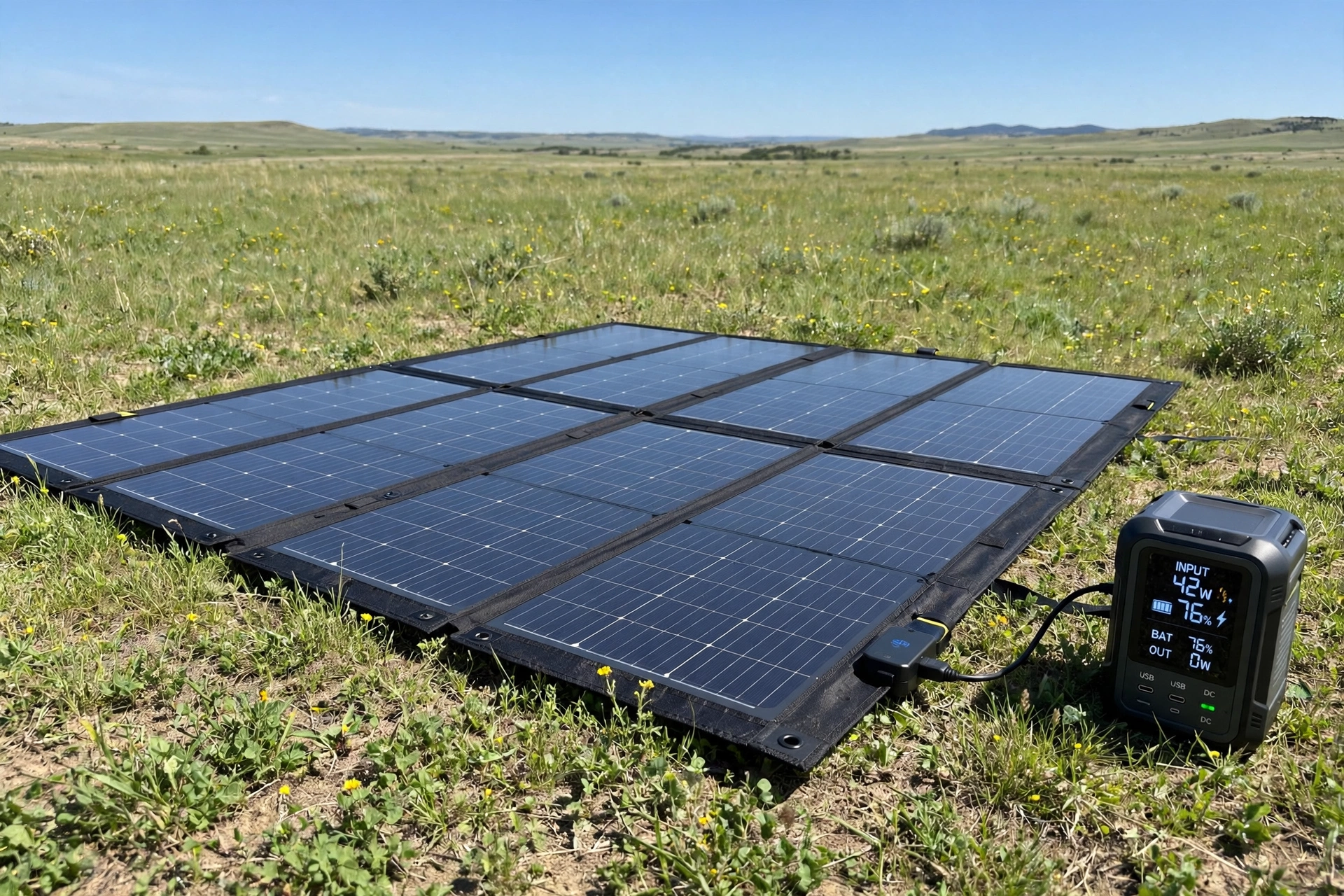
The short answer: the best portable solar panel for most people is the EcoFlow NextGen 220W Bifacial, at about $399. It has the highest rated output of any mainstream folding panel, the highest measured output in independent testing (193W from a 220W rating), and it folds to a 24-inch square that fits in a car boot or RV locker. If you want the cheapest capable 200W panel, the BLUETTI PV200 at about $329 is the value pick. If you carry your panel on foot, the 7.1 lb Jackery SolarSaga 100 Air is the one to buy.
Disclosure: Powered by Solar Panels is reader-supported. If you buy through a link on this page, we may earn a commission at no extra cost to you. Read our full affiliate disclosure. Our picks are decided from published specs, owner reports, and independent measurements — never from commission rates.
How we researched this: we did not test these panels hands-on. This guide compares manufacturer-published specifications, owner reports, and independent measurements published by OutdoorGearLab and Top Notch Outdoor, as of October 2026. Prices are from the manufacturers’ US stores in late October 2026 and change often, so check the live price before you buy. Every panel below is a portable, folding, or suitcase panel for camping, RV, and off-grid use — not a rooftop system.
Why a “200W” panel rarely delivers 200W
A panel’s wattage is measured under Standard Test Conditions: exactly 1,000 watts of sunlight per square metre, falling on a cell held at 25°C, with the light striking dead perpendicular.
Three things eat into the number. First, heat. A solar cell’s output falls as it gets hotter — typically about 0.25 to 0.3 percent per degree above 25°C — and a dark panel lying in full sun easily runs at 55 to 65°C. That alone costs 10 percent or more. Second, angle. The sun is only directly overhead for a short window around noon, and a panel laid flat loses output steeply as the sun drops; tilting the panel toward the sun matters more than most buyers expect, which is why the better folding panels have adjustable kickstands. Third, the sky itself: haze, thin cloud, dust on the surface, and a single shaded cell string can cut output by a third or more.
The measurements back this up. OutdoorGearLab measured 193W from the EcoFlow 220W, 177W from a Renogy 200W folding panel, 171W from the Jackery SolarSaga 200W, and 166W from the Anker SOLIX PS200 — that is 83 to 88 percent of rated watts, at solar noon, on a clear day, with the panels aimed properly. So plan your system on 70 to 85 percent of the rated watts at midday, and much less in the morning, in cloud, or laid flat. A 200W panel showing 150 to 180W on your power station’s display at noon is behaving normally, not broken.
Monocrystalline, TOPCon, and bifacial: what the cell terms actually mean
Nearly every portable panel worth buying today uses monocrystalline silicon cells: single-crystal silicon, which converts more sunlight per square inch than the older polycrystalline type and holds up better in low light.
Within monocrystalline, two newer variants matter. PERC adds a reflective layer behind the cell so light that passes through gets a second chance — the standard for the last several years. TOPCon and other N-type cells use a different silicon doping that loses less energy to heat and holds voltage better on hot days; EcoFlow’s NextGen panels and the current Anker PS200 use N-type cells, claiming about 25 percent conversion efficiency against about 23 percent for good PERC panels. The difference is a few percent of output, not a different league — but N-type is the direction the market is moving, and it is worth having at the same price.
Bifacial means the panel has active cells on both faces. The rear face catches light reflected off the ground, and manufacturers quote a second, lower wattage for it (the EcoFlow 220W is rated 220W front and 175W rear). The catch is that the rear face only earns its keep over a bright, reflective surface — sand, snow, concrete, light gravel. Laid on dark grass or forest soil, it adds almost nothing. Judge every bifacial panel on its front-side rating and treat the rear as a bonus.
ETFE lamination is the other term worth knowing. The clear layer over the cells on a folding panel is either PET plastic or ETFE fluoropolymer. ETFE lets more light through, resists yellowing and scratching better, and handles heat better — which is why Jackery, BLUETTI, and EcoFlow all use it on their folding panels.
Folding panels, suitcases, and blankets: three shapes, three jobs
Folding panels are the default: rigid cell sections hinged in a fabric case, with a kickstand. They fold to roughly a 24-inch square, weigh 11 to 16 lb at 200W, and suit charging a power station at a campsite. Suitcase panels are two rigid glass panels hinged like a briefcase, usually sold as a kit with a charge controller. The Renogy 200W suitcase weighs 28.5 lb — about double a folder — but charges a 12V battery directly with no power station in between, which is the RV use case. Blanket panels are fully flexible sheets that fold into a soft package and give the lightest watts per pound, but they need a flat surface, have no useful kickstand, and cost more per watt.
Connectors and compatibility: the part buyers skip, then regret
A portable panel produces DC electricity, and it has to get into your power station or battery through a plug — and there is no single standard. Most folding panels terminate in MC4 connectors, the universal solar plug. But the big power-station brands each add their own flavour. Jackery panels use a DC8020 plug (with a DC7909 adapter for older Jackery stations). EcoFlow panels ship with an XT60 or XT60i cable. Anker’s PS200 ships with MC4 cables plus an XT-60i adapter for Anker stations.
Two electrical limits matter more than the plug. First, the panel’s open-circuit voltage (Voc) must stay below your power station’s maximum solar input voltage — exceed it and you can damage the station’s charge controller. Second, the station’s maximum solar input watts caps what it will accept: a station rated for 200W of solar will not charge faster from a 400W panel. Check both numbers on the station’s spec sheet before buying a second panel.
The best portable solar panels, compared
Prices are from the manufacturers’ US stores in late October 2026; sale prices move often. Weights and folded sizes are manufacturer-published specs.
| Panel | Rated watts | Weight | Folded size | Cell type | Price |
|---|---|---|---|---|---|
| EcoFlow NextGen 220W Bifacial | 220W front / 175W rear | 15.4 lb | 24.2 × 23.2 in | N-type TOPCon monocrystalline, bifacial | $399 |
| Jackery SolarSaga 200W | 200W | 14.33 lb | 24.2 × 21.7 in | Monocrystalline, bifacial, ETFE | $379 (reg. $429) |
| Anker SOLIX PS200 | 200W | 11 lb | 27.0 × 31.2 in | N-type monocrystalline, bifacial | $499.99 list; $399.99 at Anker’s store in late Oct 2026 |
| BLUETTI PV200 | 200W | 16.1 lb | 23.2 × 24.8 in | Monocrystalline, ETFE | $329 (reg. $499) |
| Renogy 200W Portable Solar Suitcase | 200W | 28.5 lb | 34.3 × 22.8 in | Monocrystalline | $322.99 (includes 20A PWM controller) |
| Jackery SolarSaga 100 Air | 100W | 7.1 lb | 17.1 × 16.7 in | PERC monocrystalline, bifacial | $249 (reg. $299) |
The picks in detail
Best overall: EcoFlow NextGen 220W Bifacial — $399
The highest rated watts here and the highest measured watts: OutdoorGearLab recorded 193W, and Top Notch Outdoor recorded 194W at altitude — both the best raw output of any folding panel either tester measured. The N-type TOPCon cells, 25 percent claimed efficiency, IP68 waterproofing, and an integrated adjustable stand with a solar angle guide round out a strong package. The weak points are real but minor: the US warranty is only 12 months, shorter than Jackery’s and Anker’s, and it connects via photovoltaic (MC4-style) connectors with an XT60i cable, so non-EcoFlow stations may need an adapter. It pairs naturally with EcoFlow stations — its 220W rating exactly matches the solar input limit of the River 3 Plus — but it is the best folder on output alone, whatever station you own.
Best for Jackery owners: Jackery SolarSaga 200W — $379
The default panel if you own a Jackery Explorer 1000 v2 or 2000 v2: it plugs straight in with no adapter, and two of them hit those stations’ 400W solar limit. OutdoorGearLab measured 171W and called it one of the most consistent folding panels they tested. It is IP68 rated, ETFE-laminated, and carries Jackery’s 3-plus-2-year warranty — the longest here. It also has USB-A and USB-C ports on the panel itself, so you can charge a phone directly without the power station in the loop. Buy it if you own a Jackery; otherwise the EcoFlow or BLUETTI gives you more for the money.
Lightest 200W panel: Anker SOLIX PS200 — $399.99 to $499.99
At about 11 lb including the stand, the current bifacial PS200 is the lightest 200W folder on the market — over 30 percent lighter than a typical 200W panel, according to Anker — with N-type cells, a claimed 25 percent-plus efficiency, and an IP68 rating. OutdoorGearLab measured 166W from it, a little behind the EcoFlow and Jackery on raw output, but the weight saving is the point: this is the 200W panel to carry any distance from the car. Two cautions. First, Anker revised this panel, and older listings describe the previous version (23 percent efficiency, IP67, about 20 lb) — check that the listing says bifacial and IP68 before buying. Second, the price moves: Anker’s own US store listed it at $399.99 in late October 2026 while other retailers showed $499.99.
Best value 200W: BLUETTI PV200 — $329
The cheapest way to get an honest 200W of folding panel from a major brand: $329 on sale against a $499 list price, with ETFE lamination, monocrystalline cells at a claimed 23.4 percent efficiency, a standard MC4 connector that pairs with almost any station or charge controller, and an IP67 rating. The trade-offs are weight — 16.1 lb, the heaviest folder here — and a short 12-month warranty.
Best for charging a 12V battery: Renogy 200W Portable Solar Suitcase — $322.99
The only panel here that is a kit, not just a panel: the suitcase ships with a Voyager 20A PWM charge controller pre-installed, plus alligator-clip cables, so it charges a 12V leisure or RV battery directly with no power station involved. That is the use case it is built for, and at $322.99 including the controller it is good value for it. The cost is portability: 28.5 lb of glass and aluminium, folding to a 34-inch case. This is not a panel you carry to a picnic table; it is a panel that lives in an RV locker and comes out at the campsite.
Best lightweight panel: Jackery SolarSaga 100 Air — $249
Half the watts, half the weight, and the right answer when the load is phones, tablets, lights, and a laptop rather than a fridge. At 7.1 lb it folds to about 17 × 17 inches, it is IP68 rated and bifacial (rated 100W front, 110W under bifacial test conditions), and it has USB-A and USB-C ports built in for direct device charging. Buy the 100 Air when you carry the panel on foot or in a day pack; buy a 200W panel when the panel rides in a vehicle.
How to size a panel to your power station
Sizing is arithmetic, not guesswork. Start from the battery you need to refill, then work backwards through the losses.
A panel’s daily harvest is roughly its rated watts, times the peak sun hours where you camp, times a real-world factor of about 0.7 to 0.75. Most of the US gets 4 to 5 peak sun hours on a clear summer day, so a 200W panel yields about 560 to 750Wh a day, and a 100W panel about 280 to 375Wh. Compare that with the station: a 500Wh station refills in a day from a 200W panel; a 1,000Wh station needs about a day and a half of good sun from one 200W panel, or a day from two.
Then check the station’s solar input limit, which caps the useful panel size. Common limits: 200W for small stations, 400W for 1kWh-class stations, 500W and up for larger ones. Buying panel watts above that limit buys nothing — the station simply refuses the extra power. If your station’s limit is 400W, two 200W panels in parallel is the ceiling; if it is 200W, one panel is all you will ever use, and your money is better spent on a bigger battery.
| Use | Panel | Station | Why |
|---|---|---|---|
| Phones, lights, laptop for a weekend | 100W (Jackery 100 Air) | 300–500Wh | Light to carry; a day of sun covers the load |
| General camping, lights plus a small fridge | 200W folder | 500–1,000Wh | One panel refills the station in a day of good sun |
| RV or off-grid cabin, fridge plus daily use | 2 × 200W | 1,000–2,000Wh | Covers a fridge’s daily draw with margin for cloud |
| Backup power at home during an outage | 200–400W | 1,000Wh or larger | Recharges the station while the sun is out; size the station to the essentials you must keep running |
| Charging a 12V RV battery directly | Renogy 200W suitcase kit | 12V leisure battery | Controller included; no power station needed |
What to check before you buy
- Folded size against your storage. A 200W folder is about a 24-inch square; the Anker folds to 27 × 31 inches and the Renogy suitcase to 34 inches. Measure the locker or boot first.
- Weight against how far you carry it. Car camping tolerates 16 lb; anything on foot wants the 7 lb 100W panel or the 11 lb Anker.
- The connector your station needs. Same-brand pairing is plug-and-play; cross-brand needs an adapter cable, which the panel maker usually sells separately.
- Voc and max solar watts on your station’s spec sheet. Never exceed the voltage limit; watts above the limit are wasted.
- The warranty. Jackery offers 3-plus-2 years and Anker 5 years on the current PS200; EcoFlow and BLUETTI offer 12 months on the panels here.
Browse the full range in our solar panels hub, where we cover the panel types, kits, and charging guides that go with the panels above.