
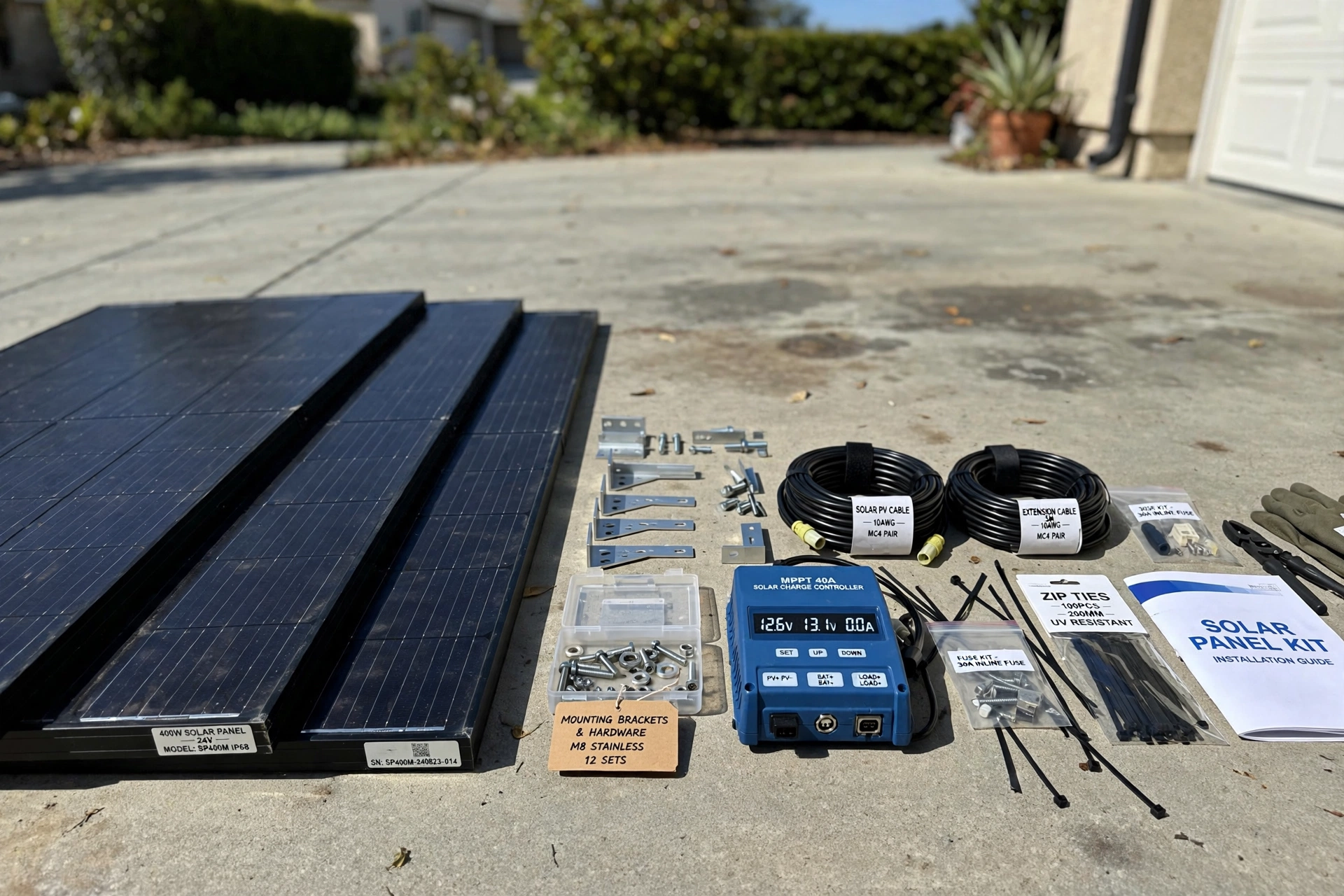
The best solar panel kit for most DIY, RV and off-grid buyers is the Renogy 200W Portable Solar Panel Suitcase Kit. It is the only kit in this roundup that needs nothing else to start charging a 12V battery: fold-out panels, a pre-installed controller and alligator clips, at about $290 to $323. If you want a fixed roof or cabin system instead, the best value is the ECO-WORTHY 400W MPPT kit at about $400 to $430, and the most expandable is Renogy’s 400W off-grid kit with the Rover 40A MPPT controller.
Disclosure: we may earn a commission if you buy through links on this page. See our disclosure for how that works. We have no affiliate agreements in place yet, so the links below go directly to manufacturers and retailers.
How this roundup was researched: we compared published specifications, manuals, retailer listings and owner reports as of October 2026. We did not test these kits hands-on. Prices are the list or sale prices we found on the manufacturers’ own stores and authorised dealers in October 2026 — solar kit prices move with sales, so treat every figure as a snapshot, not a quote.
What a solar panel kit actually is
A kit is four things sold as one matched set: panels, a charge controller, wiring, and mounting hardware. The panels turn sunlight into DC electricity. The charge controller sits between the panels and the battery and decides how that electricity is delivered. The wiring connects the pieces. The mounts hold the panels where the sun is.
The controller is the part beginners underestimate. A solar panel in full sun puts out about 18 to 22 volts, but a 12V battery charges at about 13 to 14.5 volts. Connect a panel straight to a battery and two things go wrong: the panel’s voltage is higher than the battery wants, and nothing stops the battery from overcharging once it is full. The controller fixes both. It steps the voltage down, follows a charging profile (bulk, then absorption, then float), and cuts off before the battery is damaged. Without it, you have a panel and a ruined battery.
That is also why buying a kit beats buying the pieces separately for a first system. The failure mode of a self-assembled system is almost always a mismatch: a controller rated for fewer amps than the panels can produce, cables too thin for the current, or panel voltage outside the controller’s input range. A kit’s manufacturer has already done that matching.
How to size a kit in watts
Sizing starts from the battery and the loads, not from the panel. The chain runs backwards:
- List your daily loads in watt-hours. A phone charge is about 10Wh, a laptop about 50Wh, a 12V compressor fridge about 400 to 600Wh a day, LED lights about 20Wh. Add them up.
- Divide by peak sun hours. Most of the US gets about 4 to 5 peak sun hours a day — the equivalent of full noon sun, spread across the day. 1,000Wh of daily loads divided by 5 sun hours means you need about 200W of panels.
- Discount for real conditions. Panels are rated in a lab at 25°C with perfect sun. Heat, haze, dust and a flat mounting angle all cost output, so plan on 70 to 80 percent of the lab rating in practice.
- Match the battery. A 100Ah 12V lithium battery holds about 1,280Wh. A 200W kit refills it from half-empty in about a day of good sun; a 400W kit does it in about half a day.
The short version: 100W keeps a small battery topped up for lights and phones. 200W runs a weekend RV or a shed with a fridge. 400W is the comfortable full-time RV and small-cabin size.
MPPT vs PWM: the controller inside the kit
Every kit in this roundup ships with one of two controller types, and the difference is a mechanism worth understanding before you compare prices.
A PWM (pulse-width modulation) controller connects the panel to the battery almost directly and chops the connection on and off to hold the right average voltage. When the panel’s voltage is close to the battery’s — a single 12V panel on a 12V battery — that works fine, and PWM controllers are cheap and reliable. The waste appears when panel voltage is well above battery voltage: a panel making 18V at 11A is producing about 200W, but the battery only takes 13V, so the extra voltage is simply lost as heat.
An MPPT (maximum power point tracking) controller is a DC-to-DC converter. It takes the panel’s full voltage and current, then converts the excess voltage into extra charging current. That same 200W panel delivers close to its full 200W into the battery. The gain is about 20 to 30 percent in bright, cold conditions, and larger when panels are wired in series at higher voltage. MPPT costs more — typically $100-plus extra in a kit — and it earns that premium on kits above 200W, on series-wired arrays, and anywhere the weather is cold and sunny.
The practical rule: PWM is fine at 200W and below with a single panel or parallel panels. MPPT is the right choice at 400W.
The six best solar panel kits compared
| Kit | Total watts | Controller | Battery compatibility | What’s included | Price, Oct 2026 |
|---|---|---|---|---|---|
| Renogy 100W Starter Kit | 100W | Wanderer 30A PWM | 12V sealed, gel, flooded, lithium | 1 panel, controller, 20ft cables, tray cables, Z-brackets | About $140–170 |
| Renogy 200W Portable Suitcase Kit | 200W | Voyager 20A PWM (pre-installed) | 12V sealed, gel, flooded, lithium | 2 folding panels, controller, alligator-clip cable | About $290–323 |
| DOKIO 300W Foldable Kit | 300W | Standalone PWM with USB | 12V batteries, power stations | Folding panel, controller, SAE/XT60/alligator clips, adapters, 9.8ft cable, bag | About $255–270 |
| Jackery SolarSaga 200W | 200W | None — uses power station’s built-in MPPT | Jackery power stations | Folding bifacial panel, 3m cable, DC adapter | $379 (list $429) |
| ECO-WORTHY 400W MPPT Kit | 400W | 40A MPPT, Bluetooth | 12V lead-acid and lithium | 4 panels, controller, 16ft cables, Y branches, Z-brackets | About $400–430 |
| Renogy 400W Off-Grid Kit | 400W | Rover 40A MPPT | 12V/24V sealed, gel, flooded, lithium | 4 panels (or 2×200W), controller, cables, mounts | $699.99 |
Prices are the figures we found on manufacturer stores and authorised dealers in October 2026. The ECO-WORTHY kit was listed as sold out on the manufacturer’s own store when we checked, and its price moves between about $400 and $430 with sales — check availability before planning around it.
The kits in detail
Best overall: Renogy 200W Portable Solar Panel Suitcase Kit
Two 100W N-type panels fold into a suitcase with the Voyager 20A PWM controller already mounted on the back. Unfold it, point the adjustable kickstands at the sun, clip the alligator leads to a 12V battery, and it charges. Renogy rates the cells at up to 25 percent efficiency and claims about 1kWh a day from 5 hours of sun, which matches the sizing math in the section above. At 28.5 pounds it stores flat and moves easily around a campsite or RV pad. The weakness is the same as its strength: PWM charging and alligator clips are a portable setup, not a permanent one. If the panels will live on a roof, buy a fixed kit instead.
Best first kit: Renogy 100W Starter Kit
The cheapest honest entry point. One 100W monocrystalline panel, a Wanderer 30A PWM controller, 20ft of 10AWG adaptor cable, tray cables and Z-brackets — everything a first system needs except the battery. The 30A controller is the smart part of this kit: it handles up to 400W of panels on a 12V battery, so you can add three more 100W panels later without replacing anything. Renogy claims about 500Wh a day from 5 hours of sun, enough for lights, phones and a laptop on a small battery. Buy this one if you are learning solar on a shed, a boat or a small camper and expect to expand.
Best lightweight portable: DOKIO 300W Foldable Kit
The most watts per pound in this roundup: 300W of folding monocrystalline panel at 15.2 pounds, with a standalone PWM controller, dual USB ports, and adapters covering SAE, XT60 and alligator clips plus four DC barrel sizes. The 9.8ft cable lets you park the panel in full sun while the controller and battery stay shaded. Two honest caveats: the fabric-backed folding panel is weather-resistant rather than weatherproof — DOKIO itself warns against leaving it in heavy rain — and the price varies by seller, running about $255 to $270 from Amazon sellers at the time we checked. Best for car camping, van life and emergency backup where the panel gets packed away after use.
Best for power stations: Jackery SolarSaga 200W
This one is a panel, not a full kit, and it belongs here because power-station owners search for kits and this is the matching piece. The SolarSaga 200W is a bifacial folding panel — it collects light on both faces — rated at 25 percent conversion efficiency with an IP68 waterproof rating, under 15 pounds. It has no separate charge controller because it does not need one: the Jackery power station it plugs into already contains an MPPT controller. That is the point to understand before buying. If you own a Jackery Explorer, this is the cleanest solar add-on. If you are charging a standalone 12V battery, buy a kit with its own controller instead. Watch out for the older SolarSaga 200 still listed at some retailers with an IP67 rating; the current bifacial version is the one at $379 on Jackery’s own store.
Best budget fixed kit: ECO-WORTHY 400W MPPT Kit
Four 100W monocrystalline panels with a 40A MPPT controller, 16ft cables with Y branches, Z-brackets and a Bluetooth module for phone monitoring — at about $400 to $430, roughly half the price of Renogy’s equivalent fixed kit. ECO-WORTHY claims about 1.6kWh a day and rates the controller’s tracking efficiency at 99 percent, against about 40 percent more harvest than a PWM controller on the same array. The panels are 21 percent efficient, a step below Renogy’s N-type cells, and the brand’s support and documentation are thinner than Renogy’s. But on watts per dollar for a fixed RV roof or cabin install, nothing else in this roundup comes close. Note the availability caveat above: it was sold out on the ECO-WORTHY store when we checked in October 2026.
Best expandable fixed kit: Renogy 400W Off-Grid Kit
The same 400W of panels as the ECO-WORTHY kit, but built around the Rover 40A MPPT controller with a 100V maximum PV input and 520W of headroom on a 12V battery, plus Renogy’s deeper documentation, app support and dealer network. The base configuration — panels, controller, cables and mounts, no battery or inverter — is $699.99 on Renogy’s store, and the kit is sold in configurable bundles that add lithium batteries and a 2,000W pure sine wave inverter. Buy this one if you want a fixed system you will expand later, or if you value the support network over the lowest price.
RV vs cabin vs portable: which shape fits
The six kits above fall into three shapes, and the shape matters more than the brand.
Portable folding kits (Renogy suitcase, DOKIO, SolarSaga) are for people who move. You set them up when you arrive and pack them away when you leave. They suit weekend camping, van life, and RV owners who park in shade and want to place panels in the sun instead. Their limit is setup effort and weather exposure: folding panels are not meant to live outside permanently.
Fixed roof kits (both 400W kits, the 100W starter) are for panels that stay put. Once mounted, they charge every day with no setup, which is what you want on an RV roof, a cabin, a shed or a boat. Measure the roof before buying: four 100W panels need about 22 square feet, and a panel in partial shade produces far less than its rating.
Complete kits with battery and inverter are a third shape: ECO-WORTHY sells a 400W bundle with a 100Ah lithium battery and a 1,100W inverter for about $720, and Renogy’s configurable 400W bundles go further. These make sense if you want AC power without sourcing a battery and inverter separately. They cost roughly twice the panels-and-controller price for the same wattage, and the battery is the part you will replace first, so weigh the convenience against being locked into the bundled battery.
What to check before you buy
- Roof or ground space. Four 100W rigid panels are about 41 × 21 inches each. Measure first, then buy. A folding kit sidesteps this entirely.
- Controller amperage. Divide total panel watts by battery volts: 400W on a 12V battery is about 33A, so a 40A controller has comfortable headroom. A controller run at its limit all day runs hot and shortens its own life.
- Wiring length and gauge. Longer cable runs lose more power. The kits here include 10AWG cable up to 20ft, which is adequate at these wattages; if your panels will sit more than 20ft from the battery, budget for thicker cable or accept the loss.
- Battery chemistry setting. Lithium (LiFePO4) and lead-acid charge at different voltages. Every controller in this roundup has a lithium setting — confirm it is selected before first use, because the wrong profile either undercharges lithium or overcharges lead-acid.
- What is not included. Most kits are panels plus controller plus hardware. The battery, the inverter and the battery cables are usually separate. A 400W kit plus a 100Ah lithium battery is a complete small system; the kit alone is half of one.
- Expansion headroom. If you might add panels, check the controller’s maximum PV input power now. The Renogy 100W starter kit’s 30A controller accepts up to 400W; the Rover 40A accepts up to 520W on 12V. Buying headroom once is cheaper than buying a second controller later.
The bottom line
Start from your daily watt-hours, divide by 4 to 5 sun hours, and buy that many watts — then round up one size. For most first-time DIY, RV and off-grid buyers that lands on the Renogy 200W suitcase kit: complete, portable, and expandable later with a second suitcase or a fixed array. If the panels are going on a roof and staying there, the ECO-WORTHY 400W MPPT kit is the value pick and the Renogy 400W off-grid kit is the expandable one.
For the panel-only side of the same decision, see our Solar Panels hub. If your next question is the controller itself, our Charge Controllers hub covers MPPT vs PWM in more depth, and the Batteries & Storage hub covers what to pair with these kits.