
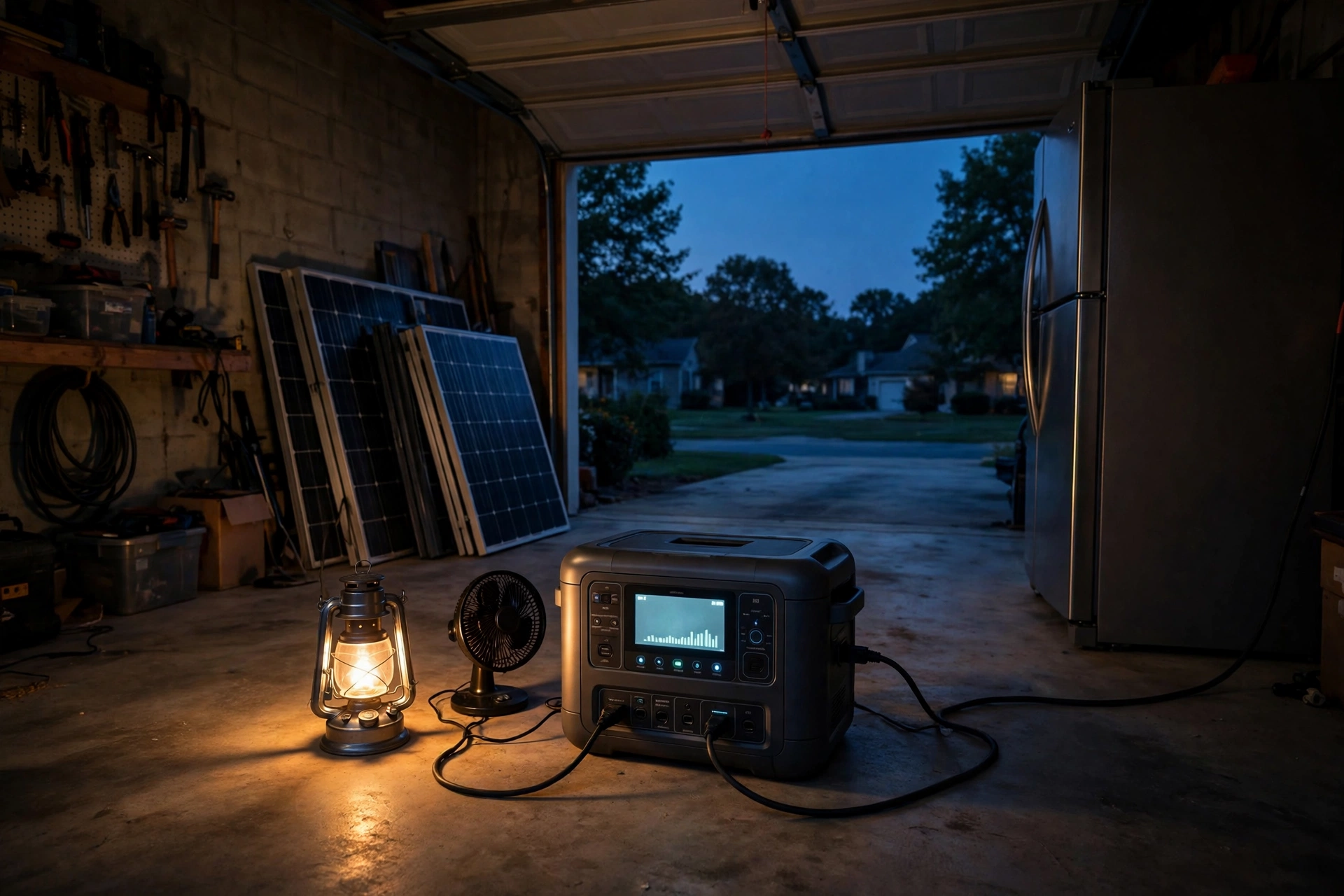
The short answer: the AC200L is the expandable 2 kWh station — and it is also the one Bluetti has just retired. Its specs still hold up: 2,048Wh of LiFePO4, a 2,400W inverter, 1,200W of solar input, and an expansion path to 8,192Wh that no rival in its class matches. But Bluetti’s US store now marks the base unit discontinued at its $899 last-listed price, so the buying advice has flipped since the spring: do not pay full price for remaining stock, and do not buy it at all unless you know you will add batteries later. The rest of this review explains what the unit is, what independent testers measured, and which of its two replacements fits your use instead.
Disclosure: this is a research review, not hands-on testing. Every figure below comes from Bluetti’s published specs and US store pages, plus independent hands-on reviews checked on November 7, 2026. We have not run this unit ourselves. There are no affiliate links on this page — prices link to the plain vendor store. See our disclosure for how the site is funded.
Discontinued — read this first
Three facts decide whether the AC200L is still a buy, and all three changed in the last few months:
- Bluetti’s US store lists the base AC200L as discontinued, at US$899.00. Every bundle variant on the same page — AC200L + B300K, + 200W solar, + Charger 1, + B500K — carries the same discontinued label.
- An independent discontinuation tracker (checked September 30, re-checked October 12, 2026) lists the AC200L as unavailable on Bluetti’s US store and not on Amazon US, with the AC200PL as the named replacement.
- The replacements are already priced at the same level. The AC200PL runs about $950 on Amazon, and the Elite 200 V2 — Bluetti’s pick for a fixed 2 kWh unit — is $899.
What that means in practice: the AC200L is a clearance-rack buy now, not a current-model buy. If you find remaining stock at a real discount (well under $899) and you plan to expand past 2 kWh, it is still a good unit — the hardware did not get worse when the listing changed. If a retailer is asking $899 or more, buy the AC200PL or the Elite 200 V2 instead; you get a current model, a live warranty channel, and in the Elite’s case twice the cycle rating. And if you already own an AC200L, nothing changes — Bluetti still supports it under its 5-year warranty, and the expansion batteries remain on sale.
AC200L vs AC200MAX — what the L changed
The AC200L replaced the AC200MAX, and the differences are all in the direction of faster charging and more solar — with one feature quietly removed:
| Spec | AC200L (this review) | AC200MAX (predecessor) |
|---|---|---|
| Capacity | 2,048Wh | 2,048Wh |
| AC output | 2,400W (3,600W Power Lifting) | 2,200W |
| Maximum input | 2,400W (AC + solar) | 1,400W (AC + solar) |
| Solar input | 1,200W | 900W |
| App control | Bluetooth + Wi-Fi | Bluetooth only |
| Wireless charging pad | No | Yes |
| Noise | ≤50 dB | Not published the same way |
The AC200MAX is itself discontinued, with the Elite 200 V2 as Bluetti’s named replacement. The practical takeaway: if you are comparing used or clearance units, the AC200L is the better buy of the two — faster wall charging, a third more solar headroom, and Wi-Fi app control — unless you specifically want the AC200MAX’s wireless charging pad.
Specs: what the AC200L actually is
A portable power station is three things in one box: a battery, an inverter that turns battery DC into household AC, and a charge controller that manages solar input. At 2,048Wh behind a 2,400W inverter, the AC200L is the size where all three stop being camping conveniences and start being genuine home backup — a fridge plus a microwave, or a full RV shore-power hookup, but not a whole house at once.
| Spec | Bluetti AC200L |
|---|---|
| Capacity | 2,048Wh (51.2V, 40Ah) |
| Battery | LiFePO4, 3,000+ cycles to 80% capacity |
| AC output | 2,400W continuous, 3,600W Power Lifting (resistive loads), 4,800W surge; 4 x 120V/20A + 1 x TT-30 30A RV port |
| USB | 2 x USB-C up to 100W, 2 x USB-A |
| DC output | 12V/10A car port, 48V/8A RV port; D40 regulator (sold separately) adds 12V/30A, 400W max for RV house batteries |
| Maximum solar input | 1,200W, 12–145V, 15A |
| Wall charging | 2,400W max input; 0–80% in ≈45 minutes, full in ≈1.5 hours |
| Solar charging | Full in ≈2.5 hours from 1,000W of panels |
| Alternator charging | Charger 1 (560W, sold separately): full in ≈3.6 hours |
| UPS switchover | Within 20 ms |
| Noise | ≤50 dB (Bluetti); independent measurement ≈40 dB on low, ≈48 dB on high at 3 ft |
| Weight | 62.4 lb (28.3 kg) |
| Dimensions | ≈16.5 x 11 x 14.4 in |
| Operating temperature | Charging 0–40 °C; discharging −20–40 °C (do not recharge below freezing) |
| AC efficiency | Up to 92% |
| Expandable | Yes — to 8,192Wh with 2 x B300; Bluetti packs only; hot-swappable |
| App control | Yes — Bluetooth + Wi-Fi via the Bluetti app |
| Warranty | 5 years |
| Price, November 7, 2026 | $899 last listed on Bluetti’s US store; unit marked discontinued |
Two honest caveats in that table. First, the 2,400W wall input needs an optional 20A plug in the US and Canada — the standard plug charges slower, and Bluetti does not publish the standard-plug time on the product page. Second, the 45-minute figure is a best case: it is the turbo charge rate, it stresses the battery harder than a standard charge, and it is the mode to reach for before a storm, not every night.
How long it runs things: the runtime math
Runtime estimates use usable energy, not rated energy. Bluetti’s own formula multiplies capacity by 95% depth of discharge and 93% efficiency, which gives ≈1,810 usable watt-hours — and independent testing measured ≈1,830Wh usable, so the formula and the lab agree. Runtime in hours is usable Wh divided by average load in watts.
| Device | Average load | Runtime |
|---|---|---|
| Wi-Fi router | 10W | ≈181 hours |
| CPAP (conservative planning draw) | 40W | ≈45 hours |
| 12V portable cooler | 60W | ≈30 hours |
| Laptop | 60W | ≈30 hours |
| 55-inch LED TV | 120W | ≈15 hours |
| Full-size fridge (cycling, conservative) | 150W | ≈12 hours |
| Coffee maker | 550W | ≈3.3 hours |
| Microwave | 1,000W | ≈1.8 hours (Bluetti’s own worked example) |
| Electric kettle | 1,500W | ≈1.2 hours |
The fridge row is where this size class earns its keep: 12 hours covers an overnight outage with margin, and a closed refrigerator keeps food safe for about 4 hours with no power at all, so the AC200L more than bridges a daytime blackout. The hard ceiling is 2,400W continuous — a space heater plus a microwave together will trip the inverter, and the 3,600W Power Lifting mode covers resistive loads like kettles and heaters, not motor start-up spikes; the 4,800W surge rating is what covers those. One hands-on reviewer found the distinction matters in practice: the unit passed a max-load test at about 2,900W before shutting down, and Power Lifting managed about 2,100W of simultaneous mixed loads without tripping — so plan on 2,400W for mixed loads, not 3,600W.
Solar charging: the strongest in its class
The solar story is the AC200L’s best feature after expansion. A 1,200W cap with a 12–145V input window means a large array actually pays off: Bluetti quotes a full charge in ≈2.5 hours from 1,000W of panels (five PV200 or three PV350 panels), and ≈3.5 hours from six 120W panels. The wide voltage window is the quiet advantage — it accepts long panel strings that lower-voltage rivals reject, which matters on an RV roof where you wire panels in series to keep cable losses down. Our guide to charging a power station with solar panels covers how to size that array.
The other charging routes are honest but secondary. Wall power is the fastest at 45 minutes to 80%. The optional Charger 1 alternator charger (560W) refills the unit in ≈3.6 hours of driving — the only serious vehicle-charging route, since the standard 12V car socket is a trickle for a 2,048Wh battery. AC and solar can combine, but the combined input caps at 2,400W, so the wall charger plus panels together charge no faster than the wall charger alone.
What owners and testers report
Treat the owner evidence with the usual care — the AC200L’s ratings are spread across many listings and bundle variants — but the hands-on record is unusually consistent, and it matches the spec sheet:
- Usable capacity checks out. Outdoor Tech Lab measured about 1,830Wh usable from the 2,048Wh rating (≈89%), and ran mixed household loads for roughly 11 hours in a real outage before hitting 10%.
- It handles loads above its rating, briefly. The same lab passed a max-load test at about 2,900W before shutdown, with Power Lifting managing about 2,100W of simultaneous loads.
- It is loud enough to notice, not loud enough to mind. Forbes measured the fans at around 40 dB on low and 48 dB on high at three feet — audible but not harsh. Bluetti’s own figure is ≤50 dB.
- Real-world runtimes track the math. The Gadgeteer ran a 65-inch OLED TV and a PS5 at about 325W for six hours of gaming and still had 39% left (about 3 more hours estimated); a 5.1 cubic-foot freezer ran about 48 hours; a 1,500W space heater on Power Lifting ran an estimated 1 hour 20 minutes. Notebookcheck’s hands-on testing found Bluetti’s charging-time estimates accurate.
- The complaint is always the weight. At 62.4 lb it is a two-hand, sometimes two-person lift, and every hands-on review says the same thing: this is a place-it-once unit, not a carry-across-the-field one. For a lighter 2 kWh box, the comparison table below shows the Jackery at 39.5 lb.
Our EcoFlow vs Bluetti guide covers how Bluetti’s expansion-first approach compares with EcoFlow’s faster-charging, app-led line.
Expansion: the real reason to buy one
Expansion is the AC200L’s defining feature, and now the only reason to choose it over its replacements. The internal battery is not replaceable and the unit cannot be paired with a second AC200L for 240V split-phase — but it takes Bluetti’s own expansion batteries, hot-swappable, without turning the unit off:
| Expansion | Total capacity |
|---|---|
| AC200L alone | 2,048Wh |
| + 1 x B230 (2,048Wh) | 4,096Wh |
| + 2 x B210 (2,150Wh each) | 6,348Wh |
| + 2 x B300K (2,764.8Wh each) | 7,577.6Wh |
| + 2 x B300 (3,072Wh each) | 8,192Wh |
At 8,192Wh the system stops being a portable station and becomes a small home battery — roughly four days of fridge runtime at the 150W planning draw. That is the buyer the AC200L was built for: someone who needs 2 kWh today, knows they will need 4–8 kWh later, and would rather bolt on batteries than replace the whole unit. Note the B210 needs a separate P090D-to-aviation cable, and the D40 regulator that charges an RV house battery from the AC200L is sold separately. Third-party expansion batteries do not work — Bluetti’s FAQ is explicit on that point.
AC200L vs its 2 kWh rivals
Every rival below is also LiFePO4, so the comparison turns on output, solar input, charging speed, expansion, weight, and cycle life — not chemistry. Prices checked October–November 2026; all move with promotions. One availability note runs through the whole table: the AC200L is the only unit here you cannot buy new from its maker anymore.
| Spec | Bluetti AC200L | Bluetti Elite 200 V2 | EcoFlow Delta 2 Max | Jackery Explorer 2000 v2 |
|---|---|---|---|---|
| Price | $899 last listed (discontinued) | ≈$899 | ≈$1,029–$1,049 | ≈$899–$999 |
| Capacity | 2,048Wh | 2,074Wh | 2,048Wh | 2,042Wh |
| AC output | 2,400W (3,600W Power Lifting) | 2,600W (3,900W Power Lifting) | 2,400W (X-Boost 3,400W) | 2,200W (4,400W surge) |
| Cycle rating | 3,000 to 80% | 6,000+ to 80% | 3,000 to 80% | 4,000 |
| Wall charging | 0–80% in ≈45 min | 0–80% in ≈1 hour | 0–80% in ≈66 min | Full in ≈1.7 hours |
| Solar input | 1,200W | 1,000W | 1,000W (2 x 500W) | 400W |
| UPS switchover | Within 20 ms | 10 ms | Not published in sources checked | ≤20 ms |
| Expandable | Yes, to 8,192Wh | No | Yes, to 6,144Wh | No |
| RV port | TT-30 30A + 48V DC | TT-30 30A | None | None |
| Weight | 62.4 lb | 53.4 lb | ≈50 lb | 39.5 lb |
Read the table by what you value most. The AC200L still wins two rows outright: the largest solar input (1,200W) and the widest expansion (8,192Wh), plus the only 48V RV DC port. The Elite 200 V2 wins on output, cycle life, weight, and UPS speed — it is the better single unit at the same money, and the one to buy if you will never expand. The EcoFlow wins on expansion among current models and has the most AC outlets (six, against the Bluetti’s five), but costs about $130 more. The Jackery is the carrying-weight pick at 39.5 lb and the only one under 40 lb, but its 400W solar cap makes it the weakest solar charger of the four. For a smaller budget, our portable power station under $500 guide puts the 1 kWh class in context.
Who should buy it, and who should skip it
Buy it if: you find remaining stock at a real discount; you know you will expand past 2 kWh (the B300 path to 8,192Wh is the reason this unit exists); you run an RV and want the TT-30 plus 48V DC ports with no adapters; or you have a 1,000W+ solar array and want the 1,200W input cap to actually use it.
Skip it if: the price is $899 or more — the AC200PL and Elite 200 V2 are current models at the same money; you will never add batteries (the Elite 200 V2 is lighter, stronger, and rated for twice the cycles); you need to carry the unit regularly (the Jackery Explorer 2000 v2 is 23 lb lighter); or you need 240V output or split-phase pairing, which no unit in this table offers.
The bottom line
The AC200L earned its reputation honestly: a 2,400W inverter, the best solar input in its class, a 45-minute dash to 80%, and an expansion path no rival matched. Independent testing confirmed the headline numbers — ≈1,830Wh usable, loads above rating handled briefly, fans audible but not harsh — and the only consistent complaint was the 62 lb weight. What changed is not the hardware but the shelf: Bluetti has discontinued it, and its replacements are already here at the same price. Buy remaining stock only at a discount and only if expansion is your plan; otherwise buy the AC200PL for the same expandable design, or the Elite 200 V2 for the better single unit. Bought on those terms, the AC200L is still a good station; bought at full price in November 2026, it is last year’s model at this year’s money.