
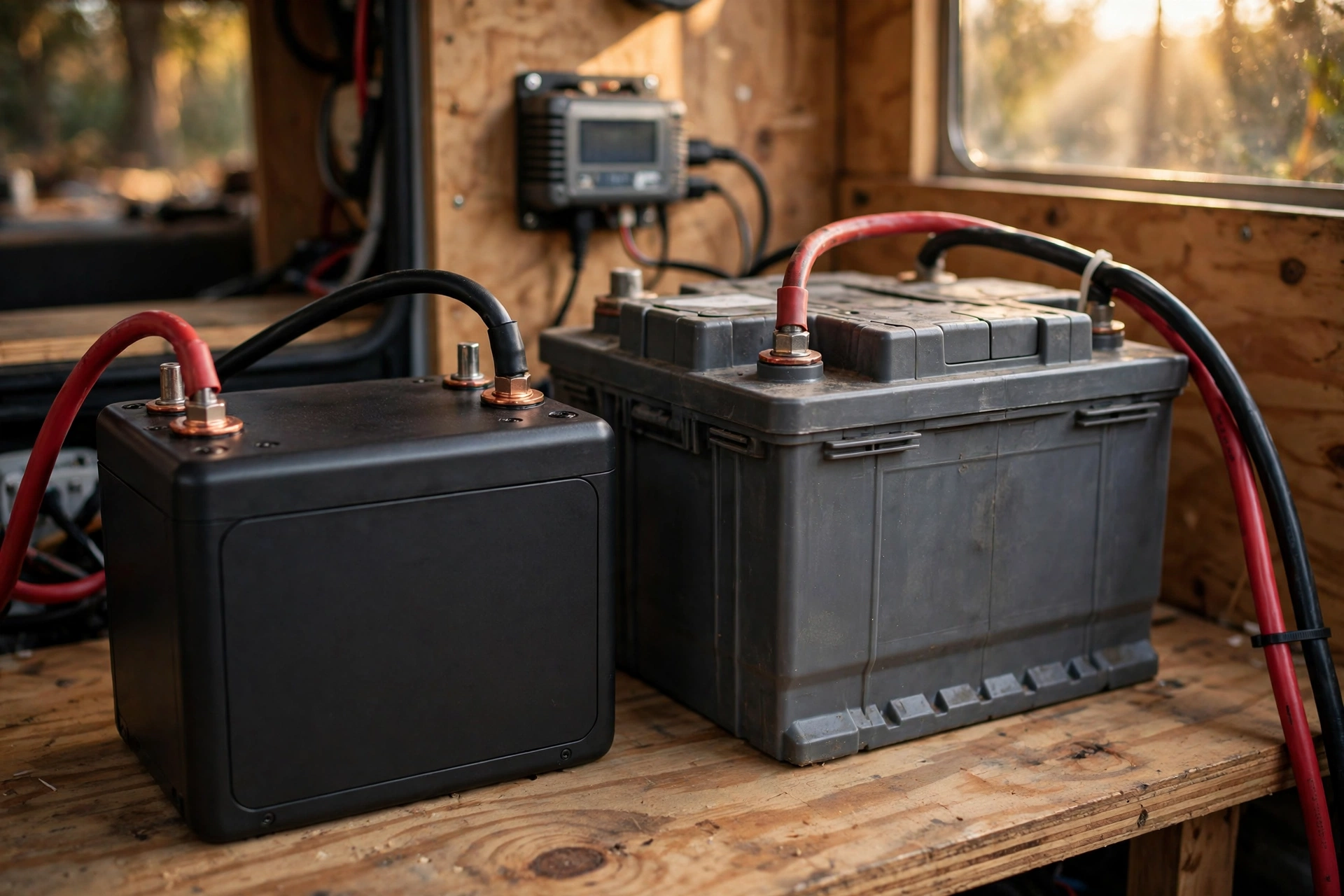
The short answer: for an RV, camper, or off-grid cabin battery bank that cycles every day, LiFePO4 wins on nearly every metric that matters — roughly double the usable energy per battery, roughly half the weight, and roughly ten times the cycle life. AGM still wins in exactly three situations: a battery that rarely cycles, engine-starting duty, and an unheated battery box in freezing weather. The price gap that used to settle this debate has mostly closed: a budget 100Ah LiFePO4 battery now costs about the same as a 100Ah AGM battery, which changes the lifetime math completely.
Disclosure: this guide is research, not hands-on testing — every figure below comes from published manufacturer specs and independent guides as of November 2026. There are no affiliate links on this page. See our disclosure for how the site is funded.
The mechanism: why the two chemistries behave so differently
Both batteries store energy by moving ions between two electrodes, but the details decide everything.
AGM (absorbent glass mat) is a sealed lead-acid battery. Its plates are lead and lead dioxide sitting in sulfuric acid electrolyte, held in fiberglass mats so the battery cannot spill. Discharging converts the plate surfaces to lead sulfate. Recharging reverses most of that — but not all of it. Each cycle leaves a little sulfate behind, permanently, and deep discharges leave much more. That is sulfation, and it is why AGM batteries die: the plates slowly crust over, capacity fades, and internal resistance climbs. Keep an AGM battery above 50% charge and the sulfation stays slow; drain it to empty regularly and it ages years in months.
LiFePO4 (lithium iron phosphate) moves lithium ions between a graphite anode and an iron-phosphate cathode. There is no sulfate crust, no acid, and no equivalent slow-poisoning reaction at normal depths of discharge — the chemistry tolerates deep cycling by design. Instead, each LiFePO4 battery carries a battery management system (BMS): a small computer that watches every cell, blocks overcharging and over-discharging, balances the cells, and shuts charging down below freezing. The BMS is both the reason lithium batteries last so long and the source of their one real weakness — cold-weather charging.
That mechanism explains the whole comparison. AGM’s usable capacity is capped by sulfation, its life is capped by cumulative plate damage, and its weight is set by lead — the densest practical battery metal. LiFePO4’s usable capacity is capped only by the BMS cutoff, its life is measured in thousands of cycles, and its weight is set by lithium and graphite, which are far lighter per watt-hour.
If you are still choosing the battery itself rather than the chemistry, our LiFePO4 battery guide covers 100Ah models, and our solar battery guide covers sizing a bank for a solar system. This page is the head-to-head.
LiFePO4 vs AGM at a glance
| AGM | LiFePO4 | |
|---|---|---|
| Chemistry | Sealed lead-acid, glass-mat electrolyte | Lithium iron phosphate, BMS-managed |
| Usable depth of discharge | About 50% for decent life | About 80–100% |
| Usable energy, 100Ah 12V | About 50Ah ≈ 600Wh | About 80–100Ah ≈ 1,000–1,280Wh |
| Cycle life (deep-cycle use) | About 300–500 cycles (premium models up to about 1,000) | About 3,000–5,000 cycles (some rated 4,000 at 100% DoD) |
| Weight, 100Ah 12V | About 60–70 lb (27–32 kg) | About 22–31 lb (10–14 kg) |
| Charge efficiency | About 85% — about 15% of input energy lost as heat | About 95–99% |
| Voltage under load | Sags as it discharges; heavy loads pull voltage down early | Flat at about 13.2V until nearly empty, then drops sharply |
| Self-discharge | Higher; needs maintenance charging in storage | About 2–3% per month; holds charge for months |
| Charging below freezing | Charges, with reduced capacity | BMS blocks charging below about 0°C unless self-heating model |
| Maintenance | Sealed, no watering; must not sit discharged | None beyond correct charge profile; BMS handles the rest |
| Engine starting | Yes — AGM starting batteries are common | No — LiFePO4 house batteries are generally not starting batteries |
| Typical price, 100Ah 12V | About $209 (Renogy 100Ah AGM, November 2026) | About $230 budget (LiTime 100Ah) to about $520 smart/premium (Renogy 100Ah smart) |
| Best for | Rarely cycled banks, starter duty, tight upfront budgets, freezing storage | Daily-cycled house banks: RV, camper, van, off-grid cabin, home backup |
The worked math: one 100Ah battery, two realities
Take a 12V, 100Ah battery — the standard RV house-bank building block — and run the numbers both ways.
Usable energy per cycle. The AGM battery gives you about 50Ah before you should stop, or about 600Wh. The LiFePO4 battery gives you about 80–100Ah, or about 1,000–1,280Wh. So a single LiFePO4 battery replaces roughly two AGM batteries for the same nightly usable energy — before cycle life even enters the picture. A camper running a 12V fridge, lights, and phones overnight (roughly 600–800Wh) drains one AGM battery to its safe limit and barely half-discharges one LiFePO4 battery.
Lifetime energy. Multiply usable energy by cycle life. One AGM battery: about 600Wh × about 400 cycles ≈ 240kWh over its life. One LiFePO4 battery: about 1,100Wh × about 3,000 cycles ≈ 3,300kWh — roughly fourteen times the lifetime energy from one battery. To match one LiFePO4 battery’s lifetime output you would buy roughly ten to fourteen AGM batteries, at about $209 each: roughly $2,100–$2,900, versus about $230 for a budget LiFePO4 battery or about $520 for a smart one. Cycle ratings are lab figures at stated depths of discharge, so treat the exact multiple as approximate — but no plausible adjustment closes a tenfold gap.
Weight. A 200Ah-usable bank needs four AGM batteries (about 260 lb) or two LiFePO4 batteries (about 44–62 lb). That is roughly 200 lb saved — payload you can spend on water, gear, or a second solar panel, and on a van or small trailer, weight you can feel in handling and fuel use. A single LiFePO4 battery is also a one-person lift; a single AGM battery at 60–70 lb often is not.
Charging time and solar harvest. AGM’s roughly 85% charge efficiency means about 15% of your solar harvest becomes heat during charging; LiFePO4’s roughly 95–99% efficiency keeps nearly all of it. AGM also charges slowly at the end: the absorption stage tapers current for hours to reach full, which is why AGM banks on solar often never quite finish charging on short winter days. LiFePO4 accepts high current almost all the way to full, so it finishes faster on the same panels. Pair either chemistry with the right controller — our MPPT vs PWM comparison covers that choice — but note that most mid-range MPPT controllers now include a lithium preset, which is one more reason the lithium pairing is simpler than it used to be.
When AGM is still the right buy
Lithium’s advantages are real, but AGM wins in three honest cases:
- A battery that rarely cycles. A camper used a few weekends a year, or a backup battery that mostly sits on a maintainer, will never use up 3,000 cycles. Here the AGM battery’s lower upfront cost wins, because the lithium battery’s lifetime advantage is never cashed in. Note the caveat: an AGM battery that sits discharged sulfates and dies early, so “rarely used” still means “kept on a maintainer.”
- Engine starting. Starter motors want a short, massive current burst, and AGM starting batteries are built for exactly that. LiFePO4 house batteries are generally not rated as starting batteries, and their BMS can cut power under a starter’s surge current. Keep a dedicated AGM starter battery and a LiFePO4 house bank if your rig needs both.
- Unheated winter storage and charging. A battery box that drops below freezing blocks lithium charging entirely — the BMS refuses, correctly, to protect the cells. If your battery must charge through a cold winter in an unheated compartment and you cannot buy a self-heating lithium model or move the battery somewhere warm, AGM keeps working. AGM also tolerates overcharging abuse more gracefully than lithium, which matters on very old, dumb chargers with no lithium profile.
AGM’s other historical advantage — price — has largely evaporated at the budget end. A Renogy 100Ah AGM battery lists at about $209, while a LiTime 100Ah LiFePO4 battery lists at about $230. At that gap, the lifetime math above makes lithium cheaper on day one in any daily-cycle application. The remaining price gap is at the premium end: smart lithium batteries with Bluetooth, self-heating, and long warranties run about $520 and up, versus about $209 for AGM.
When LiFePO4 pays for itself
Buy LiFePO4 when any of these is true:
- Your bank cycles daily. Full-time RV living, a liveaboard boat, or an off-grid cabin: the cycle-life advantage alone pays for the battery several times over, and the usable-capacity advantage means you buy half as many batteries for the same nightly energy.
- Weight or space is tight. Vans, teardrop trailers, and small campers feel every pound, and a lithium bank’s smaller footprint frees compartment space for other gear.
- You run an inverter or heavy loads. LiFePO4’s flat voltage curve means a 1,000W inverter sees steady voltage until the battery is nearly empty, where an AGM battery’s sagging voltage can trip low-voltage cutoffs early — you lose usable energy to voltage sag, not just to the 50% rule.
- Your solar window is short. Winter camping or shaded sites: lithium’s faster, more efficient charging captures more of a short solar day, and its low self-discharge means stored energy is still there weeks later.
- You plan to keep the rig for years. A lithium bank bought today is plausibly still serving in a decade; an AGM bank bought today is a replacement purchase in 3–5 years, with another installation job attached.
Switching from AGM to LiFePO4: the checklist
Swapping chemistry is usually straightforward, but three settings trip people up:
- Charge profile. Set your solar charge controller and mains charger to their lithium/LiFePO4 preset — roughly 14.2–14.6V absorption, with no indefinite float at lead-acid voltages. An AGM-only charger can still charge a lithium battery in a pinch, but it may undercharge it or hold it at a float voltage the BMS does not want. Our best MPPT charge controller roundup lists models with lithium presets.
- Alternator charging. If you charge from the vehicle’s alternator while driving, add a DC-to-DC charger rated for lithium. A lithium battery’s low internal resistance lets it pull very high current from an alternator built for a lead-acid battery’s gentler appetite, which can overheat the alternator on long drives.
- Battery monitoring. AGM state of charge can be roughly read from voltage; LiFePO4 cannot, because its voltage stays flat at about 13.2V until it is nearly empty and then falls off a cliff. A shunt-based battery monitor that counts amp-hours in and out is the accurate way to know a lithium bank’s state of charge — voltage alone will lie to you until it is too late.
- Cold plan. Decide before winter where the battery charges. If the compartment drops below freezing, either buy a self-heating model, move charging indoors, or keep an AGM battery for the cold season. Do not bypass or defeat the BMS low-temperature cutoff; it is protecting cells that cannot be repaired.
- Disposal. Recycle the old AGM battery — lead-acid recycling is one of the most established recycling streams in existence, and most auto-parts stores take old batteries. Do not landfill either chemistry.
The bottom line for portable, RV, and off-grid buyers
Buy LiFePO4 if your battery bank cycles daily, weight or space is tight, you run an inverter, or you plan to keep the rig for years — the roughly double usable capacity, roughly half the weight, and roughly tenfold cycle life make it cheaper over its life even where the sticker price is slightly higher. Buy AGM if the battery rarely cycles, you need engine-starting duty, or it must charge through freezing weather in an unheated box. The old rule of thumb — “lithium is better but costs three times as much” — no longer describes the market: at about $230 for a budget 100Ah LiFePO4 battery versus about $209 for a comparable AGM battery, the question has flipped from whether lithium is worth the premium to whether AGM’s remaining advantages apply to your setup at all. For most RV, camper, and off-grid solar buyers in 2026, they do not.