
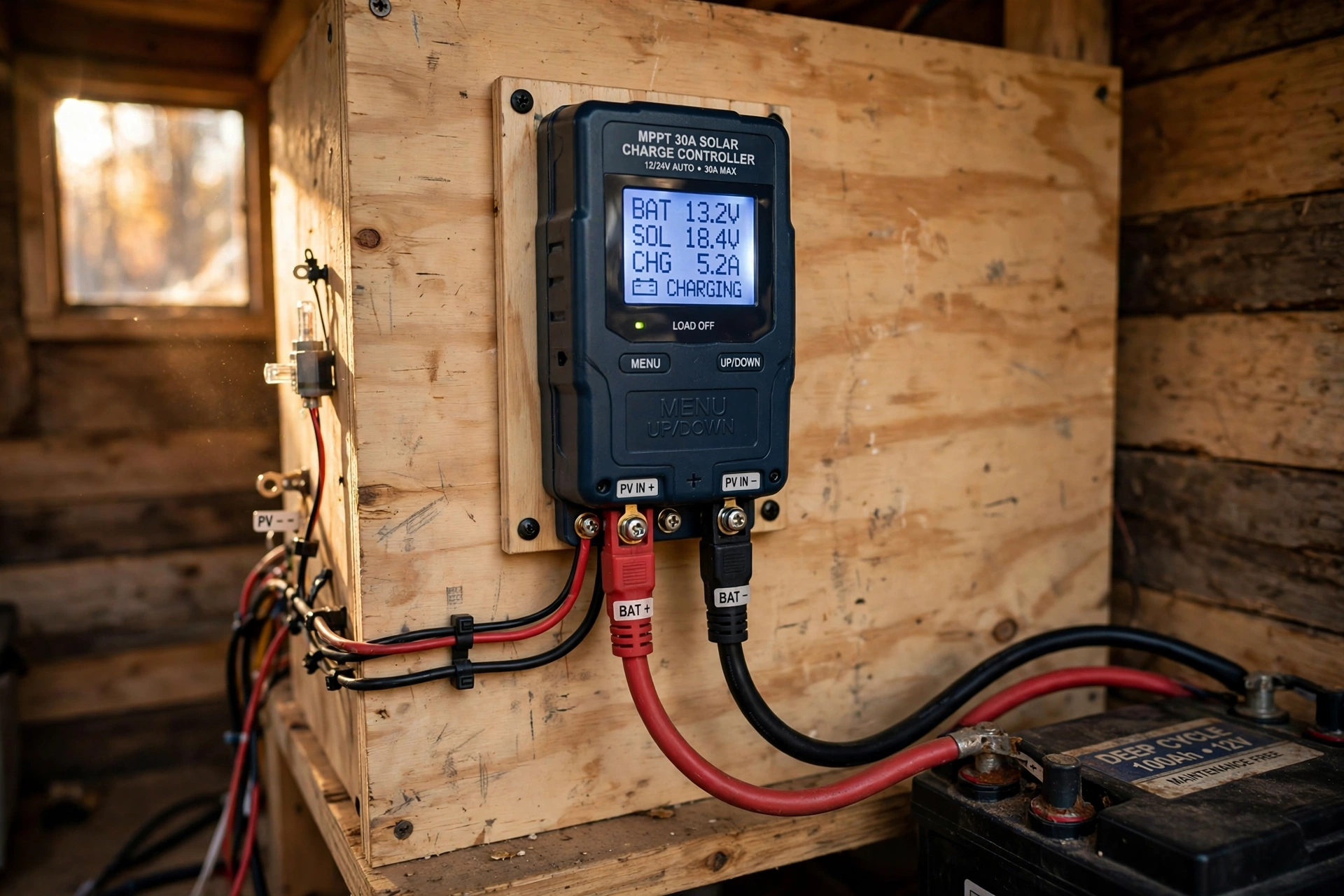
The short answer: for an RV, camper, or off-grid cabin system above about 200W, buy MPPT — it harvests roughly 15–30% more energy from the same panels. For a small, matched-voltage setup under about 200W, a PWM controller is fine and saves you real money. The two controllers do the same job — they sit between your panels and your battery and turn raw panel output into safe charging — but they handle the voltage difference between panel and battery in opposite ways, and that one difference decides everything else.
Disclosure: this guide is research, not hands-on testing — every figure below comes from published manufacturer specs and independent guides as of November 2026. There are no affiliate links on this page. See our disclosure for how the site is funded.
The mechanism: what each controller actually does with voltage
A solar panel and a battery speak different voltages. A typical 12V-nominal panel produces its maximum power at about 18V, while a 12V battery charges at about 13–14.5V. The controller’s job is to bridge that gap — and here the two designs diverge.
PWM (pulse width modulation) is essentially a fast on/off switch. It connects the panel directly to the battery and rapidly switches the connection to hold the battery at its charge voltage. The panel is therefore forced to operate at battery voltage, not at its own best voltage. The excess voltage — everything above battery voltage — is simply never harvested. It is not converted, stored, or recovered; it just does not become charging current.
MPPT (maximum power point tracking) is a DC-to-DC converter with a brain. It continuously measures the panel’s voltage and current, finds the combination where the panel produces the most watts (its maximum power point), holds the panel there, and converts the power down to battery voltage — trading excess volts for extra amps so the watts are preserved. Victron’s SmartSolar documentation puts the result plainly: its ultra-fast MPPT tracking harvests up to 30% more energy than a PWM controller, and its conversion efficiency exceeds 98%.
That mechanism explains every practical difference below. Whenever panel voltage sits well above battery voltage — high-voltage panels, panels wired in series, or cold mornings when panel voltage spikes — MPPT has something to convert and PWM has something to waste. When the two voltages nearly match, there is almost nothing to convert, and the two controllers perform nearly identically.
If you have not chosen a controller at all yet, our charge controller guide covers what the device does, battery-type settings, and the mistakes that kill batteries. This page is the head-to-head.
MPPT vs PWM at a glance
| PWM | MPPT | |
|---|---|---|
| How it works | Fast on/off switch; pulls panel voltage down to battery voltage | DC-to-DC converter; tracks the panel’s maximum power point and converts excess voltage into current |
| Conversion efficiency | About 70–80% of panel output reaches the battery | About 93–98% (Victron SmartSolar: over 98% peak) |
| Extra harvest vs PWM | Baseline | About 15–30% more from the same panels |
| Panel voltage rule | Must closely match battery voltage (18V panel → 12V battery) | Any panel voltage above battery voltage works |
| Series panel strings | Poor fit — voltage mismatch is wasted | Ideal — series strings raise voltage, MPPT converts it |
| Cold-weather bonus | None — ignores the cold voltage rise | Captures the cold voltage rise as extra current |
| Hot-weather gap | Small — panel voltage drops toward battery voltage | Still ahead, but by less |
| Typical cost (30A class) | About $15–$80 | About $60–$120 and up |
| Best for | Under about 200W, matched 12V panels, tight budgets | Everything above about 200W, series strings, lithium batteries, limited roof space |
| Complexity | Simplest device in the system; few settings | More settings (battery profiles, load outputs, Bluetooth on many models) |
The worked math: one 100W panel, two controllers
Take a standard 100W, 12V-nominal panel: maximum-power voltage about 18V, maximum-power current about 5.5A, so 18 × 5.5 ≈ 100W at the panel. The battery charges at about 13V.
With PWM: the panel is dragged down to battery voltage, but current stays about 5.5A. Delivered power ≈ 5.5A × 13V ≈ 72W. About 28W of the panel’s output never becomes charge.
With MPPT: the controller holds the panel near 18V, takes in about 100W, and converts it to battery voltage at about 95–98% efficiency. Delivered power ≈ 95W, at about 7.3A of charging current instead of 5.5A.
That is roughly 23W more from the same panel — about a third more energy on a small setup. Scale it to a 400W RV array and the gap becomes roughly 90W of extra charging, which over a 5-hour solar day is roughly 450Wh: enough to run a 12V fridge for several more hours, or to refill a 100Ah battery noticeably sooner. This is why the rule of thumb is “MPPT above 200W”: below that size, the extra watts are small in absolute terms and the price gap matters more; above it, the extra harvest quickly pays for the controller premium.
Two caveats keep the math honest. First, the 15–30% range is a range, not a promise: matched-voltage systems in hot weather sit near the bottom of it, and high-voltage or series-wired systems in cold weather sit near the top. Second, controller efficiency (93–98% for MPPT) is not the same as harvest gain: a good MPPT converts nearly all of what it takes in, and the gain over PWM comes from taking in more of the panel’s power in the first place.
When PWM is the right buy
PWM’s reputation as “the cheap one” hides the fact that it is genuinely the right choice in several common portable setups:
- A single 100W panel on a camper or van, 12V battery. Panel voltage (≈18V) sits close to battery voltage, so the MPPT gain is small — often under 10% — and a $20–$40 PWM controller leaves more budget for the panel and battery themselves.
- A small trickle or maintenance setup. A panel keeping a stored RV battery topped up does not need maximum harvest; it needs cheap reliability.
- A strict budget build where every dollar goes to capacity. On a $300 starter kit, spending $60–$100 extra on MPPT instead of a bigger battery or a second panel can be the wrong trade — more panel watts through a PWM controller can beat fewer watts through an MPPT one.
PWM’s limits are equally clear: it cannot use high-voltage or residential-style panels efficiently, it cannot take advantage of series wiring (the standard way to cut wiring losses on an RV roof), and it leaves the cold-weather voltage bonus on the table. If any of those apply, PWM stops being a bargain and starts being a bottleneck.
When MPPT pays for itself
Buy MPPT when any of these is true:
- Your array is 200W or larger. The absolute watt gain is large enough that the controller premium (roughly $40–$70 at the 30A size) pays back in faster charging and fewer generator hours.
- Your panels are wired in series. Series strings raise array voltage well above battery voltage — exactly the condition MPPT converts and PWM wastes. Series wiring also lets you use thinner, cheaper cable on long RV-roof runs.
- You use higher-voltage panels. 60-cell and 72-cell panels, and residential panels bought secondhand for a cabin build, all need MPPT to deliver their rated power into a 12V or 24V battery.
- Roof or ground space is limited. On a camper van or small cabin roof, you cannot just add another panel to make up for PWM losses — MPPT squeezes more from the panels you can fit.
- You run lithium (LiFePO4) batteries. Lithium charges at a tight voltage window and rewards precise charge profiles, which MPPT controllers typically manage better, with dedicated lithium presets and Bluetooth monitoring on most mid-range models. Our LiFePO4 battery guide covers the battery side of that pairing.
- You camp or live off-grid in cold climates. Cold mornings push panel voltage highest, and that is precisely when MPPT’s conversion earns the most extra energy — the season when you need it most.
Sizing either controller correctly
The sizing math is the same for both types, and it is where most beginners go wrong:
- Current rating: total panel watts ÷ battery voltage × 1.25 safety factor. A 400W array on a 12V battery needs 400 / 12 × 1.25 ≈ 42A, so buy a 50A controller. The same array on a 24V battery needs only about 21A, so a 30A controller works — one more reason higher-voltage battery banks are cheaper to build around.
- Voltage rating (MPPT especially): the controller’s maximum PV input voltage must exceed your array’s open-circuit voltage (Voc) on the coldest morning you will ever see, not just at the 25°C test rating. Panel voltage rises as temperature falls — roughly 0.3–0.4% per degree below 25°C — so a string that reads 90V in summer can exceed 100V on a freezing morning and trip or damage an undersized controller.
- PWM voltage matching: check that your panels’ nominal voltage matches your battery bank — 12V-nominal panels for a 12V battery, 24V-nominal for 24V. A mismatch here is not a rounding error; it is the entire PWM efficiency loss.
For the controller itself, our best MPPT charge controller roundup compares current models by current rating and input voltage, and our off-grid solar system guide walks through the full system sizing around it.
The bottom line for portable, RV, and off-grid buyers
Buy MPPT if your array is 200W or larger, your panels are wired in series or run above battery voltage, your roof space is limited, or you camp through cold weather — the roughly 15–30% harvest gain is worth the premium in all four cases. Buy PWM if you run one or two matched 12V panels on a small 12V battery and would rather put the saved money into a bigger battery or a second panel. The controller is the cheapest part of most solar setups and the easiest to regret: a $30 PWM controller strangling a $600 panel array is a false economy, while a $100 MPPT controller on a single 100W trickle panel is money that should have bought capacity instead. Size the controller to the array you actually own, and let the voltage gap — not the price tag — make the call.