
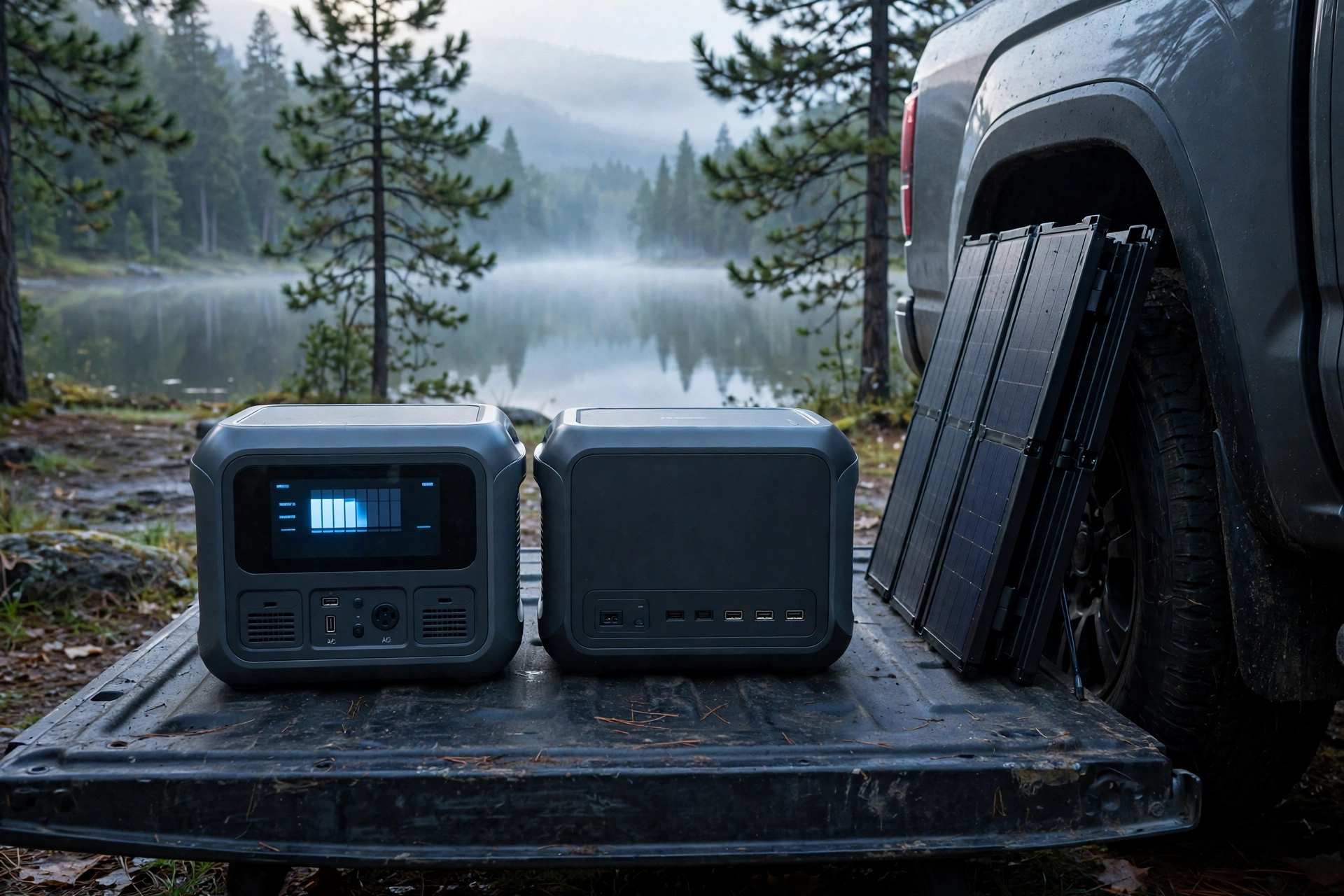
The short answer: the Delta 2 is the more powerful, more expandable station; the Explorer 1000 v2 is the lighter, simpler, usually cheaper one — and the 46Wh capacity gap between them is noise. If you run loads over 1,500W, recharge from solar daily, or might need more than 1 kWh later, buy the Delta 2. If you carry the station to a campsite every weekend and want the lightest box that still runs a fridge, buy the Jackery. Both are LiFePO4, both are decade-class batteries, and neither is a bad buy at current prices.
Disclosure: this comparison is research, not hands-on testing — every figure below comes from published manufacturer specs and independent guides checked on November 6, 2026, and we have not run these units side by side. There are no affiliate links on this page. See our disclosure for how the site is funded.
Which Jackery this comparison is about
The name is a trap, so get it out of the way first. “Explorer 1000” covers two different stations: the original 2020 model (1,002Wh lithium-ion, 1,000W inverter, 500 cycles) and the current v2 (1,070Wh LiFePO4, 1,500W inverter, 4,000+ cycles). The original still circulates under nearly the same name, sometimes at a similar price. This comparison is against the v2 — the model currently sold as new — and every Jackery figure below is the v2’s. Before ordering, check the listing for 1,070Wh and LiFePO4, and model code JE-1000D. Our Explorer 1000 v2 review works through the telltales in detail.
What you are actually comparing
A portable power station is three things in one box: a battery, an inverter that turns battery DC into household AC, and a charge controller that manages solar input. At the 1 kWh size the battery is nearly a tie — 1,024Wh against 1,070Wh, a 4% difference that vanishes inside inverter losses — so this comparison is really decided by the other two boxes: how much power the inverter delivers at once, and how fast the battery refills from wall and solar. Add one structural difference, expansion, and you have the whole decision.
Two traps to avoid before the details. First, watt-hours are not runtime: a 1,000Wh battery running a 100W fridge does not last 10 hours, because inverter losses leave roughly 85% usable energy, and a fridge cycles on and off rather than drawing steadily. Second, prices move constantly — both brands discount heavily and often, so a verdict that is true at full price can flip during a sale. Where prices appear below, they are dated street prices from November 2026, not live quotes; check the current store prices at EcoFlow and Jackery before deciding.
If you have not sized your needs yet, our portable power station under $500 guide and home backup guide work through the sizing math first, and our how to charge a power station with solar panels guide covers the panel side.
EcoFlow Delta 2 vs Jackery Explorer 1000 v2 at a glance
| EcoFlow Delta 2 | Jackery Explorer 1000 v2 | |
|---|---|---|
| Capacity | 1,024Wh | 1,070Wh |
| Battery | LiFePO4, 3,000+ cycles to 80% | LiFePO4, 4,000+ cycles to 70% |
| AC output | 1,800W continuous, 2,700W surge | 1,500W continuous, 3,000W surge |
| Max solar input | 500W (11–60V, 15A) | 400W (16–60V) |
| Wall recharge | 0–80% in ≈50 min; full in ≈80 min | Full in ≈1.7 hours; ≈1 hour in app-enabled emergency mode |
| Solar recharge | ≈3–6 hours with 1 x 400W or 2 x 220W panels | 3.8 hours with 2 x 200W panels; 7.5 hours with 1 x 200W panel |
| Expandable | Yes — to 2,048Wh (DELTA 2 battery) or 3,040Wh (DELTA Max battery) | No |
| Weight | 27 lb (12 kg) | 24.2 lb (Jackery US listing; some roundups list 23.8 lb) |
| UPS switchover | 30 ms (EPS) | ≤20 ms |
| AC outlets | 6 | 3 |
| USB-C | 100W fast charging | 100W + 30W |
| Car charging | ≈100W max (12/24V, 8A) | ≈12 hours — a trickle, not a recharge plan |
| App | Deep: monitoring, scheduling, firmware, smart-home features | Charge mode, monitoring, emergency charging |
| Warranty | 5 years | 3 years + 2-year extension on Jackery’s own store |
| Street price (Nov 2026) | ≈$549–$599 | ≈$499–$559 |
One availability note on the Delta 2’s price: an independent check on October 27, 2026 found no live Amazon offer for the standalone unit and a stale $599 tracker price, while EcoFlow’s own store price moves with sales. Treat any Delta 2 price as a same-day quote and verify it at checkout — the Jackery’s price has been steadier in the same window.
The five differences that actually decide it
1. Output: the Delta 2 runs loads the Jackery cannot
This is the largest functional gap in the pair. The Delta 2’s 1,800W inverter covers a 1,600W space heater, an 1,800W hair dryer, or a fridge plus a microwave running together; the Jackery’s 1,500W ceiling trips on any of those. The Jackery’s 3,000W surge rating is higher than the Delta 2’s 2,700W, but surge covers motor start-up spikes, not sustained loads — it does not close the 300W continuous gap. The Delta 2 also has six AC outlets against the Jackery’s three, and an X-Boost mode that lifts resistive loads above the rated output. If your load list includes anything over 1,500W, the decision is made: Delta 2. If everything you run is under 1,500W — fridge, kettle, coffee maker, laptop, lights — the gap never binds, and the rest of the comparison matters more. Our EcoFlow vs Jackery brand guide puts this inverter gap in the wider brand context.
2. Expansion: the Delta 2 grows, the Jackery does not
The Delta 2 is the only station in this pair with a future. One DELTA 2 extra battery doubles it to 2,048Wh; a DELTA Max extra battery takes it to 3,040Wh — three times the Jackery’s fixed 1,070Wh, with the same inverter and the same solar input. That matters because 1 kWh buyers are the most likely to outgrow their station: a first unit bought for camping becomes the home-backup unit, and then the outage plan wants a second fridge or a longer runtime. The Jackery’s answer to that problem is buying a second station. If you can see yourself needing more than 1,070Wh within a couple of years, the Delta 2’s expansion path is worth more than any single spec row. If 1,070Wh is genuinely enough — a weekend of camping, a fridge through a workday outage — the Jackery’s fixed capacity is not a weakness.
3. Solar input: Delta 2 by 100W, which is a quarter faster
500W against 400W is not a dramatic gap, but it is a real one: from the same sun, the Delta 2 refills roughly 25% faster, and it wastes less of a larger array. EcoFlow quotes 3–6 hours for a full solar charge with a 400W panel or two 220W panels; Jackery quotes 3.8 hours with two 200W panels and 7.5 hours with a single 200W panel. In practice the difference shows up on the second day of a multi-day trip: the Delta 2 is full by mid-afternoon where the Jackery needs the whole solar day. Both caps are modest next to the Bluetti Elite 100 V2’s 1,000W in the same class — if a fixed 600W+ array on an RV roof is the plan, neither of these two is the right pick. Our MPPT vs PWM guide explains why the built-in MPPT controller, not just the wattage, decides how much of your panels’ output actually reaches the battery.
4. Weight and carrying: the Jackery, by the margin you feel
24.2 lb against 27 lb is about a 3 lb difference — small on paper, obvious in the hand when the station is carried one-handed from a vehicle to a campsite, especially with a foldable handle on the Jackery. The Jackery is the lightest station in its comparison set and the only one under 25 lb; the Delta 2 is the heavier box, and its extra weight buys the bigger inverter and the expansion connector, not more battery. For a unit that lives in an RV bay or a garage and rolls out for outages, weight barely matters. For a unit that gets carried every weekend, it is the Jackery’s strongest row. The Delta 2’s counterweight is its charging speed: it refills from a wall outlet in about half the Jackery’s standard time, which matters more between stops than overnight.
5. Battery life, warranty, and the ownership experience
The cycle ratings look like a Jackery win — 4,000+ against 3,000+ — until you read the fine print: Jackery counts cycles to 70% of original capacity, EcoFlow to 80%, so the numbers are not directly comparable. Both are decade-class batteries at one full cycle a day; neither rating should decide the purchase. On warranty the Delta 2 is cleaner: a flat 5 years, against the Jackery’s 3 years plus a 2-year extension that applies when bought from Jackery’s own store. On software, EcoFlow’s app is the deeper tool — live monitoring, scheduling, firmware, smart-home features — while Jackery’s app covers charge mode, monitoring, and the emergency-charging toggle. One honest owner-experience difference: the Delta 2’s fans are the most common complaint in its owner feedback, while the Jackery’s sub-30 dB quiet-charging mode is built for overnight use. If the station sleeps in the same room as you do, that matters.
How long each runs things: the runtime math
Runtime estimates use usable energy, not rated energy: inverter and conversion losses leave roughly 85% of the rated watt-hours, so the Delta 2 gives about 870 usable Wh and the Jackery about 910. Runtime in hours is usable Wh divided by average load in watts. The 46Wh rated gap is worth about 20 minutes on a 150W fridge — inside measurement noise.
| Device | Average load | EcoFlow Delta 2 | Jackery Explorer 1000 v2 |
|---|---|---|---|
| Wi-Fi router | 10W | ≈87 hours | ≈91 hours |
| CPAP (conservative planning draw) | 40W | ≈21.8 hours | ≈22.8 hours |
| 12V portable cooler | 60W | ≈14.5 hours | ≈15.2 hours |
| Laptop | 60W | ≈14.5 hours | ≈15.2 hours |
| 55-inch LED TV | 100W | ≈8.7 hours | ≈9.1 hours |
| Full-size fridge (cycling, conservative) | 150W | ≈5.8 hours | ≈6.1 hours |
| Coffee maker | 550W | ≈1.6 hours | ≈1.7 hours |
| Microwave | 1,160W | ≈0.8 hours | ≈0.8 hours |
| Electric kettle | 1,200W | ≈0.7 hours | ≈0.8 hours |
The fridge row is where this size class earns its keep: about 6 hours covers a workday outage, and a closed refrigerator keeps food safe for about 4 hours with no power at all, so either station more than bridges a daytime blackout. The hard ceilings differ: the Delta 2’s 1,800W covers a space heater or a hair dryer that the Jackery’s 1,500W cannot, and the Delta 2’s expansion means its runtime can triple later while the Jackery’s is fixed.
Who should buy which
Buy the EcoFlow Delta 2 if: you run loads over 1,500W; you recharge from solar daily and want the faster refill; you may need more than 1,024Wh later and want the expansion path instead of a second station; you want the flat 5-year warranty and the deeper app; or you recharge mostly from the wall between stops and want the 50-minute-to-80% refill.
Buy the Jackery Explorer 1000 v2 if: you carry the station to a campsite every weekend and want the lightest 1 kWh box; your loads all sit under 1,500W; you want the quietest overnight charging; you want the slightly faster UPS switchover for a router or desktop; or the lower street price is the deciding factor and 1,070Wh is genuinely enough.
Either works if: you need about 1 kWh for phones, laptops, lights, and a small fridge on weekend trips or a fridge through a workday outage — the capacity tie means the decision falls to weight, output, and price on the day you buy. Both brands discount heavily and often, so check the current store prices at EcoFlow and Jackery before deciding; a sale can flip the value verdict.
The bottom line
The Delta 2 is the more capable machine and the Jackery is the easier one to live with — and those are exactly the trade-offs that map to different buyers. The Delta 2 wins on output, solar input, wall-charging speed, expansion, warranty, and app depth. The Jackery wins on carrying weight, cycle rating, UPS switchover, quiet charging, and usually price. Pick the constraint first, then the station follows: heavy loads or future growth means the Delta 2; carrying weight and simplicity mean the Jackery. For the next step, read the full Explorer 1000 v2 review for the Jackery’s ownership details, or size a full outage plan in our home backup guide.