
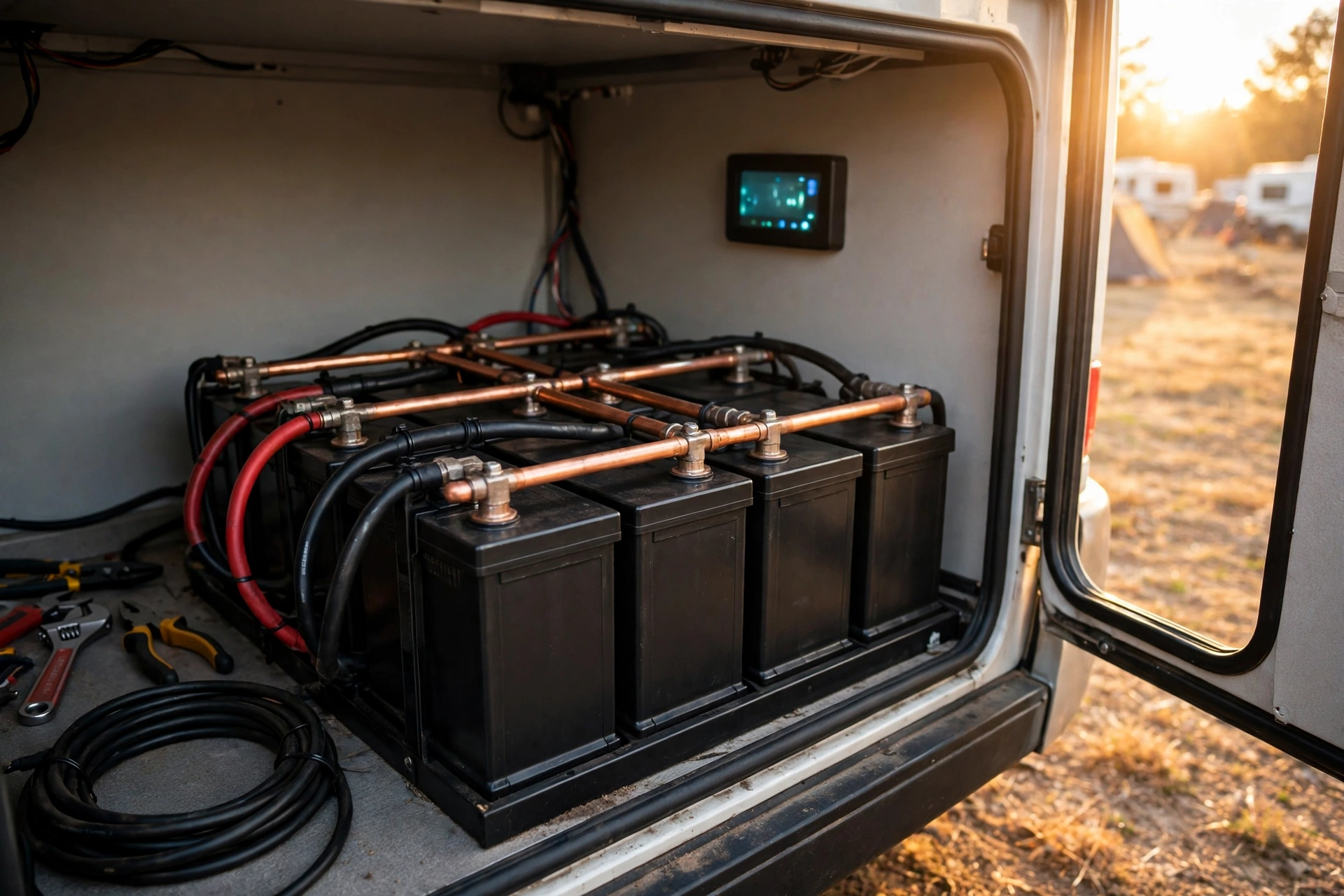
The short answer: batteries needed = daily watt-hours × days of backup ÷ usable watt-hours per battery. A campervan using about 730Wh a day with one day of backup needs 730 ÷ 1,150 = one 12V 100Ah LiFePO4 battery; the same setup wanting two days of backup needs two. The whole job is getting the three inputs right: your daily use, how many sunless days the bank must cover, and what one battery actually gives you — which is not the number printed on its label.
Disclosure: this guide is research, not hands-on testing — every figure below comes from published manufacturer specs and independent sizing guides as of November 2026. There are no affiliate links on this page. See our disclosure for how the site is funded.
The mechanism: a battery’s label is not its usable energy
Three numbers get confused in battery sizing, and each one changes the answer by a factor of two.
Amp-hours (Ah) are not watt-hours (Wh). A battery’s headline number is amp-hours at its nominal voltage: a 12V 100Ah battery holds 12 × 100 = 1,200Wh in theory, but LiFePO4 cells run at 12.8V nominal, so a 12V 100Ah LiFePO4 battery is really 12.8 × 100 = 1,280Wh. Always convert to watt-hours before comparing batteries, because a 24V 100Ah battery holds twice the energy of a 12V 100Ah battery at the same amp-hour rating.
Usable energy is rated energy × usable depth of discharge. A LiFePO4 battery can be cycled to about 90% depth of discharge day after day without meaningful life loss, so a 100Ah LiFePO4 battery gives about 1,150Wh of usable energy. An AGM or flooded lead-acid battery should stay above about 50% charge if you want a reasonable life, so a 100Ah AGM battery gives only about 600Wh usable. This is the single biggest sizing fact in solar: the same 100Ah label means nearly twice the usable energy in lithium as in lead-acid. Our LiFePO4 vs AGM comparison works through the chemistry and the lifetime cost behind that gap.
Inverter losses come out of the battery, not the load. If part of your daily use runs through an inverter, divide that share by the inverter’s efficiency — typically about 0.85 to 0.90 — before sizing the bank. A 1,500Wh day that is mostly AC loads needs about 1,500 ÷ 0.85 ≈ 1,765Wh from the battery, not 1,500Wh. DC loads (12V fridge, lights, fans, USB charging) skip this loss entirely, which is one reason RV builders run as much as possible on DC.
| One 12V 100Ah battery | Rated energy | Usable depth of discharge | Usable energy |
|---|---|---|---|
| LiFePO4 | ≈1,280Wh | ≈90% | ≈1,150Wh |
| AGM / flooded lead-acid | ≈1,200Wh | ≈50% | ≈600Wh |
Step 1: work out your daily use in watt-hours
List every device, its watts, and its hours per day. Watts × hours = Wh. A fridge’s label shows its compressor draw, not its daily energy, so count only the hours the compressor actually runs — roughly half the day for a 12V compressor fridge.
| Device | Watts | Hours/day | Wh/day |
|---|---|---|---|
| 12V compressor fridge | 50 | 10 (compressor runtime) | 500 |
| LED lights (4 bulbs) | 10 | 5 | 50 |
| Phone + laptop charging | 60 | 2 | 120 |
| Water pump / roof fan | 30 | 2 | 60 |
| Campervan total | ≈730 |
Three common setups, worked from real load lists:
- Light camping (lights, phones, small fan): ≈150Wh/day.
- Campervan / RV with a 12V fridge (the table above): ≈730Wh/day.
- Off-grid cabin (fridge, lights, laptop, pump, a few extras): ≈1,000–3,000Wh/day depending on size and appliances.
- Home backup essentials (full-size fridge ≈1,200Wh/day, lights, Wi-Fi, phones): ≈2,000Wh/day.
If you already own a portable power station, its battery capacity is the same number in a different box — a station that must recharge fully every day needs panels sized to its capacity, not to a guess. Our guide to charging a power station with solar panels walks through that version of the math.
Step 2: choose your days of autonomy
Days of autonomy is how many days the bank must carry your loads with little or no sun. It is a judgment call, not a formula output, and it is where most banks end up too small.
| Setup | Days of autonomy | Why |
|---|---|---|
| Weekend camper, drives most days | 1 | The alternator or a short drive recharges the bank; solar tops it up |
| RV boondocking, stays put for days | 2 | One cloudy day is normal; two in a row happens |
| Off-grid cabin, weekend use | 2 | Arrive Friday to a full bank, ride out a grey weekend |
| Off-grid cabin, full-time | 2–3 | Winter stretches of low sun are the sizing case, not summer |
| Small off-grid home | 3 | A generator covers anything longer; the bank covers the gap |
Do not size for a week of no sun — no reasonable bank covers that, and the panels would never refill it. The bank’s job is to bridge cloudy stretches; the panels’ job is to refill it. A bank sized for three sunless days in a place with two peak sun hours in winter is a bank that never recharges, and a battery that never fully recharges is a battery that dies early.
Step 3: run the formula
Usable Wh needed = daily Wh × days of autonomy (after dividing the AC share by inverter efficiency, about 0.85).
Batteries = usable Wh needed ÷ usable Wh per battery, rounded up.
The table below does the arithmetic for the common cases. LiFePO4 counts use ≈1,150Wh usable per 100Ah battery; AGM counts use ≈600Wh usable per 100Ah battery. The cabin rows match independent sizing guides that publish the same cases — a 3,000Wh-a-day cabin with two days of backup needs about 6,670Wh of LiFePO4 (6 batteries) or about 12,000Wh of lead-acid (10 batteries).
| Daily use | Days of autonomy | LiFePO4 100Ah batteries | AGM 100Ah batteries |
|---|---|---|---|
| 150Wh (light camping) | 1 | 1 | 1 |
| 730Wh (campervan) | 1 | 1 | 2 |
| 730Wh (campervan) | 2 | 2 | 3 |
| 1,000Wh (small cabin) | 2 | 2 | 4 |
| 2,000Wh (home backup essentials) | 2 | 4 | 7 |
| 3,000Wh (full-time cabin) | 2 | 6 | 10 |
| 3,000Wh (full-time cabin) | 3 | 8 | 15 |
| 6,000Wh (small off-grid home) | 3 | 16 | 30 |
Two things jump out of the table. First, the chemistry gap is a factor of two at every row — an AGM bank is roughly double the battery count of a LiFePO4 bank for the same job, plus roughly double the weight. Second, the counts escalate fast past about 3,000Wh a day, which is why whole-home off-grid systems step up to 24V or 48V banks and larger batteries rather than stacking dozens of 12V 100Ah units.
Step 4: bigger batteries vs more batteries, and 12V vs 24V
Once the formula gives you a watt-hour number, you still have to buy it in real batteries — and the shape of the bank matters.
One 200Ah battery beats two 100Ah batteries on wiring, not on energy. Two 100Ah batteries in parallel hold the same energy as one 200Ah battery, but the pair needs balancing cables, takes two BMS units, and doubles the connection points that can loosen or corrode. A single 200Ah battery is one connection, one BMS, and usually cheaper per watt-hour. The case for multiple smaller batteries is redundancy (one fails, the other still works) and weight — a 200Ah LiFePO4 battery weighs about 45–50 lb, which is a two-person lift in a tight RV compartment. Our 200Ah LiFePO4 roundup compares the larger sizes, and our 100Ah roundup the standard ones — a budget 100Ah LiFePO4 battery now costs about $336, a premium one about $799, and a 200Ah unit about $370, so the price gap between sizes has mostly closed.
Step up in voltage before you stack in parallel. Above about 1,500–2,000W of inverter, a 12V bank pushes currents that need very thick cable: 2,000W at 12V is about 167A, while the same 2,000W at 24V is about 83A. Four 12V 100Ah batteries wired as two series pairs (2S2P) give a 24V 200Ah bank with the same energy and half the current. Our 12V vs 24V guide works through the voltage decision in full, including when 48V is the right call.
Cold weather changes the battery choice, not just the count. Standard LiFePO4 batteries must not be charged below about 0°C (32°F) — the battery management system blocks charging to prevent permanent cell damage. They can still discharge in the cold, down to about −20°C. If the bank lives in an unheated compartment through winter, buy a self-heating model or keep the battery somewhere it stays above freezing. AGM batteries charge in the cold, though they deliver less capacity when cold. This is a real sizing factor for RVs that sit through winter: a heated LiFePO4 battery costs more per unit but needs no extra count, while an unheated one in a freezing compartment is a battery that cannot recharge at all.
Step 5: check the panels can refill the bank
A bank the panels cannot refill is dead weight. The check is one line: daily panel harvest ≈ panel watts × peak sun hours × 0.75, and it must at least equal your daily use.
| Panel watts | Harvest at 4 sun hours | Bank it refills daily |
|---|---|---|
| 100W | ≈300Wh | Light camping bank |
| 200W | ≈600Wh | One 100Ah LiFePO4 battery, most days |
| 400W | ≈1,200Wh | A campervan’s daily use, or one 100Ah battery from empty |
| 800W | ≈2,400Wh | A 2,000Wh-a-day home-backup bank |
If the bank holds three days of use but the panels only harvest one day’s worth, the bank drains over a cloudy week and never recovers — the extra batteries bought nothing. Size panels and batteries together: our panel-sizing guide runs the panel side of the same calculation, and our off-grid system guide covers the whole chain.
The mistakes that waste money
| Mistake | What happens | Fix |
|---|---|---|
| Sizing by amp-hours without converting to watt-hours | A 24V bank looks half the size it is, or a 12V bank looks double | Convert everything to Wh first: Ah × volts × usable depth of discharge |
| Using the label capacity instead of usable capacity | An AGM bank delivers half the expected energy and dies early | Use ≈90% usable for LiFePO4, ≈50% for AGM |
| Forgetting inverter losses | AC loads drain the bank about 15% faster than the load list says | Divide the AC share of daily use by ≈0.85 |
| Sizing for a week of no sun | A huge bank the panels can never refill | Size for 1–3 days of autonomy; the panels refill it, the bank bridges gaps |
| Mixing old and new batteries | The strong battery overworks, the weak one never fully charges | Build banks from identical batteries, same model and age |
| One battery on a big inverter | The BMS trips at full load — 2,000W at 12V needs about 167A | Two 100Ah LiFePO4 batteries in parallel for a 2,000W inverter |
| Ignoring cold-weather charging | A LiFePO4 bank that cannot charge below freezing | Self-heating models, or a heated compartment, for winter use |
The bottom line for RV, camping, and off-grid battery sizing
Daily watt-hours × days of backup ÷ usable watt-hours per battery — that is the whole calculation. A 100Ah LiFePO4 battery gives you about 1,150Wh you can actually use; a 100Ah AGM battery gives you about 600Wh. Most RVs land on one or two 100Ah LiFePO4 batteries, a full-time cabin on six to eight, and anything past that wants bigger batteries and a higher system voltage rather than a longer row of 12V units. Get the daily-use number right, pick an honest number of backup days, and check that the panels can refill what the bank holds — done that way, the question stops being a guess and becomes a calculation you can redo in five minutes whenever your loads change.