
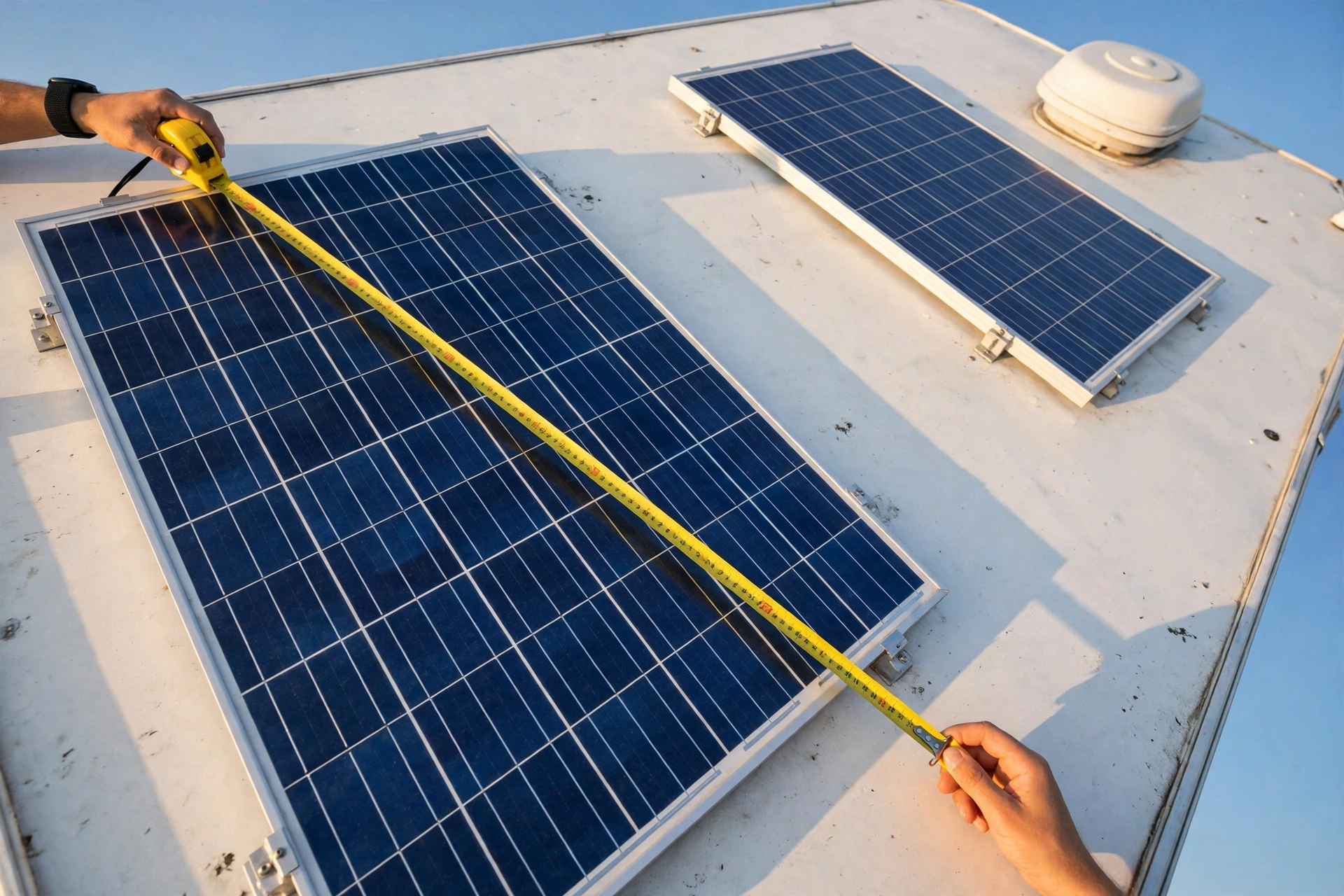
The short answer: divide your daily energy use in watt-hours by (peak sun hours × 0.75). That gives the panel watts you need. A campervan using about 700Wh a day in a place with 4 peak sun hours needs 700 ÷ (4 × 0.75) = about 250W of panels — in practice, 300W. Everything below is about getting the three inputs right: your daily use, your sun hours, and the 0.75 derate that separates a panel’s label from what it actually delivers.
Disclosure: this guide is research, not hands-on testing — every figure below comes from published manufacturer specs, the US Energy Information Administration, NREL’s PVWatts model, and independent guides as of November 2026. There are no affiliate links on this page. See our disclosure for how the site is funded.
The mechanism: watts are not watt-hours, and labels are not output
Sizing goes wrong in two predictable ways, and both come from confusing three different numbers.
Watts (W) are a rate; watt-hours (Wh) are an amount. A 100W panel produces 100 watts at one instant in full sun. Run it at that rate for one hour and you have 100Wh of energy. Your loads are the same: a 50W fridge running for 10 hours uses 500Wh. Sizing is a Wh problem — how much energy you need per day — and the panel’s watts are only the tool that produces it.
A panel’s rated watts are measured at standard test conditions: 1,000 W/m² of sunlight on a panel at 25°C. Real panels almost never see those conditions. Heat cuts output (roughly 0.3–0.4% per degree above 25°C), the sun is rarely square-on, dust and wiring lose a few percent, and the charge controller takes its cut. NREL’s PVWatts model puts total system losses at 14.08% by default for a well-installed system; for portable and RV setups — angled panels, long cable runs, partial shade — a 0.75 derate (25% losses) is the honest planning figure. That is why the formula divides by peak sun hours × 0.75 instead of by sun hours alone: a 100W panel in 4 peak sun hours does not deliver 400Wh, it delivers about 300Wh.
Peak sun hours are not daylight hours. They are the equivalent hours of full-strength sun. A June day in Arizona might have 14 daylight hours but only about 6 peak sun hours; a December day in the Pacific Northwest might have 8 daylight hours and barely 1.5 peak sun hours. Sizing to daylight hours is the single most common way to end up with half the power you expected.
Step 1: work out your daily use in watt-hours
List every device, its watts, and its hours per day. Watts × hours = Wh. Check the label or manual for watts — a fridge’s label shows its compressor draw, not its daily energy, so count only the hours the compressor actually runs (roughly half the day for a 12V compressor fridge).
| Device | Watts | Hours/day | Wh/day |
|---|---|---|---|
| 12V compressor fridge | 50 | 10 (compressor runtime) | 500 |
| LED lights (4 bulbs) | 10 | 5 | 50 |
| Phone + laptop charging | 60 | 2 | 120 |
| Water pump / roof fan | 30 | 2 | 60 |
| Campervan total | ≈730 |
Three common setups, worked from real load lists:
- Light camping (lights, phones, small fan): ≈150Wh/day. A single 100W panel covers it.
- Campervan / RV with a 12V fridge (the table above): ≈730Wh/day. Needs about 250W of panels.
- Off-grid cabin (fridge, lights, laptop, pump, a few extras): ≈1,000Wh/day. Needs about 350W of panels.
- Home backup essentials (full-size fridge ≈1,200Wh/day, lights, Wi-Fi, phones): ≈2,000Wh/day. Needs about 700W of panels. For context, the average US home uses about 28.4kWh a day (EIA, 2024) — running a whole house on portable solar is not a panel-sizing question, it is a different system entirely, and this guide does not try to size one.
If you already own a portable power station, its battery capacity is a useful cross-check: a station that must recharge fully every day needs panels sized to its capacity, not to a guess. Our guide to charging a power station with solar panels walks through that version of the math, including the station’s solar input limits that cap how much panel you can usefully attach.
Step 2: find your peak sun hours
Use your location’s number, not a generic one. Rough planning figures:
| Region | Peak sun hours (yearly average) |
|---|---|
| Desert Southwest (AZ, southern CA, NM) | 5–6 |
| Most of the US (southeast, midwest, mid-Atlantic) | 4–5 |
| Northeast, Pacific Northwest | 3–4 |
| UK / northern Europe | 2–3 |
Two corrections to apply. Winter is what matters if the setup must work year-round: winter sun hours can run roughly half the summer figure, so a campervan that needs 250W in July may need 400W in January. Shade is not averaged away: a panel that spends half the day behind a tree does not get half its sun hours — a shaded panel’s output collapses far out of proportion to the shaded area, so find a spot with clear sun first and size second.
For a location-specific number, NREL’s free PVWatts calculator (pvwatts.nrel.gov) models your exact address, tilt, and orientation against historical weather data, and is the authoritative check before buying. Our off-grid solar system guide covers how to use it for a fixed installation.
Step 3: run the formula
Panel watts needed = daily Wh ÷ (peak sun hours × 0.75)
At 4 peak sun hours, the divisor is 3 — so panel watts are roughly one-third of daily Wh. The table below does the arithmetic for the common cases at 4 sun hours; scale it to your own sun hours with the formula.
| Daily use | Panel watts needed (4 sun hours) | Practical buy |
|---|---|---|
| 150Wh (light camping) | 50W | 100W panel |
| 500Wh (fridge only) | 170W | 200W panel |
| 730Wh (campervan) | 245W | 300W (3 × 100W, or 200W + 100W) |
| 1,000Wh (off-grid cabin) | 335W | 400W (2 × 200W) |
| 2,000Wh (home backup essentials) | 670W | 800W (4 × 200W) |
Round up, not down, and add margin for cloudy days rather than sizing to a perfect sunny day. A system sized exactly to its daily need on a good day falls behind on the first overcast one and never catches up. One extra panel is cheap insurance; a battery that never fully recharges is a battery that dies early.
Step 4: translate watts into actual panels
Panel wattage is not the only dimension — physical size, weight, and type decide whether the watts fit your roof, your storage, and your setup time.
| Panel | Size (approx.) | Weight (approx.) | Best for |
|---|---|---|---|
| 50W rigid | ≈26 × 21 in | ≈7 lb | Trickle-charging a small battery, a shed light |
| 100W rigid | ≈42 × 21 in | ≈14.5 lb | RV roof, off-grid cabin — the standard building block |
| 100W flexible | ≈43 × 23 in | ≈5 lb | Curved RV roofs, weight-sensitive builds |
| 100W folding portable | ≈45 × 23 in unfolded, folds to ≈23 × 23 in | ≈7 lb | Campsites, moving the panel to follow the sun |
| 200W rigid | ≈59 × 27 in | ≈26 lb | Fewer panels, fewer mounts, bigger arrays |
| 400W rigid | ≈68 × 40 in | ≈45 lb | Large off-grid arrays, home backup |
The dimensions and weights for the 100W rows are from Renogy’s published specs for its 100W 12V monocrystalline rigid panel (41.8 × 20.9 in, 14.5 lb), its 100W flexible panel (43.0 × 22.9 in, 5.3 lb), and its 100W portable folding panel (45.1 × 23.0 in unfolded, 7.3 lb). The 200W and 400W rows are typical sizes for those classes — check the specific panel’s datasheet before planning a roof layout, because a 400W panel at roughly 19 square feet each adds up fast: four of them need about 76 square feet of clear roof before mounting gaps.
A practical note on panel count: several smaller panels beat one big one when shade or roof shape is uneven (one shaded panel in a series string drags the whole string down), and one big panel beats several small ones on mounting hardware and wiring. For RV roofs, the common answer is two or three 100W panels or two 200W panels; for a folding portable setup, 100W and 200W panels are the sizes that stay liftable by one person. Our portable solar panel guide compares rigid, flexible, and folding types in detail.
Step 5: size the other three parts, not just the panels
A correctly sized panel on an undersized battery or controller is still a broken system. Three checks, each one line of arithmetic:
Battery. The battery must hold at least a day’s use, and ideally two, so the system survives a cloudy day. Daily Wh ÷ battery volts ÷ usable share = amp-hours needed. For the 730Wh campervan on a 12V LiFePO4 bank (about 80% usable in practice after keeping a reserve): 730 ÷ 12 ÷ 0.8 ≈ 76Ah — a 100Ah battery is the right size, and 200Ah gives a full cloudy-day buffer. Lead-acid is different: only about 50% of its capacity is usable without shortening its life, so the same load needs roughly twice the headline amp-hours. Our LiFePO4 vs AGM comparison covers the chemistry trade-off, and our 100Ah LiFePO4 roundup compares the batteries themselves.
Charge controller. Controller amps ≈ panel watts ÷ battery volts × 1.25 (the 1.25 is the safety margin for cold mornings, when panel voltage and current both rise). 200W on a 12V battery: 200 ÷ 12 × 1.25 ≈ 21A, so a 30A controller. 400W on 12V: ≈42A, so a 50A controller; the same 400W on a 24V battery needs only ≈21A. If your number lands near a controller’s rating, go up a size — a controller running at its limit on a cold, clear morning is a controller about to trip. Our MPPT vs PWM guide explains which controller type the array actually needs.
Inverter (if you run AC loads). The inverter must cover the largest single load’s starting watts — a fridge compressor can draw 3–4× its running watts for a second at startup — and the battery must deliver that surge without its voltage collapsing. Sizing the inverter is a separate calculation from sizing the panels, but a 2,000Wh-a-day home-backup setup with a full-size fridge needs a 2,000W-class inverter and a battery bank to match, not just 800W of panels.
The mistakes that waste money
| Mistake | What happens | Fix |
|---|---|---|
| Sizing to daylight hours instead of peak sun hours | Half the expected energy on a winter day | Use peak sun hours; check PVWatts for your location |
| Ignoring the 0.75 derate | A “400W” array that delivers 300Wh on a good day | Divide by (sun hours × 0.75), not by sun hours |
| Buying panel watts before listing loads | A 100W panel on a 500Wh-a-day fridge, dead by evening | List loads first; the fridge decides the array size |
| One panel for a battery that must recharge daily | Battery never reaches full charge; capacity fades early | Size panels to the battery’s daily recharge need, not its size |
| Forgetting the controller and battery | Panels arrive, nothing to connect them to | Size controller amps and battery amp-hours in the same pass |
| Sizing to summer, camping in winter | System works in July, fails in January | Use the winter sun-hour figure for year-round setups |
The bottom line for RV, camping, and off-grid sizing
Daily watt-hours decide everything; panel watts are just the answer to that number. Add up what you use, divide by (peak sun hours × 0.75), round up, and buy panels in the sizes that fit your roof and your hands — 100W as the standard building block, 200W where fewer mounts matter, folding portables where the panel moves with the sun. Then size the battery to hold a day or two of that use and the controller to carry the array with a 25% margin, and check the real number for your location in PVWatts before you spend anything. Done that way, the question stops being a guess and becomes a calculation you can redo in five minutes whenever your loads change.