
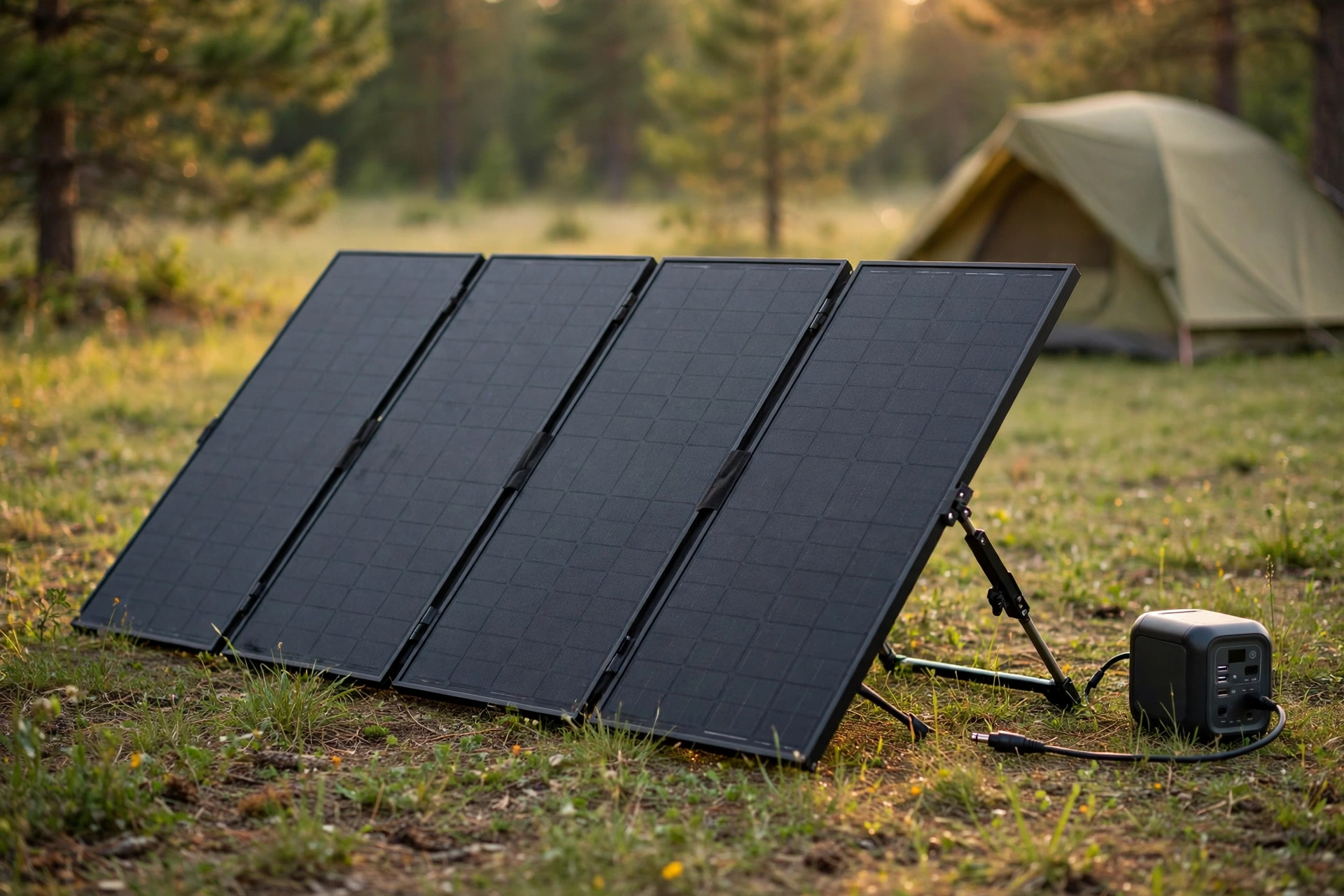
The short answer: the best folding solar panel for most campers is the Renogy E.Flex 200W — $219.99 on Renogy’s site, folding to a 24-inch square at 14.8 lb, and the top-rated folder in OutdoorGearLab’s independent testing, which measured 177W from it in good sun. If you want the highest measured output outright, the EcoFlow NextGen 220W Bifacial posted 193W — but it costs $449 and was out of stock on EcoFlow’s site at our November 2026 check. If you carry the panel any distance on foot, the Renogy REGO 200W blanket at 8.82 lb is the one to look at.
Disclosure: we may earn a commission if you buy through links on this page — see our disclosure. The links here are plain manufacturer links with no affiliate tracking attached. Prices were checked against manufacturer sites in November 2026 and move often with sales, so treat every price below as a snapshot, not a quote.
This is a research roundup, not a hands-on test: picks rest on published specs, owner reports, and published independent measurements as of November 2026.
What folding actually costs you
A folding panel is a rigid panel cut into sections and hinged inside a fabric case. The cells are the same monocrystalline silicon, but the format changes three things, and all three show up in the buying decision.
First, weight per watt goes up against rigid, and down against glass suitcases. A 200W folding panel weighs 11 to 16 lb; a 200W rigid panel weighs about 26 lb but never moves; a 200W glass briefcase weighs 42 lb. Folding sits in the middle: light enough to carry from the car to the campsite, heavy enough that you notice it on foot.
Second, the fold is a wear point. Every setup flexes the hinges, the fabric, the cable routing between sections, and the kickstand pivots. A panel folded and unfolded daily for a season of camping takes more mechanical abuse than a roof panel takes in a decade. That is why folding-panel warranties run 1 to 5 years against 25 years for rigid — the manufacturers know the format wears out first. Store the panel dry, never fold it damp, and do not drag it across gravel by its handle.
Third, output is the same physics as any panel, with one advantage folding adds: angle. A panel’s rating is measured under Standard Test Conditions — 1,000W of sunlight per square metre on a cell held at 25°C, sun dead perpendicular. Real panels run hotter than 25°C in direct sun, and heat costs roughly 0.25 to 0.3 percent per degree above 25°C. A folding panel’s kickstand is the fix: tilting the panel toward the sun through the day recovers more watts than any cell upgrade. The panels that fold flat with no usable stand — blankets — give that advantage away, which is why they need a bright, open pitch to earn their rating.
The four fold shapes
Not every panel that folds is the same product. The shape decides how it packs, how it stands, and how long it lasts.
- Fabric quad-fold. Four hinged sections in a fabric case with magnetic closures and adjustable kickstands — the Renogy E.Flex, the EcoFlow NextGen, the Jackery SolarSaga, the Marbero. This is the default folding panel: about a 24-inch square folded, 11 to 16 lb at 200W, and the best balance of output, weight, and setup speed.
- Blanket. Eight or more thin sections that fold into a soft pack with no rigid frame and no kickstand — the Renogy REGO 200W. The lightest watts per pound in this roundup (8.82 lb for 200W) and the smallest folded footprint, but you lay it flat or lean it on something, and there is no angle adjustment.
- Glass briefcase. Two rigid glass panels hinged like a suitcase, with a handle and a carry bag — the Goal Zero Boulder 200. The toughest build here and the only one that survives being thrown in a truck bed, but 42 lb and a 40-inch folded length make it a base-camp panel, not a carry panel.
- Glass suitcase kit. Two rigid panels plus a charge controller in the case, built to charge a 12V battery directly — the Renogy 200W suitcase at 28.5 lb. It is a folding panel only in the sense that it closes; in use it is a portable rigid system for RV battery charging, covered in our portable solar panels hub rather than here.
The comparison
Prices are US dollars from manufacturer sites as of November 2026. Measured watts are OutdoorGearLab’s side-by-side results from July 2026, charging an identical power station at altitude on a clear day.
| Panel | Watts | Measured output | Weight | Folded size | Weather | Price, Nov 2026 |
|---|---|---|---|---|---|---|
| Renogy E.Flex 200W | 200W | 177W (88%) | 14.8 lb | 23.7 × 23.0 × 2.0 in | IP65 | $219.99 |
| EcoFlow NextGen 220W Bifacial | 220W front / 175W rear | 193W (88%) | 15.4 lb | 24.2 × 23.2 × 1.3 in | IP68 | $449 list; out of stock at EcoFlow |
| Jackery SolarSaga 200W | 200W | 171W (86%) | 14.3 lb | 24.2 × 21.7 in | IP68 | $429 list |
| Renogy REGO 200W blanket | 200W | Not independently measured | 8.8 lb | 16.1 × 15.4 × 3.1 in | IP65 | ≈$216–$238 |
| Goal Zero Boulder 200 Briefcase | 200W | 166W (83%) | 42 lb | 40 × 26.8 × 3.5 in | IP65 | $599.95 list; ≈$450 street |
| Marbero 200W Portable | 200W | 134W (67%) | 14.2 lb | — | IP68 | ≈$187 |
| FlexSolar 100W | 100W | 70W (70%) | 4.1 lb | — | IP67 | $89 |
Renogy E.Flex 200W — best folding panel overall
The best balance in this roundup, and OutdoorGearLab’s top-rated folding panel. The E.Flex 200W is a four-fold fabric panel with N-type cells at a claimed 25 percent efficiency, ETFE lamination, and an open-circuit voltage of 21.6V — a standard 12V-class panel that pairs with almost any power station or charge controller through its MC4 output. It folds to 23.7 × 23.0 inches at 14.77 lb, closes with a magnetic clasp, and has a zippered pocket for the cable and adapters, plus USB-C and two USB-A ports for charging devices directly off the panel.
The number that earns it the top spot is the measured output: 177W from a 200W rating, 88 percent, the joint-highest efficiency in the test field — and it did that at $219.99, roughly half the price of the EcoFlow and Jackery panels it out-measured. OutdoorGearLab’s testers also rated its kickstand legs the sturdiest and most wind-resistant in the field, which matters more than it sounds: a panel that blows flat at 2pm loses the whole afternoon. The honest caveats are the IP65 rating, a step below the IP68 panels here, and a folded thickness of about 2 inches — chunkier than the EcoFlow’s 1.3 inches. Neither is a reason to buy anything else. Check the current price on Renogy’s site.
EcoFlow NextGen 220W Bifacial — highest measured output
The most watts you can get from a single folding panel, measured as well as rated. The NextGen 220W is a four-fold N-type TOPCon panel, 25 percent claimed efficiency, bifacial — 220W from the front face, 175W from the rear over a bright surface — with an IP68 rating, an integrated adjustable stand with a solar angle guide, and a 21.5V open-circuit voltage. OutdoorGearLab measured 193W from it, the highest output of any folding panel they tested, and a second independent tester measured 194W at altitude.
Two real problems at our November check. First, the price: $449 list on EcoFlow’s site, up from the $399 it sold at in late October, and the panel was out of stock there at our check — retailers may still carry it, but the manufacturer’s own store had none. Second, the warranty: 12 months in the US, the shortest of any panel here, against 3-plus-2 years for Jackery and 5 years for Anker. The rear face is a bonus, not capacity to plan around: over sand, snow, or light gravel it adds real watts; over dark grass it adds almost nothing. Buy it if you want the biggest single-panel harvest and can find it in stock; buy the Renogy if you want nearly the same measured output for half the money. Check the current price on EcoFlow’s site.
Jackery SolarSaga 200W — best for Jackery owners
The default panel if you own a Jackery power station, and a strong folder on its own numbers. The SolarSaga 200W is a four-fold bifacial panel with ETFE lamination, an IP68 rating, and USB-A and USB-C ports built into the panel for direct device charging. It plugs straight into Jackery Explorer stations with no adapter — two of them hit the 400W solar limit on the Explorer 1000 v2 and 2000 v2 — and OutdoorGearLab measured 171W from it, calling it one of the most consistent folding panels they tested. Its warranty is 3-plus-2 years, the longest here.
The price is the problem: $429 list on Jackery’s site at our check, up from the $379 sale price of late October, and the panel was on pre-order shipping by early December. At that price it costs nearly double the Renogy for 6W less measured output. The case for buying it is entirely about the ecosystem: if you own a Jackery station, the plug-and-play pairing and the warranty are worth the premium. If you do not own a Jackery, the Renogy or the EcoFlow gives you more for the money. Check the current price on Jackery’s site.
Renogy REGO 200W blanket — lightest 200W folder
The panel to buy when weight is the deciding spec. The REGO 200W is not a hinged fabric folder but a blanket: eight thin N-type sections that fold into a 16.1 × 15.4-inch pack, weighing 8.82 lb — about 6 lb lighter than the next-lightest 200W folder and light enough to carry on shoulder straps. It claims 25 percent cell efficiency, carries an IP65 rating, and has an MC4 output plus a 45W USB-C port and two USB-A ports for direct device charging. At ≈$216 to $238 it costs about the same as the E.Flex while weighing 40 percent less.
Three honest caveats. First, no independent tester has published a measured output for it yet, so the 200W rating is the manufacturer’s word alone — the E.Flex, by contrast, has a published 177W. Second, a blanket has no kickstand: you lay it flat, drape it over a windshield, or lean it against something, and a flat panel loses output steeply as the sun drops. Third, Renogy’s listing does not publish the open-circuit voltage, which you need to confirm against your power station’s solar input limit before buying. Buy it when the panel travels on your back or in a day pack; buy the E.Flex when it travels in a vehicle and a kickstand matters more than 6 lb. Check the current price on Renogy’s site.
Goal Zero Boulder 200 Briefcase — toughest build
The only panel here built like a piece of job-site equipment. The Boulder 200 Briefcase is two rigid 100W panels in tempered glass and an aluminium frame, joined by a single hinge, with corner protection, pop-out legs, and a canvas carry bag. It is the heaviest panel in this roundup by a wide margin — 42 lb, folded to 40 × 26.8 × 3.5 inches — and OutdoorGearLab measured 166W from it, 83 percent of its rating, a normal real-world figure. It connects through Goal Zero’s High Power Port, with 8mm and Anderson adapters included, and carries a 2-year warranty.
The weight is the whole story: 42 lb is not a panel you carry any distance, and at $599.95 list (about $450 street) it is the most expensive 200W folder here per watt. The kit version, with a pre-installed 20A PWM charge controller and battery cables for $649.95, is the better buy if you charge a 12V battery directly — but that is a different job from charging a power station. Buy the Boulder if the panel lives in a truck bed or at a base camp where it gets knocked around and never carried far; buy a fabric folder for anything you lift more than once a day. Check the current price on Goal Zero’s site.
Marbero 200W Portable — best budget 200W
The cheapest way into an honest 200W folder, with a measurement that shows exactly what the discount costs. The Marbero 200W is a four-fold fabric panel at 14.2 lb with an IP68 rating and the widest adapter set here — MC4, XT60, DC7909, and Anderson 30A in the box — so it pairs with almost any station without a separate adapter purchase. At ≈$187 it undercuts every other 200W folder here by $30 or more.
The measured output is the catch: OutdoorGearLab recorded 134W from it, 67 percent of its rating — the lowest in the test field by a wide margin, and 43W behind the Renogy at a similar weight and size. That is still enough to refill a 500Wh station on a good day, and the panel is a fair buy at the price, but the saving is paid for in watts, not just in brand name. A lesser-known budget panel, the JJN Bifacial 200W, measured 182W at about $130 — but it weighs 25 lb and comes from a brand with thin support, so we would not recommend it over the Marbero without a warranty you can read first. Buy the Marbero when the budget is fixed and the station is small; buy the Renogy when 40 extra measured watts are worth $30. Check the live price at your retailer of choice before ordering — Marbero sells mainly through marketplaces, where prices move daily.
FlexSolar 100W — best ultralight folder
The panel for a backpack, not a car boot. The FlexSolar 100W is a folding panel at 4.1 lb — lighter than most laptops — with an IP67 rating and a measured output of 70W in OutdoorGearLab’s testing, 70 percent of its rating. At $89 it is the cheapest panel here by a wide margin, and it charges phones, tablets, and lights directly through its USB ports with no power station in the loop.
The limits are the ones the numbers already state: 70 measured watts refills a phone many times over but makes only a small dent in a 500Wh power station, and the 70 percent measured efficiency is the weakest ratio in this roundup. It is a device charger that happens to be a solar panel, not a power-station charger. Buy it for backpacking, bikepacking, or a day pack; buy the Jackery SolarSaga 100 Air at 7.1 lb and $249 if you want a 100W panel with a longer warranty and a power-station plug. Check the live price at your retailer of choice before ordering — FlexSolar sells mainly through marketplaces, where prices move daily.
Matching the fold to the trip
Buy by how the panel travels, then by watts.
- Car camping, panel rides in the boot: Renogy E.Flex 200W. Best measured output per dollar, the sturdiest kickstand in testing, and a folded size that fits any boot or RV locker.
- Biggest single-panel harvest: EcoFlow NextGen 220W — if you can find it in stock. 193W measured is the best in this roundup, but check availability before planning around it.
- Jackery station owner: Jackery SolarSaga 200W. Plug-and-play pairing and the longest warranty here; the premium is the price of the ecosystem.
- On foot, panel on your back: Renogy REGO 200W blanket at 8.82 lb, or the FlexSolar 100W at 4.1 lb if the load is only phones and lights.
- Base camp or truck bed, panel stays put: Goal Zero Boulder 200 Briefcase. Nothing else here survives the same abuse, and nothing else weighs 42 lb.
- Fixed budget, small station: Marbero 200W. Accept the 134W measured output with open eyes — it is still a working 200W-class panel for about $187.
Connectors and voltage: the two checks before you pay
Two numbers decide whether a folding panel works with your station, and watts is not one of them. The first is the panel’s open-circuit voltage (Voc) against your station’s maximum solar input voltage — exceed it and you can damage the station’s charge controller. The panels here are all 12V-class, around 21.5 to 21.8V Voc, which suits most stations, but the REGO blanket’s listing does not publish a Voc at all, so confirm it with the seller before buying. The second is the station’s maximum solar input watts: a station rated for 200W of solar will not charge faster from a 220W panel, and buying panel watts above the limit buys nothing. Check both numbers on the station’s spec sheet, and the connector — same-brand pairing is plug-and-play, cross-brand usually needs an adapter cable the panel maker sells separately. Our portable solar panels hub covers connectors and sizing in more depth, and our sizing guide has the daily-yield arithmetic.
What folding panels cannot do
No folding panel here will match a rigid panel for lifespan. The honest expectation is years of regular camping use, not decades: the fabric case, hinges, and kickstands wear with every setup, and the 1- to 5-year warranties reflect that. A folding panel is also not a roof panel — it has no mounting holes for a permanent install, and leaving one unfolded on a roof in wind is asking for it to blow away. For a panel that lives on a roof, see our flexible solar panels hub for curved roofs or our 200 watt roundup for rigid panels.
No single folding panel here will run a full-size refrigerator, an air conditioner, or a heater — those are kilowatt-hour jobs. A 200W folding panel delivers about 560 to 750Wh on a good sunny day, enough to refill a 500Wh power station, run lights and phones indefinitely, and keep a small 12V fridge going with margin. If your daily need is over about 1,500Wh, you want 400W or more of panels — see our sizing guide — and our RV solar kit hub for complete roof systems. And a folding panel is not a substitute for a flexible panel: it does not bond to a roof, it does not follow a curve, and it needs ground space and sun angle to work. Buy folding for the ground it travels to, flexible for the roof it lives on.
One timing note for buyers: a Section 232 trade proclamation signed in August 2026 sets minimum import prices for solar modules, taking effect December 4, 2026. Panel prices may rise after that date, so a price quoted in November is not necessarily the price in January.
How to buy
- Pick by how the panel travels first. On foot: blanket or 100W folder. In a vehicle: quad-fold 200W. At a base camp: glass briefcase. The wrong form factor is a worse mistake than the wrong brand.
- Judge by measured watts, not rated watts. The spread in this roundup runs from 134W to 193W for panels all rated 200W or more. The Renogy’s 177W and the EcoFlow’s 193W are published measurements; the REGO blanket has none yet.
- Check the folded size against your storage. A 200W quad-fold is about a 24-inch square; the Boulder briefcase is 40 inches long; the REGO blanket packs to 16 inches. Measure the locker or boot first.
- Check the voltage before the price. Read your station’s solar input window, then the panel’s Voc. The REGO blanket’s missing Voc is the trap to watch: confirm it with the seller.
- Check the variant name. Renogy E.Flex, not the Renogy suitcase kit — the folder is 14.8 lb and $219.99, the suitcase is 28.5 lb with a controller included, and they are different products. Goal Zero Boulder Briefcase panel, not the Boulder Briefcase kit — the kit adds a 20A controller and costs $649.95.
- Budget for the adapter if you mix brands. Same-brand pairing is plug-and-play; a Jackery panel on an EcoFlow station, or the reverse, needs the maker’s adapter cable, sold separately.
- Check the price on the day. Every panel here spends part of the year on sale — the Jackery’s $379 sale price against its $429 list is a $50 swing, and the EcoFlow went from $399 to $449 and out of stock in under a month — and Black Friday week moves prices daily. Confirm stock before planning a trip around a panel.
Methodology
Compiled in November 2026 from manufacturer spec sheets and store pages (Renogy, EcoFlow, Jackery, Goal Zero), a published independent measurement set (OutdoorGearLab’s side-by-side portable solar panel test, updated July 13, 2026, charging an identical power station), and editorial roundups (Top Notch Outdoor, Offgrid Authority). Wattages, weights, folded sizes, efficiencies, voltages, and IP ratings were checked against at least two sources each; where sources disagreed — the Boulder Briefcase’s weight, listed as 42 lb by Goal Zero and measured at 43.3 lb by OutdoorGearLab, and the REGO blanket’s price, listed between $216 and $238 — both figures are stated. Prices are US list and sale prices observed on manufacturer sites in November 2026; they change frequently, so list and sale prices are stated separately where they differ. No unit was hands-on tested, and no output figure here comes from our own measurement. If a figure here disagrees with a manufacturer’s current page, that page wins; check it before buying.