
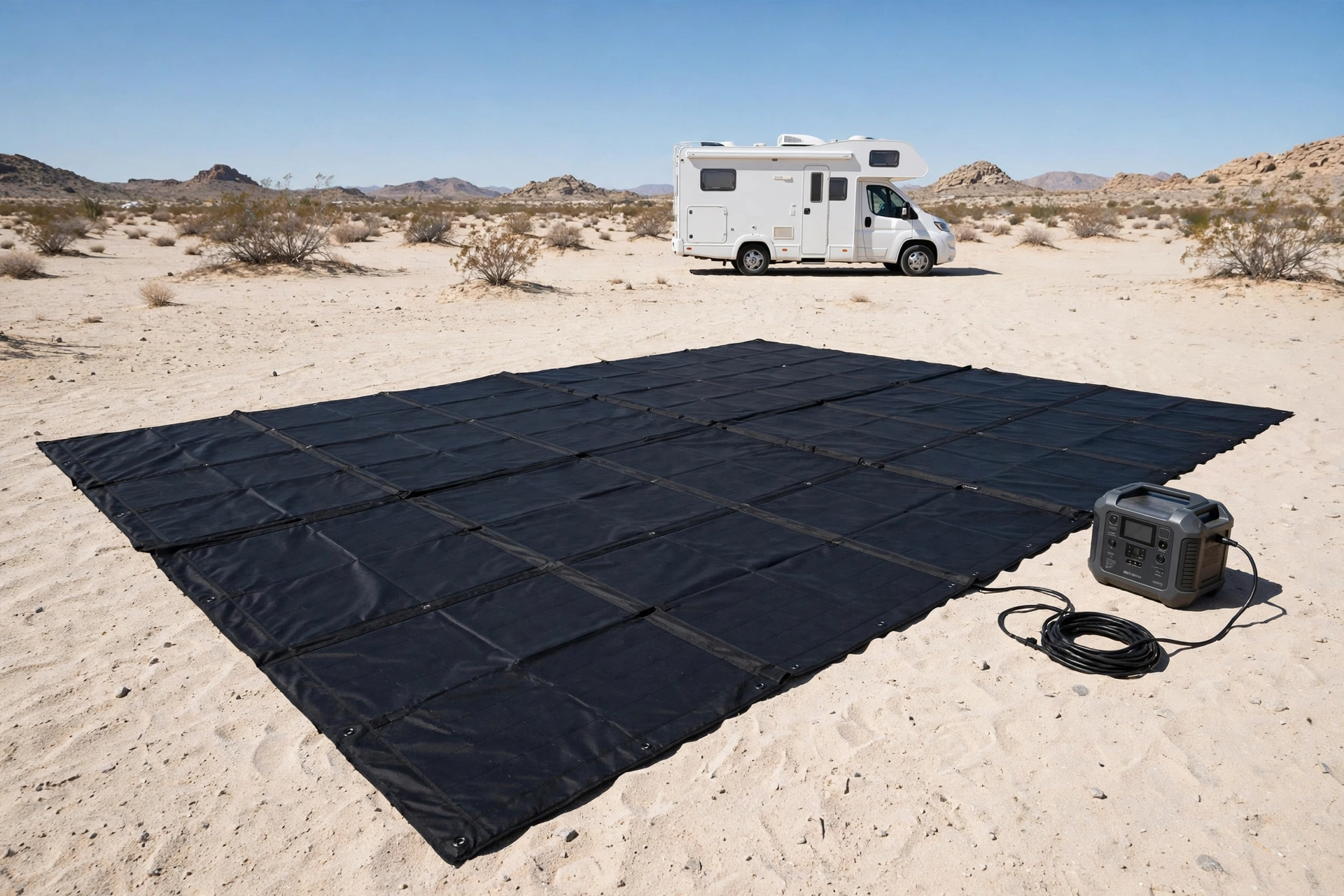
The short answer: the best 400 watt solar panel for most campers is the Renogy 400W N-Type Blanket — 400W at 16.1 lb, folding to backpack size, for $449.99 on Renogy’s site. If the panel lives on a roof instead of the ground, the HQST 400W set — two 200W rigid panels — is the cheapest 400W we track at $206.99. For a permanent RV roof with a charge controller included, the Renogy 400W Premium Kit bundles four 100W panels with a 40A MPPT controller for about $530 on Amazon.
Disclosure: we may earn a commission if you buy through links on this page — see our disclosure. The links here are plain manufacturer links with no affiliate tracking attached. Prices were checked against manufacturer sites in November 2026 and move often with sales, so treat every price below as a snapshot, not a quote.
This is a research roundup, not a hands-on test: picks rest on published specs, owner reports, and published measurements as of November 2026.
What 400 watts actually buys you
A solar panel’s wattage is a laboratory rating, not a promise. The 400W figure is measured under Standard Test Conditions: 1,000W per square metre of sunlight hitting a cell held at 25°C, with the sun perfectly perpendicular. Outdoors the sun is rarely that strong at the panel, the angle is rarely perfect, and hot cells lose output — so plan on about 70 to 80 percent of the rating in good sun, and less in winter, haze, or heat.
The number that matters for buying is watt-hours per day, not watts on the label. A 400W panel with about 5 peak sun hours delivers roughly 400 × 5 × 0.75 ≈ 1,500Wh on a good day. That is enough to refill a 1,000Wh power station with margin, run a 12V fridge averaging 40W (about 960Wh a day) plus lights and a laptop, or keep a 2,000Wh station topped up across two sunny days. It is not enough to run a full-size refrigerator, an air conditioner, or a heater for any useful length of time — those are kilowatt-hour jobs, and a single 400W panel covers roughly half a fridge’s daily need.
Folding, rigid, or kit: three panels, three jobs
“Best 400 watt solar panel” hides three different products that happen to share a wattage. Buy the wrong form factor and the panel fights you every trip.
- Folding panels and blankets unfold on the ground, drape over a vehicle, or hang from a rope, and pack away when you drive. They are the camping choice: they move with the sun and plug straight into a power station. They cost the most per watt — about $0.85 to $1.75 — because you are paying for portability. At 400W they are also heavy: 16 to 35 lb, a two-hand carry, not a backpack panel.
- Rigid panels are glass-and-aluminium rectangles that bolt to a roof and stay there. They are the cheapest per watt — about $0.50 — and the longest-lived, with 25-year output warranties. They are the RV and cabin choice. A single rigid 400W panel is about 68 × 45 inches of glass; two 200W panels cover the same watts in a shape that fits around roof vents and air conditioners.
- Kits bundle panels with a charge controller, brackets, and cables in one order. They are the first-build choice: everything arrives together and the controller is already matched to the panels. You pay for the convenience — a 400W kit costs more than the same watts bought as bare panels.
This roundup covers all three, because the search for a 400W panel splits across all three jobs. Pick the form factor first, then the panel.
The comparison
Prices are US dollars from manufacturer sites as of November 2026. Sets are listed at their combined wattage.
| Panel | Type | Watts | Weight | Weather | Voc | Price, Nov 2026 |
|---|---|---|---|---|---|---|
| Renogy 400W N-Type Blanket | Folding blanket | 400W | 16.1 lb | IP65 | 39.2V | $449.99 list; was $499.99 |
| Renogy 400W Suitcase (RSP400LSC) | Folding suitcase | 400W | 30.2 lb | IP67 | 47.2V | $495.99; seen near $400 on sale |
| EcoFlow 400W Lightweight Portable | Folding | 400W | — | IP68 | — | $699; pre-order, ships late Dec |
| BougeRV 400W N-Type Bifacial | Rigid, single panel | 400W | 44.4 lb | — | 39.7V | $479.99 |
| HQST 400W set (2 × 200W) | Rigid, two panels | 400W | — | IP65 | — | $206.99 |
| Renogy 400W Premium Kit | Kit, 4 × 100W + 40A MPPT | 400W | 56.4 lb (kit) | — | — | ≈$529.99 on Amazon |
Renogy 400W N-Type Blanket — best overall
The lightest 400W portable panel we track, and the most versatile: 400W from N-type 16BB cells at 25 percent efficiency, 16.09 lb, folding to 16.5 × 15.8 × 4.1 inches — genuinely backpack size — with a carry handle and shoulder straps. It lays on the ground, drapes over a windshield, or hangs from a rope, and it switches between 400W, 300W, 200W, and 100W output levels so it keeps producing even partly folded. The included 4-in-1 cable covers Anderson, XT60, DC 8mm, and DC 5.5mm plugs, so it reaches most power stations without a separate adapter purchase. Renogy covers it for 2 years.
Two honest caveats. First, there are no kickstands: angling it toward the sun means draping it or propping it, not unfolding a stand — it is a blanket, not a suitcase. Second, the output is MC4 only: Renogy’s own FAQ confirms the USB charging ports are on the 200W blanket, not this one, so a phone charges through a power station, not straight from the panel. At $449.99 it is also the most expensive 400W per pound saved — but if the panel moves between the car, the campsite, and storage every trip, 16 lb against 30 lb is the difference between carrying it and leaving it behind. Check the current price on Renogy’s site.
Renogy 400W Suitcase (RSP400LSC) — best folding suitcase
The panel for buyers who want a 400W folder that stands on its own: a suitcase that unfolds to over 9 ft long on aluminium kickstands, angles toward the sun without improvising, and folds back into a 27.9 × 33.7-inch case with a carry handle. It is a 400W monocrystalline panel at 30.2 lb with IP67 waterproofing — the best weather rating among the folding panels here — a 47.2V open-circuit voltage, and a 3-year warranty, a year longer than the blanket’s. It can wire in series or parallel with more panels as the system grows.
The trade-off is the weight and the bulk: 30.2 lb and a 9 ft unfolded length make it a two-hand carry from the car, not a panel you sling over a shoulder. And like the blanket it is MC4 output only, with no USB ports and no power-station adapter in the box — budget about $15 to $25 for the adapter cable. At $495.99 list it costs more than the lighter blanket; it has been seen on sale near $400, at which point the stand-it-up convenience is fairly priced. Buy the suitcase if the panel stays at one campsite per trip and you want it standing and angled with no fuss; buy the blanket if it moves every day. Check the current price on Renogy’s site.
EcoFlow 400W Lightweight Portable — best for EcoFlow owners
The newest 400W folder here and the most watts per pound from a major brand: a 400W bifacial panel (445W under bifacial test conditions — judge it on the 400W front-side rating) at up to 25 percent efficiency, with a built-in 3.5 m XT60 cable that plugs straight into EcoFlow River and Delta stations, a 30-to-60-degree stand with an integrated solar angle guide, and IP68 protection. EcoFlow covers it for 5 years, the longest warranty in this roundup.
The catch is availability: at our November check EcoFlow’s US store listed it at $699 as a pre-order shipping late December, sold out in the meantime. The older EcoFlow 400W rigid panel is a different product — a roof panel sold in multi-panel bundles — so check the product name, not just the wattage. If the lightweight portable is in stock when you buy and you own an EcoFlow station, the zero-adapter fit and the 5-year warranty justify the premium over the Renogy blanket. If it is still on pre-order, the Renogy blanket at $250 less is the panel to buy that week. Check the current price on EcoFlow’s site.
BougeRV 400W N-Type Bifacial — best single rigid panel
The only true single 400W rigid panel in this roundup: one glass-and-aluminium panel, 67.8 × 44.6 × 1.4 inches at 44.4 lb, with N-type 16BB bifacial cells, a 39.7V open-circuit voltage, and a 33.16V operating voltage. One panel, one cable run, no parallel wiring to plan — the simplest 400W roof array there is, and the bifacial rear face adds output over a pale roof or light gravel.
The trade-off is size: a single 68-inch panel needs a clear rectangle a two-panel set does not, and at $479.99 it costs more than twice the HQST 2×200W set for the same 400W. It is also a 44 lb lift onto a roof, a two-person job. Buy it for a ground mount, a shed, or a van roof with one big clear rectangle; buy the HQST set if the roof is crowded with vents or the budget matters more than the single-panel simplicity. Check the current price on BougeRV’s site.
HQST 400W set (2 × 200W) — best budget
The cheapest 400W in this roundup by a wide margin: two 200W N-type rigid panels with 16-busbar Grade A+ cells at up to 25.4 percent efficiency, aluminium frames, and IP65 protection, for $206.99 — about $0.52 per watt, less than half the cost per watt of any folding panel here. The set is rated for 2,400 Pa wind load with a 30-year service life at 87.4 percent output.
Two panels instead of one is a feature, not a compromise: they fit around roof vents and air conditioners where a single 68-inch panel cannot, they split the carry weight, and if one panel is shaded the other keeps producing. The trade-off is the brand: HQST is a value brand with thinner support and documentation than Renogy or BougeRV, and the set ships as bare panels — no controller, no brackets, no cables in the box. For a DIY roof array on a budget, that is the right trade; for a first build where everything needs to arrive together, the Renogy kit below is the better order. Check the current price on HQST’s site.
Renogy 400W Premium Kit — best complete RV kit
The one-order 400W roof system: four 100W rigid panels, a Rover 40A MPPT charge controller, a Bluetooth monitoring module, cabling, and Z-brackets, for about $529.99 on Amazon at our check (Renogy’s own store lists it at $639.99). The controller is the point: an MPPT unit harvests more of the 400W than a cheap PWM controller, the Bluetooth module shows charging live in the Renogy app, and Renogy rates the Rover 40A for about 520W of panels on a 12V battery, so the kit has headroom to grow. The whole kit weighs 56.4 lb — a two-person roof job.
What it does not include is a battery or an inverter, so budget for those separately, and the panels carry a 10-year output warranty rather than the 25-year output coverage some rigid panels advertise. Buy it if you are building your first RV roof system and want the controller matched and the hardware in one box; buy bare panels if you already own a controller. See our RV solar kit hub for the wider kit picture. Check the current price on Renogy’s site.
Matching the panel to your station: voltage and connectors
Two numbers decide whether a panel works with your power station, and watts is not one of them. The first is the panel’s open-circuit voltage (Voc) against the station’s solar input window: the combined Voc of panels wired in series must stay inside it, and Voc rises as cells get colder — about 0.28 percent per degree below 25°C — so a panel that fits on a warm afternoon can exceed the limit on a cold morning. The 400W panels here run 39.2V to 47.2V Voc: each fits a 60V solar input one panel at a time, and none of them wires two-in-series on a 60V input. A 400W panel on a station whose solar input tops out at 28V or 30V does not work at all — check the input window before the price.
The second is the connector. MC4 is the weather-sealed industry standard and the most flexible choice — a Renogy or BougeRV panel reaches any station through a cheap MC4-to-XT60, MC4-to-DC7909, or MC4-to-8mm cable. XT60 is the solar input on EcoFlow and Anker stations; DC8020 is Jackery’s 8mm input. Adapters cost about $15 to $25 and solve the plug problem completely; nothing solves a voltage mismatch, so check Voc first and the plug second. See our portable solar panels hub for the full compatibility picture, and our charging guide for the wiring itself.
Sizing it to your loads
Start with a list, not a product page. For each item, multiply its watts by the hours a day it runs to get watt-hours per day, add the items up, then divide by 0.85 for inverter losses. That is your daily need; the panel’s job is to replace it.
Example: a 12V fridge averaging 40W over 24 hours (960Wh), a laptop at 70W for 3 hours (210Wh), phones and lights (100Wh) — about 1,270Wh per day, about 1,490Wh after losses. One 400W panel delivering about 1,500Wh a day covers that with almost no margin; two 400W panels cover it with room for a cloudy day. A single 400W panel is the right size for a weekend of fridge, lights, and laptops on a 1,000 to 2,000Wh station — see our sizing guide for the full arithmetic — and the right size for keeping a station under $500 topped up at a base camp. If your daily need is over about 1,500Wh, you want 800W of panels, not a better 400W panel.
What a single 400W panel cannot do
No single 400W panel will run a full-size home refrigerator for days — a typical full-size fridge uses 1,000 to 1,500Wh per day, so one panel’s 1,500Wh covers about a day, with nothing left for anything else. None here will run a space heater, air conditioner, electric water heater, or well pump for any useful length of time, and none powers a whole home or backs up a house through a multi-day outage. A 400W panel is a portable-system component: it refills a power station or a 12V battery bank over the course of a sunny day. Buy inside that envelope and it is a genuinely capable tool; outside it, no amount of brand loyalty fixes the physics.
One timing note for buyers: a Section 232 trade proclamation signed in August 2026 sets minimum import prices for solar modules, taking effect December 4, 2026. Panel prices may rise after that date, so a price quoted in November is not necessarily the price in January.
How to buy
- Pick the form factor first. Folding for camping, rigid for a roof, kit for a first build. The wrong form factor is a worse mistake than the wrong brand.
- Check the voltage before the price. Read your station’s solar input window, then the panel’s Voc. The Renogy suitcase’s 47.2V is the trap to watch: it fits 60V inputs only, one panel per input, and never a small station.
- Check the variant name. Renogy blanket, not the Renogy suitcase — the blanket is 16 lb, the suitcase is 30 lb, and they are different products at different prices. EcoFlow lightweight portable, not the EcoFlow rigid 400W. BougeRV 16BB N-type, not the older 10BB bifacial. The older variants are still listed, sometimes at similar prices.
- Budget for the adapter. A $15 to $25 MC4-to-XT60 or MC4-to-8mm cable is part of the system cost for any cross-brand pairing; the panel price alone is not the system price. The EcoFlow and the blanket’s 4-in-1 cable are the exceptions — they ship with the adapter included.
- Check the price on the day. Every panel here spends part of the year on sale — the Renogy blanket’s $449.99 against its $499.99 list is a $50 swing, and the suitcase has been seen near $400 against a $495.99 list — and Black Friday week moves prices daily. The EcoFlow was on pre-order at our check. Confirm stock before planning a trip around a panel.
Methodology
Compiled in November 2026 from manufacturer spec sheets and store pages (Renogy, EcoFlow, BougeRV, HQST), retailer and editorial price checks (RV Gear Lab, SolarGenAdvisor, GearRanking), and published independent measurements where available. Wattages, weights, efficiencies, voltages, and IP ratings were checked against at least two sources each; where sources disagreed — the Renogy suitcase is listed at $495.99 by one tracker and near $400 on sale by another — both figures are stated. Prices are US list and sale prices observed on manufacturer sites in November 2026; they change frequently, so list and sale prices are stated separately where they differ. No unit was hands-on tested, and no output figure here comes from our own measurement. If a figure here disagrees with a manufacturer’s current page, that page wins; check it before buying.