
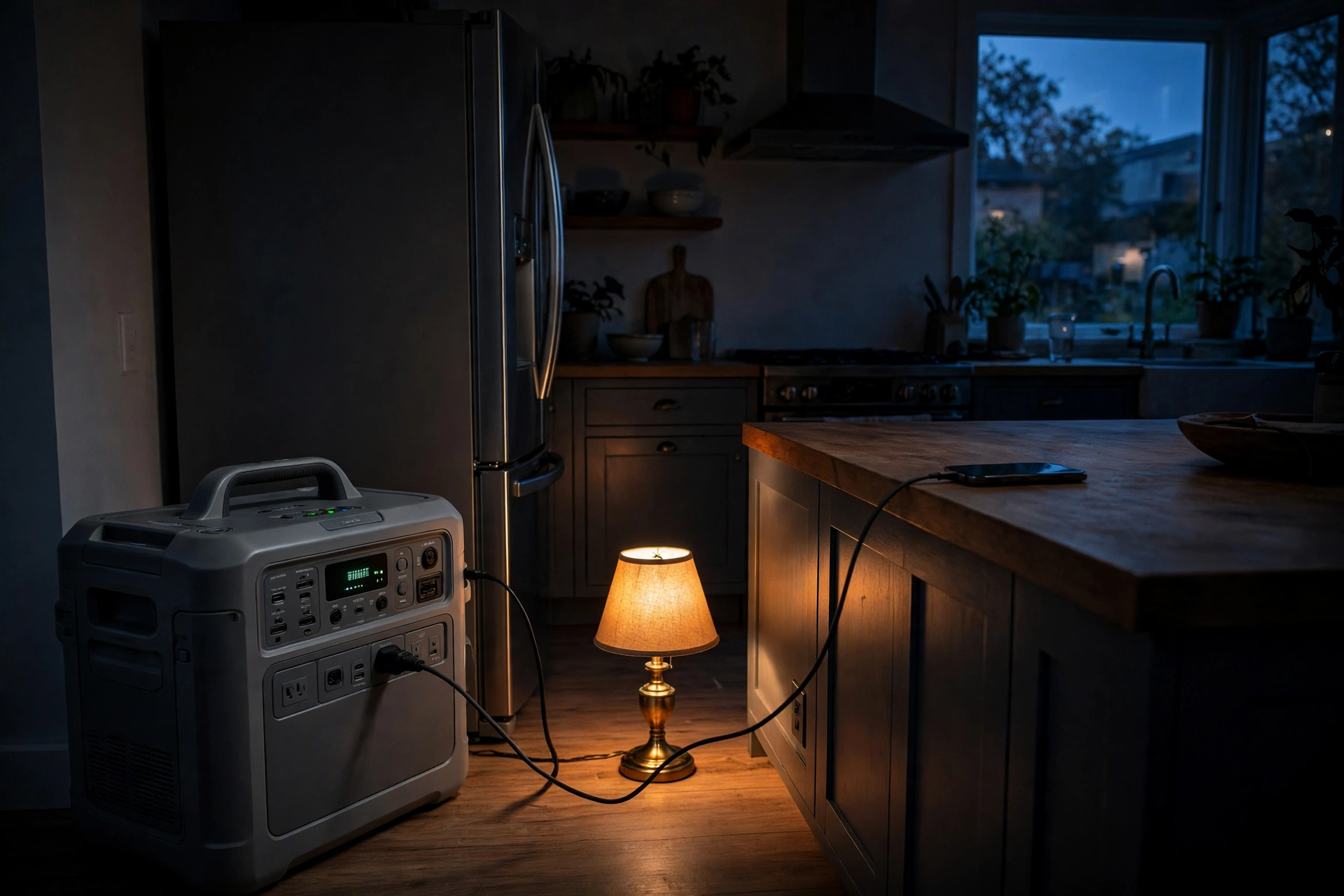
The short answer: the best 1000Wh power station is the EcoFlow DELTA 3 Classic — 1,024Wh of LiFePO4 battery, 1,800W of continuous output, a 500W solar input, a 10ms UPS switchover, and a 5-year warranty, for $479 on EcoFlow’s US store. It is the cheapest current big-brand station in the class, and it gives up nothing that matters at this size. The Bluetti Elite 100 V2 at $499 is the better solar pick — a 1,000W solar input, double the EcoFlow’s — and the Anker SOLIX C1000 Gen 2 at $529.99 is the most powerful, with 2,000W of output and a 49-minute wall recharge. The lightest is the Jackery Explorer 1000 v2 at 23.8 lb, listed at $559 — currently sold out on Jackery’s own store, so check retailers for stock.
Disclosure: we may earn a commission if you buy through links on this page — see our disclosure. The links here are plain manufacturer links with no affiliate tracking attached. Prices were checked against manufacturer sites on November 12, 2026 and move often with sales, so treat every price below as a snapshot, not a quote.
This is a research roundup, not a hands-on test: picks rest on published specs, owner reports, and published measurements as of November 2026.
The rule for this roundup: the 1,000Wh class, station only
“1,000Wh” is a class, not a single number. In real shopping, buyers compare models from about 900Wh to about 1,200Wh side by side because they solve the same problems — a weekend of camping power, an RV’s overnight loads, a home’s essentials through an outage. This roundup holds that class: every pick stores 1,024Wh or 1,070Wh, is a current model on its maker’s US store with a verified live price, and is priced as the station alone — no panels in the price, so the numbers compare cleanly. Our best solar generator hub prices the station-plus-panel kits instead.
The rule is also why there are four picks and not eight. The 1kWh shelf has turned over fast in 2026: EcoFlow’s DELTA 2 is gone from its US store, Bluetti’s AC180 is being replaced by the Elite 100 V2, Jackery sells five different products with “1000” in the name, and DJI’s Power 1000 V2 is not sold through DJI’s own US store at all. The section near the end covers each of those, so you can stop hunting for stations that are gone, renamed, or effectively unavailable.
Quick picks
- Best overall: EcoFlow DELTA 3 Classic — 1,024Wh, 1,800W, $479
- Best for solar: Bluetti Elite 100 V2 — 1,024Wh, 1,800W, $499
- Most powerful: Anker SOLIX C1000 Gen 2 — 1,024Wh, 2,000W, $529.99
- Lightest: Jackery Explorer 1000 v2 — 1,070Wh, 1,500W, $559
What 1,000Wh actually buys you
Two numbers describe almost everything a station can do, and confusing them is the most common buying mistake.
Watt-hours (Wh) are the size of the tank. A 1,024Wh station holds about three and a half times the energy of a 288Wh station, so it runs the same load about three and a half times as long. Watts (W) are the width of the tap. A 2,000W inverter can feed a 1,800W induction burner; a 1,500W inverter cannot, no matter how big the battery behind it is. Capacity decides how long, output decides what.
One correction: you never get the full rated watt-hours out — the inverter loses energy as heat and the battery keeps a reserve. Plan on about 85 percent being usable: a 1,024Wh station delivers about 870Wh. Every runtime below uses that 85 percent rule unless it is a manufacturer-published figure. One published check supports it: OutdoorGearLab measured 890Wh of usable AC energy from the Bluetti Elite 100 V2, about 87 percent of its rated 1,024Wh.
| Load | Draw | Runtime on a 1,024Wh station |
|---|---|---|
| Full-size fridge | About 1,200Wh per day | About 17 hours |
| 12V compressor fridge | 60W | About 14 hours |
| Laptop | 70W | About 12 hours |
| CPAP, no humidifier | 40W | About 21 hours — two nights |
| Microwave | 1,000W | About 50 minutes |
| Coffee maker | 900W | About 55 minutes |
| Router + lights | 20W | About 43 hours |
| Phone charge | 11Wh per charge | About 79 charges |
The fridge row is the one that defines this class. A 288Wh station covers a fridge for a couple of hours; a 1,024Wh station covers most of a day. That is the difference between a camping box and a backup box — and it is why the 1,000Wh class is the smallest size that genuinely backs up a home’s essentials.
Inverter watts: the ceiling on what runs
The inverter sets the hard limit. Add up the watts of everything you want to run at once; pass the inverter’s continuous rating and the station shuts down or refuses the load.
- 1,500W (Jackery Explorer 1000 v2): a microwave, a coffee maker, a full-size fridge, most power tools. A 1,800W induction burner or a large hair dryer is out of reach.
- 1,800W (EcoFlow DELTA 3 Classic, Bluetti Elite 100 V2): the above, plus an induction burner on medium, a 1,500W space heater for short bursts, and a larger microwave. This is the output where a station stops saying no to ordinary kitchen appliances.
- 2,000W (Anker SOLIX C1000 Gen 2): the widest envelope in this class — a full-size microwave and a coffee maker at once, or a 1,800W appliance with headroom to spare.
Note the two numbers brands quote side by side. Continuous watts is what the inverter sustains; surge watts is what it tolerates for a few seconds while a motor starts. The Bluetti’s “Power Lifting” 2,700W figure is a third kind: it pushes past the rating by dropping voltage for resistive loads like heaters. Treat that as a bonus for a kettle, not capacity to plan around: it does not work for motors or sensitive electronics. EcoFlow’s X-Boost works the same way, up to 2,600W.
Solar refill: the panel decides, not the station
A 1,024Wh station is a big tank, and refilling it from the sun takes real panel wattage. On a day with 4.5 peak sun hours, a panel delivers roughly its wattage × 4.5 × 0.85 in watt-hours — the 0.85 covers charge-path losses and real-world panel output below the label.
| Panels | Refill on a good day (4.5 sun hours) | Share of a 1,024Wh battery |
|---|---|---|
| 100W | About 380Wh | About a third |
| 200W | About 765Wh | About three-quarters |
| 400W | About 1,530Wh | Full refill — and more |
That math is also why the solar-input maximum matters. The Bluetti Elite 100 V2 accepts 1,000W of solar, so a 400W array refills it in about half a day and a bigger array later would go faster still. The EcoFlow DELTA 3 Classic caps at 500W and the Jackery Explorer 1000 v2 at 400W — enough for a full refill with a matched array, but with no headroom beyond it. If solar is your main charging path, the Bluetti’s input is the feature to buy; if the wall is your main path, it is a feature you will rarely use. Our how to charge a power station with solar panels guide covers panel sizing in full.
LiFePO4 is now the whole class
Every station here uses lithium iron phosphate (LiFePO4) cells — the older nickel-manganese-cobalt (NMC) chemistry is gone from the current 1kWh shelf. The older chemistry was typically rated for about 500 to 800 full cycles before capacity fell to 80 percent. LiFePO4 is rated for 3,000 to 4,000-plus cycles to 70 or 80 percent, roughly four to six times the life.
The mechanism is structural: LiFePO4’s crystal lattice barely changes shape as lithium moves in and out, so the cell degrades slowly, and it is far more thermally stable — which is why these stations can fast-charge at hundreds of watts. Treat the cycle figures with a sceptical eye, though — manufacturers test under lab conditions, and heat, deep discharges, and long storage shorten real life. Read “4,000 cycles” as “a different league from the 500-cycle packs,” not as a promise of 4,000 trips.
The comparison
Prices are US dollars from manufacturer sites as of November 12, 2026. The Anker price is the discounted street price against a $699.99 list; the others are the prices shown on their makers’ stores.
| Station | Capacity | Inverter (continuous) | Solar input max | Weight | Wall recharge | Price, Nov 2026 |
|---|---|---|---|---|---|---|
| EcoFlow DELTA 3 Classic | 1,024Wh | 1,800W | 500W | 26.7 lb | 0–80% in 45 min | $479 |
| Bluetti Elite 100 V2 | 1,024Wh | 1,800W | 1,000W | 25 lb | AC time not published; 70 min on 1,000W solar | $499 |
| Anker SOLIX C1000 Gen 2 | 1,024Wh | 2,000W | 600W | 24.9 lb | 0–100% in 49 min | $529.99 |
| Jackery Explorer 1000 v2 | 1,070Wh | 1,500W | 400W | 23.8 lb | 0–100% in about 59 min (emergency mode) | $559 — sold out at jackery.com |
All four stations use LiFePO4 cells and carry a 5-year warranty. Price per watt-hour: EcoFlow $0.47, Bluetti $0.49, Anker $0.52, Jackery $0.52.
EcoFlow DELTA 3 Classic — best overall
The cheapest current big-brand 1kWh station, and the one that gives up the least for the price: 1,024Wh, 1,800W of continuous output with 3,600W of surge and X-Boost to 2,600W for resistive loads, a 500W solar input, and LiFePO4 cells, for $479 on EcoFlow’s US store. It recharges from the wall from 0 to 80 percent in 45 minutes and fully in 60, its UPS switchover is 10ms — fast enough that a computer or NAS plugged into it does not notice a power cut — and it runs at a published 30 dB. At 12.1 kg (26.7 lb) it is the heaviest pick here, and it has three AC outlets against the Anker’s five.
The deciding feature is the price. At $479 it is $20 less than the Bluetti, $51 less than the Anker, and $80 less than the Jackery, for the same 1,024Wh and the same 1,800W class of output as the Bluetti. The trade is the solar input: 500W is enough for a full refill with a matched array, but it is half the Bluetti’s headroom, so a solar-first buyer gets more from the Elite 100 V2. For everyone else — wall charging at home, a panel for weekends — the Classic is the pick. One naming note: this is the DELTA 3 Classic, the value version of the DELTA 3 line, not the DELTA 3 or DELTA 3 Plus. Check the current price on EcoFlow’s site.
Bluetti Elite 100 V2 — best for solar
The best solar pick in the class, and the replacement for Bluetti’s AC180: 1,024Wh, 1,800W of continuous output with 3,600W of surge and 2,700W of Power Lifting for resistive loads, and a 1,000W solar input — double the EcoFlow’s and two and a half times the Jackery’s — for $499 on Bluetti’s US store. Its LiFePO4 cells are rated for 4,000-plus cycles, the longest rating here, it weighs 11.5 kg (25 lb), and it carries a 5-year warranty. Bluetti’s own figure is a full solar recharge in about 70 minutes with a 1,000W array.
The 1,000W input is the deciding feature, and it is the only one here that changes what a solar setup can be: with 400W of panels the Elite 100 V2 refills in about half a day of good sun, and the input leaves room to grow the array later instead of replacing the station. The trade is wall charging — Bluetti publishes no AC recharge time for this model, unlike the 45-to-60-minute figures its rivals advertise — and three AC outlets, fewer than the Anker’s five. If the wall is your main path, the EcoFlow is cheaper and faster to refill; if the sun is, this is the station. A bundle worth knowing about: the Elite 100 V2 with a 200W solar panel is $699 on Bluetti’s store. Check the current price on Bluetti’s site.
Anker SOLIX C1000 Gen 2 — most powerful
The most powerful station in the class and the fastest to refill from the wall: 1,024Wh, 2,000W of continuous output with 3,000W of surge, a 600W solar input, and a 49-minute full recharge on AC, for $529.99 on Anker’s US store against a $699.99 list. Its LiFePO4 cells are rated for 4,000 cycles, it weighs 24.9 lb, its UPS switchover is 10ms, and it has five AC outlets — the most here.
The 2,000W output is the deciding feature: it is the only station here that runs a 1,800W appliance with headroom, and the only one that comfortably runs a microwave and a coffee maker at the same time. The 49-minute wall recharge is the fastest in the class, which matters when the power comes back for an hour between outages. The trade is price: $51 more than the EcoFlow for the same capacity, and the street price moves — Anker lists it at $699.99 and applies the discount automatically, so the $529.99 figure is the price on the day, not a list price. Check it on the day you buy. Check the current price on Anker’s site.
Jackery Explorer 1000 v2 — lightest
The lightest station in the class and the one with the longest service history behind it: 1,070Wh, 1,500W of continuous output with 3,000W of surge, and LiFePO4 cells, at 23.8 lb, listed at $559 on Jackery’s store. One honest caveat before anything else: the station alone is currently sold out on jackery.com — the buy button is replaced by a “Notify Me” form, and the SolarSaga 200W kit at $879 is sold out too. The $559 price is the live store listing, and the station was in stock on Amazon at the same price in late October, so check retailers rather than waiting on Jackery’s store. Its emergency charging mode refills it from the wall in about 59 minutes, it takes 400W of solar, and it carries a 5-year warranty.
The weight is the deciding feature: 23.8 lb is about 3 lb lighter than the Anker and the Bluetti and about 3 lb lighter than the EcoFlow, which is the difference you feel carrying it from the car to the campsite. The trade is output and price: 1,500W is the lowest inverter here, so a 1,800W induction burner is out of reach, and $559 is the highest price here — $80 more than the EcoFlow for 46Wh more battery. You are paying for the lightest box and Jackery’s service history, not for capacity or output. One capacity note: Jackery’s own page shows 1,024Wh for the station-alone variant and 1,070Wh for the kit variant, with different weights for each (about 10.6 kg vs 23.8 lb) — the page mixes regional spec text, including a 230V line on the US page. This roundup uses 1,070Wh and 23.8 lb, the figures Jackery’s other stores and most reviews publish. And mind the name: Jackery sells five products with “1000” in the name, including the 1,264Wh Explorer 1000 Plus and the HomePower 1000 v2 — check the “Explorer 1000 v2” name and the 1,500W output before buying. Check the current price on Jackery’s site.
Same money, more capacity: the Bluetti AC180
The AC180 deserves a paragraph, not a pick. It costs the same $499 as the Elite 100 V2 on Bluetti’s store, but stores 1,152Wh — 128Wh more, about an extra hour on a 100W load. The catch is everything else: it weighs 35 lb against the Elite 100 V2’s 25 lb, its solar input caps at 500W against 1,000W, its cells are rated for 3,500 cycles against 4,000-plus, and its UPS switchover is 20ms against 10ms. If the station mostly sits in one place and you want the most watt-hours per dollar, the AC180 is the better buy at the same price. If you carry it, charge it from solar, or run a computer through it, the Elite 100 V2 is the better station. Bluetti sells both, and the AC180 is the older model being replaced — buy it for the capacity, not because it is the current line.
The models to stop hunting for
If you have been shopping this category for a while, the names below will look familiar. None of them has a verified live price as a current station on its maker’s US store as of November 12, 2026.
- EcoFlow DELTA 2 — gone from EcoFlow’s US store. The DELTA 2 set the benchmark for this category for years, and it no longer appears on EcoFlow’s store, which now lists the DELTA 3, DELTA 3 Plus, and DELTA 3 Classic as its 1,024Wh models. The DELTA 3 Plus at about $719 is the premium step up — same capacity, 1,000W of solar input, and an extra-battery port the Classic lacks. Leftover DELTA 2 stock still appears at retailers, but EcoFlow itself no longer sells it.
- DJI Power 1000 V2 — no US store sale, wild price swings. DJI’s 1,024Wh station is rated at 2,600W of output — the highest in the class — and its price on Amazon US swung from about $400 to $699 and back to about $470 within five weeks in autumn 2026, sold only by third-party sellers. DJI does not sell it through its own US website, so US warranty service is not guaranteed. A strong spec sheet with no reliable way to buy it or get it serviced is not a pick.
- Jackery Explorer 1000 Pro and Explorer 1000 Plus — replaced or renamed. The 1000 Pro is an older 1,002Wh model now sold only as refurbished; the 1000 Plus is a 1,264Wh station that sits above this class. The current Jackery pick in the 1kWh class is the Explorer 1000 v2 above.
- Anker SOLIX C1000 (original) — superseded, but still sold. The original C1000 at $479.99 on Anker’s store stores 1,056Wh and delivers 1,800W, but the Gen 2 at $529.99 adds 200W of output, a 49-minute recharge, 4,000 rated cycles instead of 3,000, and 3.5 lb less weight. The original’s one advantage is an extra-battery port that grows it to 2,112Wh — if expansion matters, it is the cheaper route to 2kWh; otherwise buy the Gen 2.
Sizing it to your loads
Start with a list, not a product page. For each item, multiply its watts by the hours a day it runs to get watt-hours per day, add the items up, then divide by 0.85 for inverter losses. That is your daily need; multiply by the days between recharges.
Example: a full-size fridge at about 1,200Wh per day, a router at 10W for 24 hours (240Wh), phones and lights (100Wh) — about 1,540Wh per day, about 1,810Wh after losses. No single 1,024Wh station covers a full day of that; the EcoFlow covers about half a day. That is why the panel matters: 400W of panels adds about 1,530Wh on a good sunny day, stretching the station across the weekend. Without solar, size for the whole trip; with solar, size for a day.
Check the watts on the device itself, not the category: a “mini fridge” can mean a 40W compressor fridge or a 100W thermoelectric cooler, and the difference doubles your battery need. And remember the inverter ceiling: a station can hold the watt-hours for a job and still fail it if one load’s watts exceed the inverter.
What the 1,000Wh class cannot do
No 1,024Wh station will run a space heater, air conditioner, electric water heater, or well pump for any useful length of time — a 1,500W heater empties a 1,024Wh station in about 35 minutes, and a 2,000W air conditioner in about 25. None powers a whole home, backs up a house through a multi-day outage on its own, or runs a 240V appliance, and none replaces a built-in RV or cabin system for full-time living. A full-size fridge for a full day needs about 1,200Wh before losses, so even this class covers roughly two-thirds to four-fifths of a day of fridge alone — plan the panel, not just the station.
What the class does well is the job it was built for: a weekend of camping power for a fridge, lights, and laptops; an RV’s overnight loads without starting a generator; and a home’s essentials — fridge, router, lights, phones, CPAP — through an overnight outage, refilling from a panel the next day. If your loads grow past that, step up to our best solar generator hub, where the kits run to about $1,529, or to our best power station for RV roundup. Buy inside this class’s envelope and a 1,000Wh station is a genuinely capable tool; outside it, no amount of brand loyalty fixes the physics.
How to buy
- Check the price on the day. Every station here spends part of the year on sale, and the sale price is the real price — the Anker lists at $699.99 and sells at $529.99, and the Jackery has moved between $499 and $559 within a month. The list price is not the price.
- Match the inverter to your biggest load, not your total. One 1,800W appliance needs a 1,800W inverter even if everything else draws 50W. Add up the watts of the things that run at the same time, then buy the inverter, not the battery.
- Judge the solar input if solar is your plan. A 400W solar cap means a 400W array is the ceiling; a 1,000W cap means the station grows with your panels. If you charge from the wall, the cap is nearly irrelevant.
- Check the variant name. DELTA 3 Classic, not DELTA 3 or DELTA 3 Plus. Explorer 1000 v2, not Explorer 1000 Plus or HomePower 1000 v2. C1000 Gen 2, not the original C1000. The older variants are still listed, sometimes at similar prices, with lower output or older features.
- Count your outlets. Five AC outlets covers a fridge, a laptop, and a lamp with room to spare; three outlets means choosing. The USB-C wattage matters too — a 100W port charges a laptop directly, a 15W port does not.
- Read the warranty terms, not just the years: all four stations carry 5 years, but registration windows, battery coverage, and service location differ by brand. Jackery’s 2-year extension applies to purchases on its own store.
Methodology
Compiled in November 2026 from manufacturer spec sheets and store pages (EcoFlow, Bluetti, Anker, Jackery), checked live on November 12, 2026, with independent review sites as a second source for prices and specs. Capacities, inverter ratings, solar input maxima, weights, and cycle-life figures were checked against at least two sources each. Station prices are US list and sale prices observed on manufacturer sites on November 12, 2026; they change frequently, so list and sale prices are stated separately where they differ. A November 2026 SERP check confirmed the classification: page 1 for this term is small affiliate blogs and a personal blog, with no major authority on the head term — a WEAK SERP, as the October 2026 keyword research classified it. No unit was hands-on tested, and no runtime here comes from our own measurement — runtimes are manufacturer-published or calculated from the 85 percent rule and the 4.5 peak-sun-hour refill formula above. If a figure here disagrees with a manufacturer’s current page, that page wins; check it before buying.