
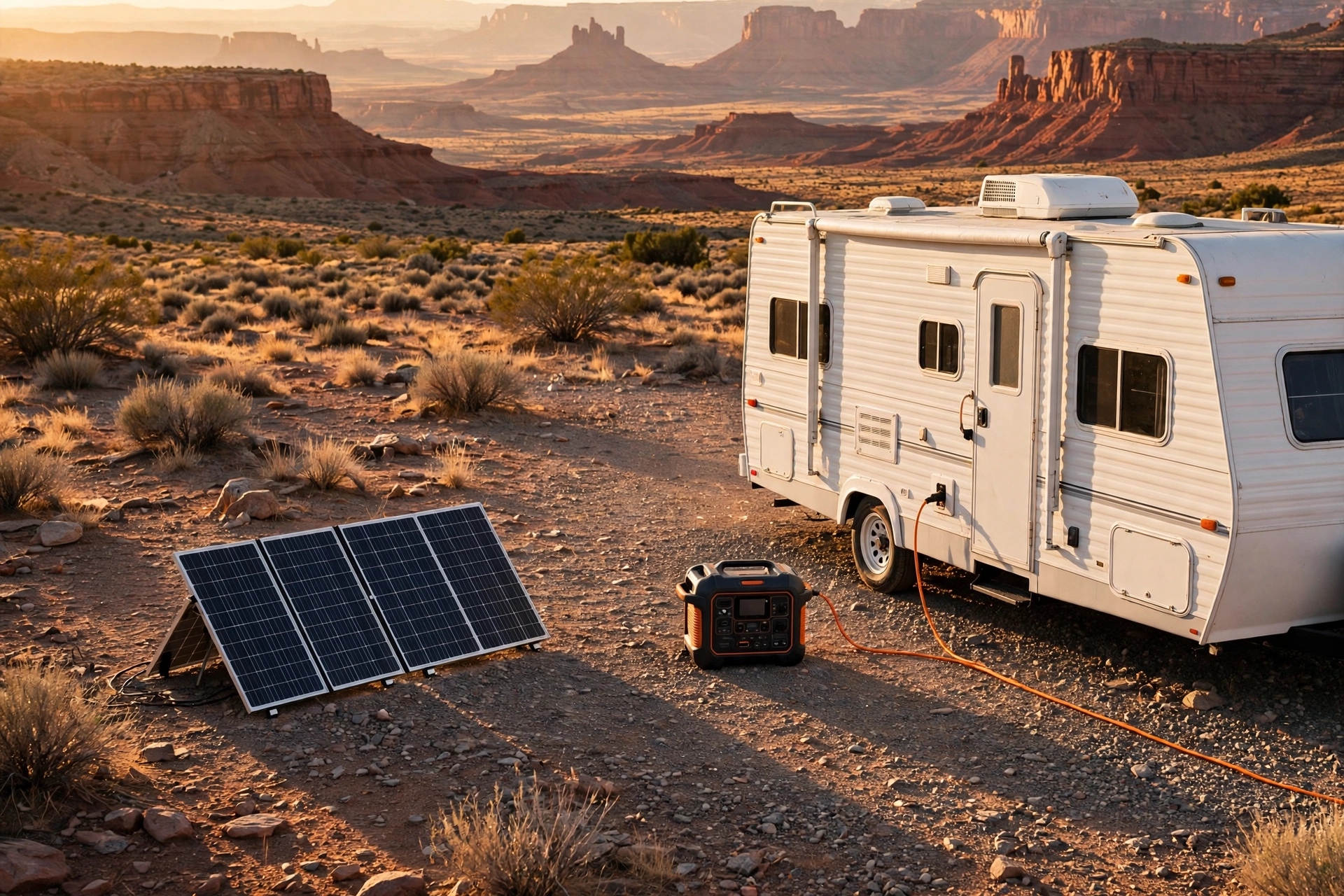
The short answer: the best power station for an RV is the Jackery HomePower 3600 Plus — 3,584Wh, a 3,600W inverter, and a native TT-30 outlet that takes your RV’s shore-power cord directly, for about $1,899. It is the only station here that powers a typical 30-amp RV the way a campground pedestal does, with enough battery to run a fridge, lights, and small appliances through a day and a night. If your budget is smaller, the Jackery Explorer 2000 v2 gives you 2,042Wh and 2,200W for $899 — the cheapest real RV-capable station — but it has no TT-30, so you run appliances off its own outlets instead of the RV’s panel. And for full-time living in a big rig, the EcoFlow DELTA Pro 3 is the heavyweight: 4,096Wh, 4,000W, a TT-30, and 2,600W of solar input for $2,799, at 113.5 lb.
Disclosure: we may earn a commission if you buy through links on this page — see our disclosure. The links here are plain manufacturer links with no affiliate tracking attached. Prices were checked against manufacturer and retailer sites in November 2026 and move often with sales, so treat every price below as a snapshot, not a quote.
This is a research roundup, not a hands-on test: picks rest on published specs, owner reports, and published measurements as of November 2026. It is the RV slice of the wider power-station market — the station-only comparison lives in our best portable power station roundup, the station-plus-panel kits in our best solar generator roundup, and fixed roof-panel systems in our best RV solar kit roundup.
Quick picks
- Best overall for a 30A RV: Jackery HomePower 3600 Plus — 3,584Wh, 3,600W, TT-30, about $1,899
- Best value 2kWh: Jackery Explorer 2000 v2 — 2,042Wh, 2,200W, $899, no TT-30
- Best for full-time living: EcoFlow DELTA Pro 3 — 4,096Wh, 4,000W, TT-30R, $2,799
- Best RV-focused 2kWh: Bluetti AC200L — 2,048Wh, 2,400W, TT-30 plus 48V RV port, discontinued at $899
- Best lightweight 2kWh: DJI Power 2000 — 2,048Wh, 3,000W, 48.5 lb, $1,299
- Best for rolling around camp: Anker SOLIX F2000 — 2,048Wh, 2,400W, wheels and handle, about $1,699
What makes a power station RV-ready
A power station that works in a house does not automatically work in an RV. Four things decide it, and they are the reason this roundup’s picks look different from a general camping list.
The TT-30 outlet is the deciding feature. A TT-30 (NEMA TT-30R) is the 120V/30A receptacle on a campground pedestal — the plug your RV’s shore-power cord ends in. A station with a native TT-30 lets you plug that cord straight in and power the whole RV through its own breaker panel: fridge, lights, outlets, water pump, all at once, up to 3,600W. That 3,600W is a hard ceiling — 120V × 30A — so a 4,000W inverter is capped at 3,600W through the RV plug, and the extra headroom only matters on the station’s regular outlets. Without a TT-30, you run one appliance at a time off the station’s own outlets, or you use a 15A-to-TT-30 adapter that caps the entire RV at 1,800W — enough for lights and a fridge, not for a microwave. Three of the six stations here have a native TT-30; the other three are still good RV stations, but they power appliances, not the RV.
Regulated 12V output matters more than the brochure suggests. An RV’s 12V systems — compressor fridge, lights, fans, water pump — expect a stable 12–13.6V. A station’s 12V car socket is usually regulated, but some sag under load, and a fridge compressor that sees 11V instead of 12.6V runs hotter and shorter. The Bluetti AC200L goes further with a dedicated 48V/8A RV output for its own ecosystem. Check the 12V spec before you buy, not after the fridge complains.
Solar input is the ceiling on boondocking, not a footnote. A station’s maximum solar input decides how fast it refills off-grid. The Jackery Explorer 2000 v2 caps at 400W — a full solar refill takes about a day and a half of good sun, and extra panels add nothing. The EcoFlow DELTA Pro 3 takes 2,600W and the DJI Power 2000 takes 1,800W, so a 1,000W-plus roof or portable array actually pays off. If you plan to live off solar for days, the input number matters more than the battery size.
Weight is a daily tax, not a spec-sheet line. A 2kWh station weighs 40–67 lb; the 3.5–4kWh stations weigh 77–114 lb. The lightest 2kWh station here, the Explorer 2000 v2 at 39.5 lb, is a one-person carry into a truck bed. The DELTA Pro 3 at 113.5 lb is a two-person lift that lives in one place. The Anker F2000 splits the difference with wheels and a telescopic handle — at 67.2 lb it rolls across a campsite instead of being carried. Decide where the station will live before you decide how much it should weigh.
One more boundary worth stating plainly: a 50-amp RV is a different job. A 50A service is 240V split-phase — 12,000W of panel capacity — and no single portable station feeds it. Two EcoFlow DELTA Pro 3 units in parallel give 240V, and that is the only configuration here that comes close. If your rig is 50A, budget for a pair, or for a built-in system.
The comparison
Prices are US dollars from manufacturer sites and major retailers as of November 2026. Every station here lists well above its sale price for part of the year, so the price column shows the sale price you can realistically expect.
| Station | Capacity | Inverter (continuous) | RV outlet | Solar input max | Weight | Price, Nov 2026 |
|---|---|---|---|---|---|---|
| Jackery HomePower 3600 Plus | 3,584Wh | 3,600W | TT-30 | 1,000W | 77 lb | About $1,899 |
| Jackery Explorer 2000 v2 | 2,042Wh | 2,200W | None | 400W | 39.5 lb | $899 |
| EcoFlow DELTA Pro 3 | 4,096Wh | 4,000W | TT-30R | 2,600W | 113.5 lb | $2,799 |
| Bluetti AC200L | 2,048Wh | 2,400W | TT-30 + 48V RV | 1,200W | 62.4 lb | $899 last price, discontinued |
| DJI Power 2000 | 2,048Wh | 3,000W | None | 1,800W | 48.5 lb | $1,299 |
| Anker SOLIX F2000 | 2,048Wh | 2,400W | None | 1,000W | 67.2 lb | About $1,699 |
Every station here uses lithium iron phosphate (LiFePO4) cells. Check for “v2,” “Plus,” or “Gen 2” in the name before buying: the original Jackery Explorer 2000 and the original EcoFlow Delta Pro still appear in listings, with older chemistry and lower output. And check the variant name on the Jackery side carefully — the HomePower 3000 is the non-expandable sibling at $1,499, and the Explorer 2000 v2 is a different, smaller machine from the Explorer 2000 Plus.
Jackery HomePower 3600 Plus — best overall for a 30A RV
The only station here built to be a campground pedestal in a box: 3,584Wh, a 3,600W inverter with 7,200W surge, and a native TT-30 outlet rated for the full 120V/30A — your RV’s shore cord plugs straight in, no adapter, and the whole RV runs through its own breaker panel up to 3,600W. It takes 1,000W of solar, recharges from the wall in about 1.8 hours, and its LiFePO4 cells are rated for 6,000 cycles — the longest rating in this roundup. At 77 lb it has wheels and a retractable handle, and it expands to about 21.5kWh with extra battery packs, so a weekend rig can grow into a full-time system without replacing the station.
The price is the honest number: about $1,899 at Jackery’s store and on Amazon as of late October 2026, with some retailers showing $1,698–$1,709. That is roughly double the 2kWh stations, and the weight is double too — this is not a box you carry to a picnic table. The solar input is also the weak spot for serious boondocking: 1,000W is fine for a 400W portable array, but it cannot take the 1,600W-plus roof array the DELTA Pro 3 swallows. If you want the station to be the RV’s power, though — plug in the shore cord and forget about it — nothing else here does that job as completely. Check the current price on Jackery’s site.
Jackery Explorer 2000 v2 — best value 2kWh
The cheapest real RV-capable station: 2,042Wh, a 2,200W inverter with 4,400W surge, and LiFePO4 cells rated for 4,000 cycles, at 39.5 lb — the lightest 2kWh station in this roundup by a wide margin, and the only one most people will carry one-handed into a truck bed. It recharges from the wall in about 1.7 hours, has a 100W USB-C port for direct laptop charging, and a 20 ms UPS switchover. The price is the story: $899 is the typical price, with $799 sale prices seen in October 2026 — about $0.44 per watt-hour, the best value in the 2kWh class.
The trade is the one this roundup is about: there is no 30-amp RV outlet on this box. You run appliances off its three AC outlets, not the RV’s panel, and a 15A-to-TT-30 adapter caps the whole RV at 1,800W. The solar input is also the lowest here at 400W, so a full solar refill takes about a day and a half of good sun, and it takes no expansion batteries — 2,042Wh is the ceiling. If your RV use is a fridge, lights, and laptops for a weekend, and you carry the station yourself, this is the right call at the right price. If you want shore-power plug-in or multi-day solar living, step up to the HomePower 3600 Plus or the DELTA Pro 3. Check the current price on Jackery’s site.
EcoFlow DELTA Pro 3 — best for full-time living
The heavyweight, in both senses: 4,096Wh, a 4,000W inverter with 8,000W surge and 6,000W X-Boost for resistive loads, a TT-30R outlet, and 2,600W of solar input across two MPPT ports — the highest solar ceiling in this roundup by a wide margin. It expands to 48kWh with extra batteries, runs 120/240V (two units in parallel give a 50A rig its split-phase feed), and takes EcoFlow’s 800W alternator charger, so it refills from the engine while you drive. At $2,799 it is the most expensive station here, and at 113.5 lb it is a two-person lift that lives in one place — installed in the rig, not carried to the picnic table.
The solar input is what justifies the price for full-timers: a 1,600W roof array refills the whole battery in about three hours of good sun, and the alternator charger means driving days are charging days too. The trade, beyond weight and price, is that the TT-30 is the only RV-specific outlet — there is no dedicated 48V RV port like the Bluetti’s — and the 5-year warranty is standard, not exceptional. If you live in the RV and want a station that behaves like a built-in system, this is the one. If you camp weekends, it is far more station than you need. Check the current price on EcoFlow’s site.
Bluetti AC200L — best RV-focused 2kWh
The most RV-specific 2kWh station ever made, and the one you can no longer buy new: 2,048Wh, a 2,400W inverter with 3,600W Power Lifting for resistive loads, a native TT-30 outlet, and a dedicated 48V/8A RV output — the only station here with two RV-facing ports. Its 1,200W solar input across a wide 12–145V window takes a serious roof or portable array, it recharges to 80 percent from the wall in about 45 minutes, and it expands to 8,192Wh with Bluetti’s own batteries — the widest growth path in the 2kWh class. At 62.4 lb it is a two-hand lift, and its 3,000-cycle rating is half the Elite 200 V2’s 6,000-plus at the same price.
The buying advice flipped when Bluetti retired it: the US store now marks the base AC200L discontinued at its $899 last price, so do not pay full price for remaining stock. Buy it only at a real discount, and only if you will actually add batteries later. Everyone else should buy the replacement — the AC200PL, at about $950, with 2,304Wh, the same 2,400W output, 1,200W solar input, and the same TT-30 and 48V RV ports. Our Bluetti AC200L review covers the switch in full. Check the current price on Bluetti’s site.
DJI Power 2000 — best lightweight 2kWh
The outlier on the spec sheet: 2,048Wh with a 3,000W inverter — the highest output of any 2kWh station here — and 1,800W of solar input, second only to the DELTA Pro 3, at 48.5 lb. That combination is the RV sweet spot on paper: enough output to start a rooftop air conditioner or run a microwave, enough solar headroom for a 1,000W-plus array, and light enough for one person to lift into a truck bed without thinking. At $1,299 it costs $400 more than the Explorer 2000 v2 for 800W more output and 4.5 times the solar input.
The catch is the one this roundup is about: there is no native TT-30 outlet. You run appliances off its AC outlets, or through a 15A-to-TT-30 adapter capped at 1,800W for the whole RV. DJI is also the newest brand in this category, with a shorter service history than Jackery, EcoFlow, Bluetti, or Anker — worth weighing when the station is your RV’s power. If you boondock with a big portable array and carry the station yourself, the output-per-pound is unmatched. If the TT-30 matters to you, the Jackery HomePower 3600 Plus is the answer instead. Check the current price on DJI’s site.
Anker SOLIX F2000 — best for rolling around camp
The mobility pick: 2,048Wh, a 2,400W inverter, and 1,000W of solar input, at 67.2 lb — heavy, but it rolls on built-in wheels with a telescopic handle instead of being carried, which is the difference that matters on gravel and grass. It expands to 4,096Wh with an extra battery, recharges to 80 percent in about 1.4 hours from the wall, and carries a 5-year warranty. At about $1,699 it is the most expensive 2kWh station here, and that price is the question: the DJI Power 2000 gives you more output and more solar input for $400 less, and the Jackery Explorer 2000 v2 gives you the same capacity for $800 less.
What the F2000 still wins is the campsite experience — a 67 lb box that rolls is easier to live with than a 48 lb box you carry, and Anker’s service network is the deepest of the brands here. The honest caveat is availability: the F2000 is a 2022 design, and Anker’s own store now pushes the newer F2600 bundles alongside it, so check stock before you commit — if the F2000 is gone, the F2600 is the current-generation equivalent to compare. And like the DJI and the Explorer 2000 v2, it has no TT-30: it powers appliances, not the RV’s panel. Check the current price on Anker’s site.
Sizing it to RV loads
Start with a list, not a product page. For each item, multiply its watts by the hours a day it runs to get watt-hours per day, add the items up, then divide by 0.85 for inverter losses. That is your daily need; a station covers as many days as its usable capacity divided by that need.
A realistic boondocking day looks like this: a 12V compressor fridge averaging 50W (1,200Wh), lights and phones (150Wh), a laptop at 70W for 3 hours (210Wh), a CPAP at 30W for 8 hours (240Wh) — about 1,800Wh per day, about 2,120Wh after losses. A 2,048Wh station covers roughly one day of that; a 3,584Wh station covers about a day and a half; a 4,096Wh station covers about two days. Without solar, size for the whole trip; with solar, size for a day and let the panels refill you.
The air conditioner changes the math completely. A 13,500 BTU rooftop unit draws about 1,200–1,500W running and needs roughly 2,800W to start — so it needs a station with at least a 2,400W inverter, and even then a 2,048Wh station holds about an hour of runtime after losses. A 3,584Wh station gives about two hours; a 4,096Wh station about two and a half. No portable station runs an RV air conditioner all night, and none here should be bought for that job — that is generator or shore-power territory, and any roundup that implies otherwise is selling you a battery you will resent.
The microwave and coffee maker are the same story in miniature: a 1,000W microwave draws about 1,500W from the wall, so it needs a 2,000W-plus inverter and eats about 125Wh per five minutes of use — affordable as an occasional load, ruinous as a routine one. Count your outlets and your watts before you buy: add up everything you want to run at once, and if the total passes the inverter’s continuous rating, the station shuts down.
Solar refill on the road
On a day with 4.5 peak sun hours, a panel delivers roughly its wattage × 4.5 × 0.85 in watt-hours. A 200W portable panel adds about 765Wh; a 400W array about 1,530Wh; a 1,000W roof array about 3,825Wh. Compare that against the battery, and the station’s character shows up:
| Station | Solar input max | Refill from a 400W array (good day) | Days to refill from empty |
|---|---|---|---|
| Jackery Explorer 2000 v2 | 400W | About 1,530Wh | About 1.5 days |
| Anker SOLIX F2000 | 1,000W | About 1,530Wh | About 1.5 days |
| Bluetti AC200L | 1,200W | About 1,530Wh | About 1.5 days |
| Jackery HomePower 3600 Plus | 1,000W | About 1,530Wh | About 2.5 days |
| DJI Power 2000 | 1,800W | About 1,530Wh | About 1.5 days |
| EcoFlow DELTA Pro 3 | 2,600W | About 1,530Wh | About 3 days |
Two lessons fall out of that table. First, a 400W portable array is the same refill for every station here — the input ceiling only matters when the array is bigger than 400W. Second, the bigger batteries take longer to refill, not shorter: the DELTA Pro 3’s 2,600W input is only an advantage with a 1,000W-plus array, and with a 400W portable panel it refills no faster than the Explorer 2000 v2. If you boondock for days, the panel matters more than the station — buy the station, then size the array to the battery. Our how to charge a power station with solar panels guide covers panel sizing in full, and our best RV solar kit roundup covers fixed roof-panel systems for the rig itself.
What a power station cannot do in an RV
No portable station runs a 50-amp RV’s full panel — a 50A service is 240V split-phase, 12,000W, and only two DELTA Pro 3 units in parallel come close. None here runs a rooftop air conditioner all night, a space heater, an electric water heater, or a well pump for long: a 1,500W heater empties a 2,048Wh station in about an hour. None replaces a built-in RV system for full-time living — a built-in bank charges from the alternator while you drive and never needs carrying — and none powers the RV’s 12V systems directly except through its own 12V ports, which are no substitute for the house battery bank on a multi-day stay. And no portable panel refills a big station in one day on its own — the 3.5–4kWh stations need a 1,000W-plus array, or two days of sun, to refill fully.
What the category does well is the portable job it was built for: a weekend of boondocking power for a fridge, lights, laptops, and a CPAP, a night or two of fridge and communications through an outage at a hookup site, and a solar-fed base camp that refills itself each day. Buy inside that envelope and a $899 to $1,899 station is a genuinely capable tool; outside it, no amount of brand loyalty fixes the physics.
Find your size: the detailed roundups
This hub picks across the whole market for one use. If you already know your budget or your use, the detailed roundups go deeper on one slice each:
- Station only: our best portable power station roundup compares the same stations without panels, if you already own panels or charge mostly from the wall.
- Station plus panels: our best solar generator roundup compares six station-and-panel kits, including the Anker C1000 Gen 2 and the Bluetti Elite 200 V2.
- Under $500: our best portable power station under $500 roundup covers the 1kWh class at its cheapest — the Anker C1000 Gen 2, Jackery 1000 v2, and Bluetti AC70.
- Camping: our best portable power station for camping roundup weighs capacity against carry weight for weekends off-grid.
- Home backup: our best solar generator for home backup guide sizes a station plus panels for keeping a fridge, lights, and communications running through an outage.
- Roof panels: our best RV solar kit roundup covers fixed roof-panel systems for RVs, a different job from a portable station.
And if you are choosing between brands rather than models, our head-to-head guides compare EcoFlow vs Jackery and EcoFlow vs Bluetti. Our Jackery Explorer 1000 review covers the smaller Jackery in full.
How to buy
- Decide on the TT-30 first. If you want the station to act as shore power — plug in the RV’s cord and run the whole rig — only the HomePower 3600 Plus, the DELTA Pro 3, and the AC200L (or its AC200PL replacement) do it. Everything else powers appliances one at a time, and a 15A-to-TT-30 adapter caps the whole RV at 1,800W.
- Check the price on the day. Every station here lists well above its sale price and spends part of the year on sale, and the sale price is the real price — a “$1,899” Jackery at $1,698 is a $1,698 station; at $1,899 it is a different purchase.
- Match the solar input to your array. A 400W-capped station wastes a 1,000W array, and a 2,600W-capable station wastes a 200W panel. If solar refill is your plan, the panel array is half the system — budget about $200 to $400 per 200W of portable panel.
- Check the variant name. HomePower 3600 Plus, not the non-expandable HomePower 3000. Explorer 2000 v2, not the original Explorer 2000. DELTA Pro 3, not the original Delta Pro. AC200PL, not the discontinued AC200L at full price. The older variants are still listed, sometimes at similar prices, with older chemistry or lower output.
- Weigh the box before you buy it. A 39.5 lb station is a one-person carry; a 77 lb station needs wheels; a 113.5 lb station needs two people and a permanent spot in the rig. If the station lives in a basement compartment you reach twice a year, weight does not matter; if it moves every day, it is the spec that decides whether you use it.
- Count your outlets and your watts. Two AC outlets covers a fridge and a laptop; the USB-C wattage matters too — a 100W port charges a laptop directly, a 15W port does not. And add up the watts of everything you want to run at once before you buy: pass the inverter’s continuous rating and the station shuts down.
- Read the warranty terms, not just the years: the Jackery, EcoFlow, Bluetti, Anker, and DJI stations here all carry multi-year station warranties — but registration windows, battery coverage, and service location differ by brand, and the Explorer 2000 v2’s 5-year warranty applies only when bought direct from Jackery.
Methodology
Compiled in November 2026 from manufacturer spec sheets and store pages (Jackery, EcoFlow, Bluetti, DJI, Anker), retailer listings, published runtimes, and owner reports. Capacities, inverter ratings, RV outlets, solar input maxima, weights, and cycle-life figures were checked against at least two sources each. Prices are US list and sale prices observed on manufacturer and retailer sites in October–November 2026; they change frequently, so list and sale prices are stated separately where they differ. A November 2026 SERP check confirmed the market shape: the same six stations lead current RV roundups, with small specialist sites (PowerStationScout, GridSpecLab, OutagePowerGuide, SmartHomeExplorer, PortablePowerNerd) on page one and no dominant authority owning the head term — a MIXED SERP, not a weak one. No unit was hands-on tested, and no runtime here comes from our own measurement — runtimes are manufacturer-published or calculated from the 85 percent rule and the 4.5 peak-sun-hour refill formula above. If a figure here disagrees with a manufacturer’s current page, that page wins; check it before buying.